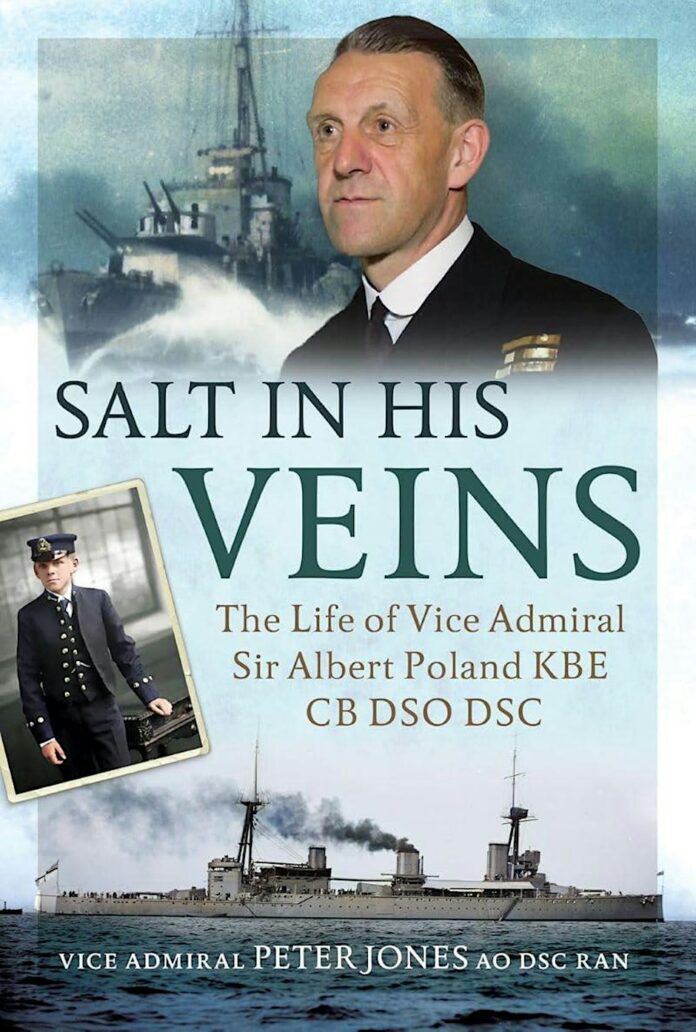
Salt in His Veins: The Life of Vice Admiral Sir Albert Poland KBE CB DSO DSC RN. By Vice Admiral Peter Jones AO DSC RAN. Pen and Sword Books Limited 2026. 248 Pages.
Reviewer: Desmond Woods
https://www.amazon.com.au/Salt-his-Veins-Admiral-Albert/dp/1036156311
Before reading this new biography by Admiral Peter Jones I knew Sir Albert Poland’s name – but that is all I knew about him. I am therefore most grateful for having had the opportunity to correct this gap in my knowledge by reading this carefully researched and enlightening account of this long- serving naval officer’s career in peace and war in the Royal Navy.
This was an exceptional career that deserves to be remembered and is done justice to in this thoroughly readable biography written by a retired senior officer who, like his subject, has commanded a task group of warships at sea during conflict. Peter Jones not only describes Poland’s life but also the numerous campaigns, operations and battles in which he took part from 1914 to 1945. This is a valuable element of the book and very necessary if the reader is to fully comprehend the breadth and depth of the operational experience Poland gained early and used when he commanded at sea as a senior officer.
Albert Poland, known to his family as Bertie, and in the navy as ‘Patsy’, was born in 1895 and his training was a product of the rationalization of the RN’s officers recruitment and education. These sensible reforms to what had been a less than optimal system, left over from the age of sail, were undertaken by the dynamic Admiral Sir John Fisher. He wanted to prepare the navy’s future officer corps intellectually as well as physically for the twentieth century.
Bertie was one of that generation, aged correctly for action in both world wars, first as junior and then as senior officers. For his generation of keen young officer cadets in 1908 avoiding being killed in action at sea in the coming decades was a combination of skill and luck. Bertie Poland had both in abundance.
In 1913 in Auckland, while coaling HMS New Zealand as a midshipman, a bag of coal badly fractured both his tibia and fibula. His captain wrote that the accident occurred because his zeal had exceeded his prudence. Fortunately, over two months both bones slowly healed leaving no limp and therefore his RN career continued.
Bertie served from 1913 to1917 in the battle cruiser New Zealand. He was in action at Heligoland Bight, Dogger Bank and at Jutland. The accurate descriptions of all three battles, and particularly of Jutland, are a masterpiece of concise writing. The clear chronology of Jutland provides readers with the information needed to understand the multiple phases of that never to be repeated epic clash of the world’s greatest two battlefleets, the Grand Fleet and the High Seas Fleet.
Bertie Poland and his shipmates were lucky to serve in New Zealand which came through three battles in the North Sea unscathed when so many of his term mates from Osborne and Dartmouth lost their lives in the disasters which destroyed three battlecruisers Indefatigable,Invincible and Queen Mary at Jutland. One can only speculate on what the future might have held for the 6094 young RN officers and sailors of Bertie’s generation whose careers were cut short when their ships erupted under them on 31st May 1916.
After serving briefly in Furious Bertie was given command of a torpedo boat for the raid on Ostend which aimed to try to finally seal this U Boat haven. The operation was extremely hazardous. He displayed courage and a cool head while under fire and won a well-deserved DSC.
His post 1918 postings saw him in action in the Black Sea and the Sea of Azov where his light cruiser Caradoc assisted White Russian forces with naval gunfire in their failed attempt to keep the Red Army from taking Yalta and the Crimea. This active service was followed by quieter years in command of a gunboat on the Yangtze River, which he thoroughly enjoyed.
Bertie was a ‘sailors’ officer’ and cared about his men’s welfare and consequently was respected and liked. He did not have a private income and he and his young wife Leila were living off a junior officer’s pay, which was far from munificent. He was therefore very well attuned to the indignation his sailors, and their wives, felt when lower deck pay was cut by the Ramsay MacDonald government by twenty five percent. This unnecessary and greatly resented act of stupidity and meanness provoked the Invergordon Mutiny of 1931 when 1000 men of the Atlantic fleet refused duty.
Bertie was posted to the Mediterranean as a Commander in 1932 to take command of the destroyer Vivacious in Malta. This was at a time when Mussolini’s naval building program and ambitions to make the Mediterranean ‘Mare Nostrum’ were obvious and challenging. Consequently, the relaxed peacetime pace of Mediterranean fleet exercises were stepped up in preparation for war with not only the Italian fleet but their powerful land-based air force. Nothing like enough attention was given to equipping ships with high angle anti-aircraft guns, despite the entreaties of the Commander in Chief of the Mediterranean fleet, Sir William Fisher.
Bertie and Leila were well known to the Fleet Communications Officer Lord Louis (Dickie) Mountbatten whose generous hospitality, backed by a private income, was widely enjoyed.
When war came Bertie was engaged in the ill-fated campaign in Norway where his sloop Black Swan was bombed relentlessly but, due to Bertie’s seamanship and skill and a fair measure of luck, survived to fight another day.
Back in the Mediterranean, Bertie was promoted and appointed by the Commander in Chief, Admiral Sir Andrew Cunningham, to be in overall command of the inshore squadron making the hazardous nightly ‘spud run’ from Alexandria into Tobruk and back again during 1941-42. This was a highly demanding posting both operationally and diplomatically and clearly it was given to Bertie by Cunningham because he knew his capability.
To achieve this daily reinforcement and resupply he developed a warm working relationship with the Australian Major General ‘Ming the Merciless’ Morshead and his staff who were defending besieged Tobruk. Bertie did all that was possible to equip the of RAN and RN destroyers and sloops, and the South African Navy’s whalers, passing through ‘bomb alley’ with protection and air cover, but inevitably there were many ships and crews lost to both air and submarine attack.
The last fresh troops that went into Tobruk were Poles. They were released by Stalin when Hitler attacked the Soviet Union and travelled to Egypt via the Caucasus to be equipped by the British Army. Bertie noted that once in the Tobruk perimeter they did not economize on the use of ammunition and that “they were not particularly interested in fighting Italians but, the sight of any German troops would rouse them to a fury.”
Back at sea, as Captain (D) of the 14th Destroyer Flotilla, Bertie was in the thick of the Second Battle of Sirte commanding his captains from Jervis. He handled his flotilla with great skill giving his destroyer captains the opportunity to charge through a well laid smoke screen, get within range of the Italian battlefleet and fire a spread of torpedoes. It was the classic action for which destroyer captains trained, hoped and waited for and it kept the Italians from closing on the vulnerable convoy that that was lumbering forward at slow speed with vital cargo and fuel for Malta.
But these attempts to relieve Malta by convoys from Alexandria were costly operations as Bertie recounted when one of his destroyers, Lively, was hit by five bombs. He later wrote about this day:
“Lively was hidden for a moment or two from the splashes and when she emerged she was low in the water forward but was still being forced ahead by her engines. She quickly went down by the bows and sank. While embarking about 30 men from one of Lively’s carley floats I sighted her injured captain, Lieutenant Commander Bill Hussey in the water ahead, but did not dare move the ship to get near to him for fear of capsizing the float. If that happened a number of men would probably have lost their lives as some were exhausted and others wounded. I could see Hussey was alive but in a bad way and it was difficult to resist the temptation to try to save this very fine officer.”
Hussey was brought on board Jervis but died of his internal injuries. Some of Lively’s men would lose their lives when the destroyer which rescued them, Kipling, was sunk in the next wave of bomb attacks. When it was safe to do so Bertie took Jervis back to where men from both destroyers were struggling to survive and rescued all those still alive.
The scale of the losses to the navy, and to the merchant ships of the convoys in the Mediterranean campaign is borne in on the reader by the vivid writing, both by the author and Bertie’s notes and reports which are quoted from verbatim. It was a horrific toll of RN and merchant navy sailors killed and ships sunk and it went on relentlessly for two years. Finally, with Italy’s surrender in September 1943, Cunningham was able to radio to London: “Be pleased to inform their Lordships that the Italian battlefleet now lies at anchor under the guns of the fortress of Malta.”
Bertie’s next theatre of war in 1944 was on promotion as Commodore (Destroyers) for the Royal Navy’s East Indies fleet operating from Ceylon. The joint operations task was to support General Bill Slim’s 14th Army as it advanced south from the Arakan campaign and on to Rangoon. This required the tightest coordination between the blue water and littoral operations and the Army commanders ashore. Bertie once again worked efficiently and harmoniously with his military colleagues.
On 15 May 1945, in the Royal Navy’s last destroyer action of the war, the 26th Destroyer flotilla, guided by ultra decryption of Japanese signals, found the Haguro and sank this heavy cruiser in the Malacca Strait. This was some payback for all the RN and RAN ships and merchant vessels that Japanese cruisers had sunk in S E Asian waters earlier in the war.
At war’s end Bertie’s skills as a diplomat were evident when he hoisted his broad pennant in the cruiser London and negotiated the surrender of the Japanese garrisoned port of Sabang. This was far from easy or safe operation to arrange and required just those qualities that Bertie possessed, keen intelligence and determination to exercise due caution and patience.
Had the war continued Bertie might have been employed in the planned capture of Singapore or as flag officer in the British Pacific Fleet. Instead he returned home to his wife and young sons to duty at the Nore.
He was promoted to Rear Admiral in 1948 and returned to the Middle East as Senior British Officer Middle East. Not an easy posting as the British position in Egypt had changed irrevocably. Bertie’s final appointment was as Superintendent of the Chatham Dockyard in 1950 where he had authority over both a naval and civilian workforce and succeeded in increasing productivity.
He was knighted in the Coronation Honours list in June 1953. He retired as a Vice Admiral from the Navy in 1954.
By then his eldest son Peter was on exchange with the RAN and was in command of the corvette HMAS Gladstone. Having got tired of trying to be a chicken farmer in Kent, Bertie and Leila lived in Cornwall until his death from inoperable stomach cancer in 1967.
His ashes were taken to sea by the Padstow Lifeboat and his two naval officer sons Peter and Patrick scattered them.
This book is very well illustrated with a range of original photographs and an extensive set of endnotes, and an impressive bibliography demonstrating the scholarship that has been done by Peter Jones to ensure the book’s completeness and accuracy.
Like Peter Jones’ two previous books, published since his retirement, Salt in His Veins is a delight to read and is thoroughly recommended. It provides much more than a very good naval biography – it is a contribution to understanding of half a century of Royal Navy history through the life of a remarkable and admirable officer caught up in war at sea across the world. He was described by the naval historian Duncan Macintyre as being the most bombed officer in the Royal Navy.
The author’s concluding words to his book, do his subject justice. He describes him as: conservative in outlook , sensible in judgement, Bertie loved being at sea. He was to become a fine seaman and a highly respected leader of men. Importantly Bertie could and would make difficult decisions at sea in action. This garnered him the great respect, trust and loyalty of his ships’ companies and he was at his finest when he was one of Admiral Sir Andrew Cunningham’s trusted captains.”
Bertie loved being in the Royal Navy from the day he entered Osborne in 1908 as a cadet midshipman until his retirement 46 years later. He must have also been one of the luckiest of his generation of Midshipmen, so many of whom paid with their lives for their choice of profession and their devotion to duty in two world wars.
His generation’s experience of two world wars was unique and Peter Jones leaves the reader with much to consider and reflect on. The combination of excellent judgement, seamanship, humanity and fine leadership of sailors and officers, which Bertie Poland displayed, is timeless and can never be irrelevant to any navy no matter how advanced its technology and sensors have become. Courage under fire and wise command decision making has always mattered at sea and always will when ships are sent in harm’s way.