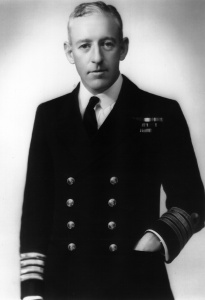
In Headmark 138, published in December 2010, Dr Tom Lewis provides an illuminating profile of one the RAN’s most colourful and capable cruiser captains – Captain Harry Howden CBE RAN (1896-1969).
One of the RAN’s ‘fighting captains’, Harry Howden almost belongs in another world compared to his Navy brothers. Originally an RN officer, in manner Howden was fierce, single-minded, but very much a man of genuine kindness, firmness and enormous ability as a ship-handler and as a leader. In a peacetime world naval officers such as Howden are a rarity with limited survival prospects. In war, Howden compares well to the famous General Patton.
Being shipwrecked at an early age might deter any would-be naval officer, but not Harry Howden. As a boy in the years before World War I, he had spent much time in boats belonging to a friend whose family owned a fleet of large sailing-ships. Both boys went to Wellington College, and Howden’s last holiday from school was spent in one of the ships. Its voyage was adventurous: the ship met heavy weather, was dismasted, and finally wrecked. Howden thought that ‘useful’: presumably he learnt a lot from it.
Born in 1896 in New Zealand, to a family long given to seafaring – an uncle at one time was the youngest captain in the Royal Navy – Harry Howden was determined to join the RN. When war came in 1914, he prevailed on his father to let him go to England by sailing ship about Cape Horn. He had not the normal RN qualifications as to age and sea-time but once before an interview board impressed his interviewers with his determination and was accepted as a midshipman in the RN Reserve.
Howden’s first sea appointment was to a minesweeper, then to the 10th Cruiser Squadron, patrolling the North Sea between Iceland and the Norwegian coast. In 1916 he transferred to the RAN. Attached to HMS Benbow, with the First Battle Squadron of the Grand Fleet, he saw action at the Battle of Jutland. Benbow engaged several enemy ships and sank three destroyers. In 1918 he was appointed to HMAS Sydney, and travelled to Australia in 1919; on 5 May promoted lieutenant. The day following his 23rd birthday he was given command of the old South Australian gunboat Protector. Howden conned her into Flinders Naval Depot, south-east of Melbourne, the first ship of war to be brought into the berth.
Howden remained at Flinders, standing by while the Depot was being built. For a time the Commander was ill; and as the only officer he ate in solitary state in an otherwise empty Mess, attended by two cooks and four stewards. He was the Executive Officer when Flinders commissioned and the first President of the Wardroom Mess.
He was given command of the destroyer HMAS Huon, and in 1924, after a course in England, HMAS Tasmania, an S-Class destroyer. His first reports in his new ship showed nervousness. The Captain of the 9th Flotilla noted:
His leadership is inclined to suffer from a lack of confidence in himself when in the presence of other officers but this will improve as he gains experience.
Any lack of confidence near senior members was not exhibited to those of his ship’s company. Henry Burrell (later Vice Admiral Sir Henry), serving with him as a lieutenant, recalled that Howden:
Kept on his desk a wooden plaque with an inscription from Nelson’s standing instructions: ‘The order of cruising will be the order of battle’.
Burrell recalled Howden’s boldness, with a particularly hair-raising incident where Tasmania was brought extremely close to the cliffs of Jervis Bay heads, at night. Burrell observed:
…I was not amused. The sailors knew that Harry was slightly eccentric, although he was sound in dealing with matters of importance. There was just room for Harry in a small navy.
Around this time, thousands of miles away, George S. Patton’s divisional commander was writing: ‘This officer would be invaluable in time of war but is a disturbing element in time of peace’. Howden shared that same mercurial temperament that, like the great American General, would make him invaluable in combat.
Howden commanded Tasmania for two and a half years and in 1927 went to Japan for language studies. He had passed his preliminary exam in the language, but now lived among the country’s people for speech practice and to study the customs. Although lodging officially at the British Embassy in Tokyo, he took Japanese clothes and a Japanese name. (The 1970s Vice Admiral Sir Richard Peek, who served under Howden as a young officer, is of the opinion that this year was taken without pay.) He spent time in China and saw something of the civil wars in 1927.
This interlude is unusual for a serving naval officer proceeding up the ladder of experience. Japan had been an ally of the British Empire in the Great War, and its naval training and practices were so-derived. But militarism following the disastrous international politics of the 1920s was slowly emerging, and so perhaps Howden exhibited a far-sighted attitude. Promoted Lieutenant Commander, he joined the newly-built cruiser Australia. Gunnery Officer Lieutenant John Collins (later Vice Admiral Sir John) remembers an incident which gave some insight into the fiercely capable nature of the man’s character:
The inevitable storm in the Atlantic was encountered, and a party went to the forecastle to secure some gear that had come adrift. A heavy sea was shipped which swept a Petty Officer, the Captain of the Forecastle, overboard. Fortunately, we had been by then some months in commission and the lifebuoy drill worked well. It was too rough to lower a boat, but the Captain, by very good seamanship brought the ship alongside the man. We were rolling heavily and he was obviously having difficulty in catching the rope jumping ladder, which was living up to its name. The forecastle officer, Lieutenant Commander Howden, went down the ladder and was completely submerged on each roll. At last he contrived to come up right under the exhausted man and thus cradled him in his arms till the ladder was hauled the thirty feet to the upper deck.
Eighteen months later Howden went again to China, on RN exchange, to command HMS Mantis, a gunboat on the Yangtse Kiang. He was also actively pursuing, via letter, a love interest with one Vanda Fiske, who he first met in Switzerland. She made a brave decision to join him in China where they were married in Hankow at the British Consulate, attended by with the Mantis officers and others from the flagship HMS Bee. Howden was soon involved in the rescue of some Irish missionaries,16 captured by bandits who were demanding a ransom, which Howden duly transported up river, without a pilot, at night. A similar incident took place the next year, with a Chinese fort attacked at night by personnel from Mantis. The bandits’ flag was recovered, and later became the property of the HMAS Hobart Association.
Promoted to Commander, Howden voyaged with his wife to Australia in 1932, and after a spell as Commander of the seaplane tender Albatross, he went to England and brought back the destroyer Vampire, already a veteran though still far from her later fame as a member of the so-called ‘scrap-iron flotilla’. The day after his arrival back in Sydney, Howden was appointed to the flagship, Canberra. Later-Rear Admiral Mesley noted that Howden introduced electro-plating to the ship to ‘tiddly up the quarterdeck and gangway fixtures and fittings’. Bill Cook, then a midshipman, remembers this caused great comment in Australia:
…we thought it wasn’t quite within the spirit of the Service! Hal Farncomb, our Commander insisted on our davit being shone by hand with a pussers’ steel wire burnishing pad.
It was probably the case that Howden paid for such decoration out of his own pocket. His generosity may have been helped by his finances being better than other naval officers. His father had left some bequests to him as the eldest son of the family. These included properties, amongst which was a commercial venture. Such acquisitions may well have given him complacency in his career which allowed him to indulge in risky behaviour.
The next appointment was as Executive Officer to HMAS Cerberus – the former Flinders Naval Depot – now commissioned and considerably changed since Howden had dined there in splendid solitude. Where he had once dined alone he now oversaw, in his many duties, the Wardroom, and from April 1935 until December 1936 he was Mess President. In his Confidential Report of 23 November 1935, Howden received some criticism over his personality:
Complex, and in some ways a difficult character…impulsive, and being egotistical his actions are inclined to lose value in a desire for personal satisfaction.
Furthermore, his RN Captain noted:
I have welcomed an improvement in his dress in which respect he is inclined to be careless.
An unusual comment for one who was in later life noted for his sartorial elegance. Despite these remarks, Howden’s numerical ratings contained two ‘eights’, for Zeal and Energy, and Initiative. The other scores were sixes and sevens with a sole five for Judgement.
By then a family had started to arrive. His son Patrick, born in 1934, recalls:
Naval lifestyle bred in young Harry an uncompromising discipline, unnerving curiosity and enthusiasm, inventiveness, a precision for detail, encyclopedic knowledge, unorthodoxy, legendary skills, a loyal duty to King and country, plus total intolerance for incompetence. This latter often scared me as a kid…One valet – Edwards at Flinders Depot where Pa was in charge – was matted 12 times until a perfect 4.5 minute boiled egg arrived!
Howden’s eccentricity went beyond that. A report of 1936 noted that he ‘kept two horses and regardless of late evening engagements always rides early in the morning and hunts when opportunity offers’. This was a little ostentatious by the standards of the age, but the report went on to add: ‘An expert on paint, it’s (sic) mixing, application and properties but not in my opinion on colour schemes’. Whether this was in reference to some decorative scheme for the Establishment in not known.
In January 1937 Howden was made an Officer of the Order of the British Empire. This is noted on his Service Record, but the reason for the award is not given. Several historical notes on Harry Howden suggest he received the honour for services on the China Station.
His Cerberus report of February 1937 was a mixed message. Here another Captain described him as possessing ‘boundless self-confidence but perhaps a fair amount of vanity, selfishness and stubbornness’. The reporting officer made the interesting remark that in war Howden would be the sort of person not to hesitate in taking responsibility and showing initiative, but in other circumstances would show too much authority and have a highhanded manner. There also seems to have been something in a background incident around this time which irritated Howden’s superior:
I think he is also possibly inclined to use unorthodox even ‘piratical’ methods to get what he wants for the service but the particular instance I have in mind came to light after his departure and I have been unable to hear his side of the matter.
There seems to be in Howden’s character an impatience with authority, if formed of petty or incompetent bureaucracy.
Howden was chosen to be the Australian naval representative in Westminster Abbey for the coronation of King George VI in 1937, and then to Admiralty Intelligence in London. Promoted captain and back in Australia he commanded the sloop Yarra. On 28 August 1939 he moved to the cruiser Hobart and the ship sailed from Sydney for the developing war in the Mediterranean. She was soon engaged on patrol and escort duties, mainly in the Bombay-Gulf of Aden area. Howden quickly stamped his own personality on the warship. On Christmas Day he provided 100 gallons of beer to provide ‘Christmas cheer’ for the ship’s sailors. He had previously arranged in Singapore a shore party for the ship’s company complete with liquid refreshments. As one of the ship histories notes: ‘…this was typical of him’.
Months of duty followed, with convoy escort a main feature as the war enveloped more countries. Italy joined the German forces as a main partner. The patrols were monotonous, tiring and hot. Hobart dragged her anchor in Berbera Harbour and went aground on a mudflat. Irritation was not only the captain’s: Syd Clark noted:
Fri 7: Heat rash becoming steadily worse and nothing being done about it so this morning something like 250 men muster(ed) for treatment. Some of the stokers are having a really cruel time and a few have just toppled over with the heat. One chap took a fit and had to be straightjacketted.
But eventually action was joined. Early in the morning of the 8th August 1940, three enemy fighter aircraft raided the Berbera airfield, and, thinking they might be from the nearby Zeila airfield and could be caught on the ground refuelling, Howden had Hobart’s amphibian catapulted. At 0530 the aircraft approached Zeila from the sea in a steady dive from eight thousand feet and dropped its two bombs from 800 feet, aiming at the Residency – believed to be the Italian headquarters – for lack of other targets. The bombs fell close enough to blow in all the windows, after which the amphibian overflew the town at 250 feet and machine-gunned the Residency, motor-lorries, and enemy post and troops. It landed on the harbour at Berbera with two bullet holes in the port main lower plane, but no other damage. The Italians hit back three hours later, when two aircraft dropped eight bombs which fell in the harbour between Hobart, Auckland, and the armed trawler HMS Amber. They came nearer in an attack at 1050, when they straddled Hobart and armed merchant cruiser HMS Chakdina. Neither attack caused any official harm, although Syd Clark noted: ‘One did slight damage to the Captain’s cabin.’
In the evening of the following day, in response to a request for support from military headquarters, Howden landed a three-pounder Hotchkiss saluting gun on an improvised mounting with a crew of three and sixty-four rounds of ammunition. By four o’clock in the morning the gun was in position and supporting the garrison.
From the 14th Hobart was involved with the evacuation of Berbera, then the capital of British Somaliland. After some discussion with the Base Commandant and an army representative it was decided that embarkation should begin at 1100 on the 16th.
Hobart’s shipwrights made from an old lighter an additional pontoon pier. Beach masters were appointed, and ship to shore communications established with Hobart’s signalmen. Throughout the operation, ships’ armament was constantly manned in anticipation of a possible surface attack by enemy destroyers or torpedo boats, and in readiness for air attacks, which materialised on a number of occasions, in bomber and fighter raids. Seaward defence was afforded by the radar and anti-aircraft guns of Carlisle, and by an anti-submarine patrol of destroyers and sloops.
Embarkation into Chakdina began shortly after noon on the 16th, and by 1845 she had embarked 1,100 of the civilian population and sailed for Aden. On the 17th Ceres, patrolling the coast, engaged with gunfire an enemy column moving along the Zeila-Berbera road forty miles west of Berbera, and held up its advance. At 2030 intensive embarkation of troops at Berbera into Chantala, Laomedon, and Akbar began and continued through strong winds. Hobart herself evacuated 1,300 members of the Black Watch.
Post this operation the cruiser continued on her normal duties for the next four months. She was bombed numerous times by the Italian air force; escorted convoys, patrolled unceasingly, and interrogated numerous civilian ships. On 3 December 1940 Howden was awarded the CBE for distinguished services with the Somaliland Force’. A copy of the Recommendation noted his,
Untiring energy and exceptional ability in preliminary organisation were beyond all praise….To all these emergencies Captain Howden rose supreme and his cheery confidence inspired all.
By 28 December the ship had left “the Med” and was alongside in Fremantle. No time ashore except for ‘wharf leave’ was given. The ship proceeded to Sydney arriving on 3 January 1941. Shore leave was given and the ship was deployed on convoy escort to and from New Zealand. Meanwhile, apart from the withdrawal of the old destroyers, there were other changes in Australian naval representation in the Mediterranean. On 4 June the Australian War Cabinet considered a proposal that if permanent repairs needed to Perth could be made in Australia, she should return from the Mediterranean but be replaced by Hobart. This was agreed. The ship left Sydney on 20 June and reached Aden on 9 July. Howden found that conditions in the Red Sea presented a contrast to those of 1940. Intelligence was that ‘all surface vessels could be considered friendly; no submarines would be encountered; and attack by aircraft could be considered most remote’. He was quickly to find this last an over optimistic appreciation. During July the Germans made heavy air attacks on Port Said, Ismailia, Port Tewfik, and Suez, and mined the Canal on several occasions.
Hobart left the Mediterranean on 9 December, after orders were received for her to return to the Pacific, where the Japanese had struck so successfully.
According to the history of the ship Howden ‘blatantly disobeyed’ an order to return a four barrelled ‘Pom Pom’ gun which had been on loan to her. His ‘piratical methods’ of obtaining what was necessary for the ship were sometimes imitated by his ship’s company. He told one of his stewards that a new engine was needed for his jolly boat. The steward arranged, for a bottle of scotch, for a suitable engine to be sourced from an American ship. A US Rear Admiral’s barge soon arrived alongside, and the query was made as to where the engine might be. The Americans removed the barge’s engine, had it hoisted aboard, and scuttled the boat on the spot! Howden asked his steward the next day how he had managed the engine’s acquisition, and was told, for a case of scotch, a battleship could be arranged. Back at sea, on 16 December 1941, bridge lookout Keith Barry noted in his diary:
Somewhere in the Indian Ocean Colombo bound. Now heard that a Wireless Station on Minokoi Island had not been heard from for 5 days. The island is 2 days steaming from Colombo and was once a Leper Island. It was believed it could be in Japanese hands. Hobart detailed to investigate. At 7:15pm a vessel was sighted and when challenged it would not answer our challenge for quite awhile. Captain Howden ordered to train our eight 6’”guns on the vessel in readiness to blow her out of the water. Then identified herself as a Norwegian. Passed all was well. It could have been another Sydney episode but we were prepared.
Howden was always suspicious of unidentified ships he encountered and took no chances. Seeing Hobart under Howden from the enemy viewpoint could be quite daunting. On 29 January, 1942, Brian Ogle was on board the corvette Maryborough in the Bangka Straits:
As was normal at dawn, the ship was closed up at action stations when the lookout on the bridge sighted smoke on the horizon ahead and shortly afterwards masts and the bows of a large vessel closing fast….the largest ship (was) HMAS Hobart, which was accompanied by Tenedos and Stronghold…The relief was qualified by the need to exchange the recognition signal of the day. A number of Maryborough ratings had served in Hobart and were very much aware of Captain Harry Howden’s policy of when in doubt, shoot.
Duties in the Pacific were immediate and difficult: escorting convoys, attacking submarine contacts and beating off Japanese aircraft. Keith Barry recorded in his diary for 1 February 1942 that Hobart was alongside in Keppel Harbour, Singapore. The ship endured eight air raids through the day, being ‘very nearly hit’. Hobart left harbour at 1800 after taking her full load of stores and fuel and with the ship’s company given permission to salvage anything useful from ashore. The ship took on board many residents of Singapore including Ah Yong, a young Chinese Amah, who later took up the position of nanny in the Howden household. The Royal Coat of Arms was salvaged from the front dockyard gates, and eventually ended up in the NSW section headquarters of the HMAS Hobart Association. Keith noted too that Captain Howden commandeered: ‘…an Austin 8 motor car plus petrol’.
Two days later Hobart and her escorts were bombed again and became involved in the rescue of survivors from a bombed merchantman. Entering the Bangka Straits they were attacked by three enemy bombers dropping six bombs each. Keith thought they missed ‘by approx 25 feet’. A little while later fire and smoke could be seen on the horizon: the SS Norah Moller had been hit aft of the funnel and through to the engine room killing about 30 people below decks. The freighter was blazing fiercely. While Tenedos attempted to control the fire from alongside, Hobart took on the wounded and survivors. Keith noted: ‘4 or 5 boatloads, mostly Chinese, all very badly burnt with their raw red skin torn and blistered from blast and fire, bleeding very freely. A terrible sight. There were 40 survivors. Four were buried at sea’.
The transport of the Dutch reinforcements was covered by a sweep to the north of Bangka by a small British force. Hobart, with the Norah Moller survivors, reached Tanjong Priok on 4 February, and sailed that night under orders from Commodore Collins to join Exeter, Jupiter, and Encounter in a search for enemy forces north of Bangka Island. No surface ships were sighted, but around midday on the 5th, the ships went through three separate high-level bombing attacks. Keith remembered:
Attacks caught us by surprise as the bombs were on their way before we realised they were overhead. Bomb narrowly missing our bows by 5 yards and put a dent in the Paint Shop, showering the deck with shrapnel. I myself was hit and sent to Sick Bay treatment for days after. The two other attacks missed us by miles.
Hobart was officially near-missed, but without damage. Howden noted: “… bombs from Japanese high-level attacks have not the noisy shriek common to German or Italian bombs.” He observed, however, the Japanese accuracy was better, and the explosive effect more powerful, than those of the German and Italian bombs. Keith Barry related:
Arrived at Oostenhaven at 11am where we discovered the whole of the Dutch Fleet were there waiting consisting of 3 Cruisers De Ruyter, Java and Tromp plus 4 Dutch destroyers. We secured alongside a Norwegian tanker for refuelling and after securing alongside only to find she was carrying gasoline for aircraft and had to return to the naval anchorage.
At 1pm Exeter with 6 American four-funnel destroyers arrived. Something brewing obviously. Anchors weigh at 4:30pm and Hobart leaves with 3 Dutch cruisers, four Dutch destroyers, the six American destroyers and Exeter at 27 knots – what a sight to see. Looks a formidable battle fleet, the only Force left to repel any Jap landings. Now proceeding to intercept a Japanese convoy consisting of 6 cruisers & 16 destroyers headed for Java.
Bangka Straits. Received a report from Catalinas (our Patrol Aircraft) that in this reported convoy were 25 troop transports with their escorts as previously stated, as opposed to our 5 cruisers and 16 destroyers. Captain Howden spoke to the Ship’s Company over the Intercom wishing us ‘Good Luck and God Speed’. Everybody uneasy but all willing and eager to do battle with the Nips. Closed up at Action Stations for the rest of the Patrol.
Speaking of the bombing attacks of February, Gordon Johnson, a telegraphist in Hobart, recalled later:
There is little doubt that Hobart’s survival from these bomber onslaughts was a miracle. But important factors contributed. They were the extraordinary skill of our much revered Captain Harry Howden, together with a high level of competence of the ship’s company in all departments… Hobart was also an extremely happy ship with a great team spirit.
Howden’s nicknames acquired over his career attest to the spirit of the man. ‘Lucky Harry’ was one, and ‘Captain Harry’ another. He was also known as ‘Collar and Cuffs’ by junior ratings at one period because of his liking for fine clothes and stiffly starched three inch collars and five inch cuffs. He gave others titles too: he was in the habit of referring to his Hobart Ship’s Company as his ‘Fighting Men’, a label they recalled proudly in post-war years. Patrick Hanley, who was a Writer (Clerk) on board, noted some of the reasons Howden was so popular:
January-February would have been Captain Harry’s greatest days. We were almost continuously under air attack but about three times a week Harry addressed us and told us all he could. We had many near misses but Harry had the crew in the palm of his hand. We all thought he was wonderful. After we got through the Sunda Straits on 28-2-1942 around 30-40 unsigned letters were dropped into Harry’s sea-cabin – all 100% complimentary. We just wanted to say thank you for a wonderful job done.
Rear Admiral Mesley agreed in a later address:
He was gregarious and talkative, friendly towards most but a fiery, quick temper and a villainously sharp tongue with an unprintable vocabulary when roused to his peppery best, or worst. But such outbursts, although common were generally short-lived and he rapidly returned to the normally kindly and thoughtful person he mostly was.
On 13 March Howden received a signal from Collins telling him to join the striking force at Oosthaven. Hobart arrived to find a multitude of Dutch and American ships gathering for a strike against the oncoming Japanese. Speed was a necessity, and Bangka Strait was the quickest route by which to get at the enemy. But Japanese ships had been sighted at the north entrance of the passage, and there was a possibility of enemy minelaying in the strait. It was decided that Rear Admiral Doorman’s strike force should take the longer, difficult route north through the unlit Gasper Strait; if possible attacking the enemy from the north of Bangka Island.
The task force was deployed, but when it was obvious that the force had been reported, and conditions were favourable for enemy air attack, Doorman decided, in view of the absence of Allied air support, to return to Batavia. Course was reversed, but soon the ships were the target for 13 successive heavy air attacks. Ships were near-missed and often completely hidden in the columns of water raised by the exploding bombs, but due to skilful handling avoided major damage. Howden estimated a total of 109 enemy aircraft took part in the attacks, the heaviest when three formations, of nine, eight, and seven aircraft respectively, carried out a simultaneous attack on the Australian cruiser. The average size of the enemy bomb was 500 lb, though some heavier were dropped. Howden later wrote: ‘the bombs fell close enough for me to see the ugly red flash of their burst and to feel the heat of their explosions across my face – but the ship steamed clear.’ He went on to commend the actions of the ship’s company, noting that with a less alert engine-room team the results might have been different.
The task force was split up on its return to Tanjong Priok. On the 26th Hobart and her consorts left harbour at 2115, with an intention of joining Doorman, and steamed north about 90 miles until 0300, when they reversed course. 45 minutes later a signal from Collins told Howden, as Senior Officer of the force, of Japanese ships 55 miles north of him. As it would not be possible to establish contact before dawn, Howden continued south and awaited dawn reconnaissance results. The next morning he turned the force north, intending to attack if reconnaissance disclosed an enemy not overwhelmingly superior, but to withdraw to the eastward if the odds were too great. However, no further sightings were reported, and the force returned to Tanjong Priok, after being bombed by eight aircraft and near missed, with slight damage to Hobart and five of her ratings wounded.
A day later Howden was instructed by Collins to take Hobart and the ships of the Western Striking Force on a northward sweep. The official historian, Gill, noted:
It was a token gesture, for it was obvious that a force which consisted (apart from Hobart) of old and obsolete ships and which was numerically and materially so much inferior to that the Japanese could oppose to it, would stand little chance in an engagement.
Howden’s instructions were that if he failed to meet the enemy by 0430 on the 28th, he was to retire through Sunda Strait to Ceylon, calling at Padang on the way, to embark refugees from Singapore and Sumatra. In the northern part of Sunda Strait, Howden’s force overtook a convoy escorted by HMAS Yarra and HMIS Jumna – the former would soon be overwhelmed by a Japanese force which would sink her and kill many of Lieutenant Commander Rankin’s ship’s company.
The ship’s company were, apparently, united in their praise of their captain’s ‘cool courage and skill throughout the difficult operations. He was the idol of the lower deck’, as the ship’s history later put it. Howden himself praised his ship’s company: ‘I have never in my life seen a more magnificent spirit of courage, loyalty, determination and high ability, than has been exemplified by officers and men throughout by whole ship’s company during the recent operations…’
On 1 March, having sent the destroyers on ahead, the cruisers including Hobart arrived at Padang. The cruiser embarked 512 refugees: navy, army, air force and civilians, including women and children. On 6 March Hobart arrived at Trincomalee (Ceylon) Naval Base. The ship then proceeded to Fremantle escorting a convoy which included Australian troops from the Middle East. She arrived to some disbelief as popular opinion, emanating from rumours put about by the Japanese propaganda of ‘Tokyo Rose’, had spread the story that Hobart had been sunk. This may have arisen because of the occasion when the ship was having difficulties with damage to the bow sections, which caused her, in the words of (later Vice Admiral) Richard Peek, to mean they entered harbour: ‘…stern first in Fremantle Harbour – caused the locals to think we had our bows blown off’.
The ship continued to Melbourne. Howden had always been concerned for the welfare of his ships’ companies over the years. However, now, he exhibited that even more. Chris Coulthard-Clark later wrote:
Crace had been told that an extensive Japanese movement southwards from New Britain was expected after 3 May. The commanding officer of Hobart, Captain Harry Howden had been similarly forewarned. A later CNS, Sir Richard Peek, then the cruiser’s gunnery officer, recalls that Howden promptly passed the news to the ship’s company while steaming down Port Phillip Bay. Taking a risk with security, he announced from the bridge that the six weeks leave due to all ranks would be reduced to two. If anyone spoke of this, Howden said he expected to be court-martialled, but in the event his show of trust was not misplaced.
The ship arrived in Sydney on 4 April. Later-Commodore Dacre-Smyth recalled Hobart in April 1942: ‘I saw her arrive in Sydney, with so many shrapnel holes still in her funnel and upper works that we christened her the ‘pepperpot’’. Keith drafted off the ship, and later noted of Howden:
I left the ship to do a Radar Course and later joined Warrego but we can all thank God for a great Skipper. They’re maybe some who fell foul of him, who probably cursed him as it is with anyone who falls foul of discipline. Being an ex-Police Officer I know only too well. But they can thank him also.
Roy Scrivener remembers Howden taking the ship’s company into his confidence and that ‘Captain Howden’s trust was not broken by his loyal and admiring men’. Crew member Don Hewson summed that up over 50 years later: ‘there wasn’t a bloke on board who wouldn’t have walked backwards to Bourke for the skipper’. This extended even to the unusual: the car that Howden had commandeered in Singapore was still on board, and it saw regular use ashore as Howden’s personal transport. Bill Wreford, one of the officers on board at the time, recalls that a pipe would be made:
Crane driver man the crane; Captain’s car-handling party muster on the iron deck’. Whereas a hairy-arsed team of stokers would literally manhandle the car into the ship’s pinnace, accompany it to Man of War Steps and Harry’d step out of the jolly boat, pull on his gloves, thank the ‘car-handling party’ and saunter off…
The ship remained alongside for a month, making repairs and undertaking thousands of maintenance tasks. Nearby was Australia, going through similar housekeeping. The two ships were soon to be united in one of their greatest tests.
Whilst alongside Howden took the opportunity to arrange an event which once again showed his concern for his men. He organised for afternoon tea to be held on board the cruiser as she swung at Number One Buoy, with every one of the 650 ship’s company to invite his mother, or wife, or girlfriend. Patrick Hanley later wrote: ‘I was delighted and proud with my mother and then-girlfriend – I even took them down to the Captain’s office where I worked’. It is an interesting insight into how Howden handled his people. The massive afternoon tea would have been quite a bit of work, but by having each sailor bring a loved one aboard, the ship’s company ‘owned’ the evolution and therefore were in a position of being proud of their ship – an attitude that carried through to other activities.
After minor repairs to the end of April, Hobart sailed as part of Rear Admiral Crace’s Task Force 44, together with Australia to become part of what was to be called the Battle of the Coral Sea. On 7 May the aircraft from the Japanese fleet began their attacks on two of the detached Allied ships, while a little while later five vessels from the combined American-Australian force were deployed apart from the main body, under Admiral Crace, to seek out and destroy enemy ships.
Hobart was in company with the Australia, USS Chicago and three US destroyers. While the main body of the American aircraft in the main fleet engaged the enemy, Crace’s force was spotted, and in mid-afternoon attacked by land-based navy bombers. Later it was attacked by another large number of enemy aircraft, with the chief target Australia. Dacre-Smyth later recalled: ‘The Coral Sea Battle, where Hobart and my ship Australia, were the only Australian ships, and both escaped damage during heavy aircraft attacks. Hobart bagged 3 Jap bombers’.
The ships escaped through skilful handling, with some wounded members, including ‘Captain Howden, who received a flesh wound in the arm from fragments caused when one of the ship’s light anti-aircraft guns fired into the shield of another gun.’ The escape of the ship at this time is all the more remarkable, and all the more testimony to Howden’s command, in that the Japanese aerial bombing was probably at that stage the best in the world.
This was also the occasion when Howden exhibited the direct style of leadership which must have endeared him to many of his ships’ companies, even perhaps to the recipients of his unique brand of justice. Richard Peek remembered one such incident when the ship had been attacked by two torpedo bombers:
…one came close to the ship – you could have hit it with a cricket ball. We had two .5 machine guns mounted down below either side of the bridge, and one hadn’t fired at this plane. Howden sent me to find out why from the captain of the gun…I brought the leading hand up – this was a Leading Seaman, I don’t recall his name. Howden listened to the explanation – he’d forgotten to take the safety catch off – and then said very quietly, ‘Very interesting Able Seaman so and so’ – it was the quickest piece of justice I’d ever seen. That was the sort of man he was.
Peek thought a lot of his captain, even though at times life with Howden could be a mixture of excitement, trepidation and exhilaration. While the Admiral is of the opinion his CO was a ‘… tremendous character; the sailors loved him, and I think he loved the sailors’, he also remembered Howden as a ‘man of violent emotions; he threatened to have me shot at dawn once through a misunderstanding, but we became quite good friends after it was cleared up’.
With the bulk of the fighting taking place some 350 nautical miles away, the detached force escaped further punishment, with the exception of being mistakenly bombed by some US aircraft which fortunately missed their targets. Meanwhile the two opposing fleets’ aircraft hammered each other. The end result was a tactical victory for the Japanese, but a strategic one for the Allies, in that the enemy’s vision of cutting Australia off from United States support by dominating New Guinea and the Australian east coast was ultimately thwarted. Due primarily to her low fuel state, Hobart was eventually detached along with USS Walke, for Brisbane, then returning to Sydney. Captain Showers (from HMAS Adelaide) assumed command of Hobart on 8 June 1942.
Bill Wreford, one of the ship’s officers, remembers that ‘…something ‘ died’ in the ship when Harry Howden left…Harry left an indelible reputation behind him in Hobart and she was never the same ship again’.
Howden was brought ashore to travel Australia, interviewing and selecting candidates for the new Officers’ Training School. The recruits were amiably known as ‘Howden’s Hussars’. On 8 September 1942 he was awarded a Mention in Despatches: ‘for bravery and endurance when HMAS Hobart was taking convoys across the China and Java Seas in the face of sustained enemy air attacks’. His Writer – Patrick Hanley – later recorded that he thought Howden had been unfairly treated: ‘…if ever a DSO or DSC was appropriate this was the occasion’.
In December 1942 Howden and his family moved once more to Cerberus. The Captain now held the title of Deputy Superintendent of Training. Probably around 7 February 1943 Howden had what may have been some form of stroke. He was subsequently moved to the Alfred Hospital in Melbourne. Upon recovery, he decided to separate himself from his family and went for recuperation into the Blue Mountains. From February until May 1943 he was posted as ‘Additional’ to Cerberus, and after that to Penguin in Sydney.
In September 1943, having recuperated, he was appointed Commanding Officer of HMAS Penguin in Sydney Harbour. Between the departure of Rear Admiral Muirhead-Gould and the arrival of Rear Admiral George Moore, Captain Howden acted as Naval Officer-in-Charge NOIC), Sydney. Howden’s subsequent service record certainly notes attendances to hospitals and sickbays with headaches. Although rated fit for duty to the highest category on 19 December 1945 the medical report noted that he had received ‘…a lesion of one of the arteries at the base of the brain, possibly due to the strain imposed by his very arduous war service…’ Sea duty was to be considered in the light of that injury. He remained apart from his family.
On 8 January 1946 Howden received a disappointing letter from Admiral Louis Hamilton, informing him there was little prospect of a sea-going command, with so many younger Captains looking for experience. Furthermore, he had limited opportunities for Flag rank given his lesser war and sea experience compared to others. In September he was posted as NOIC Western Australia. He bought a house and moved much of his memorabilia there.
Post-war an HMAS Hobart Association was formed, with Roy Scrivener remembering that ‘Quite naturally, he (Howden) became founding Patron’. Scrivener recalled a later occasion when a gathering of the Hobart members was being held and:
…the visiting US top general of the day inspected us ‘veterans’ and invited our Captain to join him and all VIPs at the official function. Rejecting this fine thought, ‘Harry’ explained that he was here to enjoy his WW2 men, sharing their hospitality. That coupled with so many inspirational moments was enough to have me offer my next thirty or so years keeping that Association together…
In retirement Howden travelled widely; invested in several companies; kept up with old shipmates and periodically spent time in hospital. He married again. His permanent home was in Applecross, WA, where a large and diverse collection of memorabilia was housed, including a binnacle from Tasmania, and a rangefinder from Hobart. His house had as a gateway two old mines. The 1939 Austin car from Singapore found a home there, resplendent in battleship-grey paint, and complete with naval-style ropework on the steering wheel, although it carried as mementoes bullet-holes from Japanese guns.
Howden had always had been a generous man, and as a result of years of donations was asked to become a Life Governor of the NSW Society for Crippled Children. He was involved with the Hastings and District Bush Nursing Hospital in Victoria, and the Benevolent Society of NSW. Reflecting his diverse range of interests, he was a member of the United Service Institute in London, the United Hunt Club of the same City, the Weld Club in Perth, and the Western Australian Hunt Club. His Secretary from his WA appointment in the 1950s, Mrs Abbott, later recalled his spontaneous generosity in retirement:
Some people thought he was an eccentric, but he was a very kind and thoughtful person. He did a lot of kind things. When the Navy was disposing of any whalers he would buy them with his personal cheque and give them to a group of sea scouts.
In 1962 what must have been a proud, but sad occasion took place: Hobart was paid off for scrap. In Sydney, Howden attended a get-together of some of her ship’s company ex-members. Then the old ship was towed out of Sydney Harbour heads to the breakers.
Howden died in London 1969 at the age of 73. His ashes were brought back to Australia, and his son Merlin organised a Memorial Service to him, held in the Navy Chapel of Garden Island in Sydney. He is buried in the Rookwood Cemetery in Sydney. A memorial bronze has been raised to him in the wall of the naval section of a Sydney cemetery. Small bequests were settled on members of Howden’s family, but the bulk of his estate bequeathed over $2.7 million to his various charities – an enormous sum which must be multiplied by ten to get some idea of its worth today.
In studying Howden as an outstanding RAN leader, how may we sum up his qualities?
Howden achieved almost all things he tried to do, with illness preventing him from the higher ranks to which he would undoubtedly have been promoted. His primary achievement must be the great feat of bringing Hobart through much of World War II, although she was in the thick of the action, and at the same time proving that Australia’s relatively new Navy was as good as any other in combat. As a cruiser captain, few were his equal. The survival of Hobart against the all-conquering Japanese Navy in their great sweep south in the early parts of their attacks on the Allies was a testimony to his skill as a ship commander, but also as a leader of naval men, whom he welded into a formidable team.
Howden was a figure to be emulated in the eyes of many, and he received much loyalty from his ship’s company. Akin to another great fighting captain of the RAN – Hec Waller – he inspired devotion and almost love from his followers. We might recall, from the first explanation of trait leadership, the commander of the USS Benfold and his thoughts in It’s Your Ship. Howden had the same attitude of being a commander who expected the best but gave his people control over their part of the warships he commanded, and let them reap the rewards – or not. He was always in tune with what his people were experiencing, and he acted on his understandings. His fierce personality probably got in the way of this from time to time, but his people forgave him sudden flashes of temper because they knew that inside that fierce exterior Howden cared for them. By magnanimous gesture he showed his understanding of how seemingly small things were important.
Although personal communication was not his best field, for he could be too blunt, people always were in no doubt as to what he wanted. It is notable that he was in regular contact with his ships’ companies, and carried his trust of his people through to equipping them with information he thought they needed to know – as witnessed by the decision to tell Hobart’s ship’s company of their shortened leave.
Howden looked the part of a leader. He possessed perhaps more than any other RAN officer so far, that characteristic author Ronald Welch described: ‘panache’ – ‘…the almost untranslatable expression of dash, of valour, the ability to do things with an air of reckless courage and inspiring leadership’.
Certainly one to go forward whenever necessary, Howden was a man of action. He often translated that into his ship’s strategic and tactical manoeuvres: handling a cruiser like a destroyer and always, but always, exhibiting that important Principle of War of Offensive Action; punching forward; looking for trouble, being aggressive even in defence. However, this sometimes set him at odds with others.
In conclusion, Howden must rate as one of the RAN’s foremost fighting captains. Together with Waller, he shares that enviable quality of inspiring fierce loyalty from those under his command. Harry Howden was truly a great leader of the RAN.
About the Author
Dr Tom Lewis OAM, is a retired naval intelligence analyst who has been a military historian since 1990 when the first of his 26 books was published. His OAM was bestowed on him for services to naval history. For twelve years he was the editor of Headmark for the ANI. He has won the ANI’s Commodore Sam Bateman Book Prize twice, for Teddy Sheean VC, and for The Sinking of HMAS Sydney.