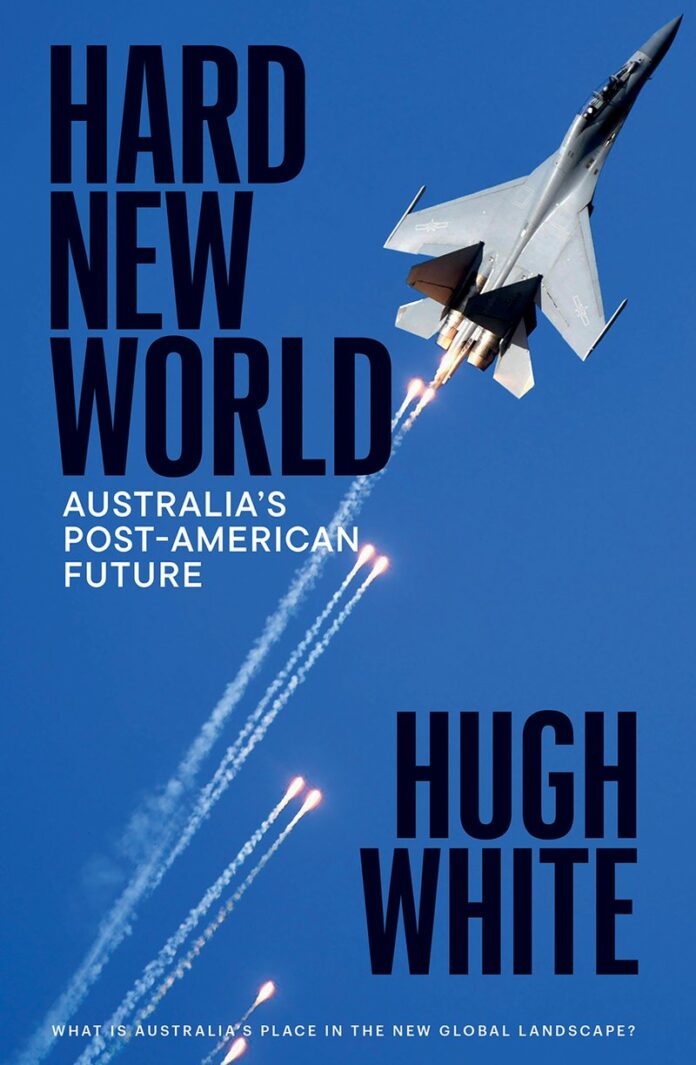
Hard New World. Australia’s Post-American Future. By Hugh White. Published by Black Ink Inc, an imprint of Schwartz Books Pty. Ltd., Collingwood, Victoria 2026.
Reviewed by Tim Coyle
The emergence of the People’s Republic of China (PRC) as a burgeoning world power from the 1990s, and accelerated in the early 2000s, largely driven from 2012 on the ascendency of Xi Jinping, saw public officials (notably in the United States and Australia} voice quizzical demands for explanations of China’s military expansion. These were coupled with a level of disdain over the perceived impertinence of China threatening the long-established, United States-led, ‘Rules-Based Order’.
‘China Hawks’ fulminated over the need to ‘confront/contain China’. A comfortable fence-sitting position of ‘we don’t have to choose (between the PRC and the US’ was adopted by the then Australian Government: ‘
At the 01 June 2025 Shangri-La Dialogue in Singapore Australian Defence Minister Richard Marles demanded that ‘China should explain why it needs to have such an extraordinary military buildup’, and ‘Beijing needs to provide greater transparency and reassurance as it is the “fundamental issue” for the region’. Marles’ demands echoed US feigned surprise at China’s military growth.
The US now more realistically views the People’s Liberation Army as a ‘pacing challenge’ and a ‘near peer competitor’.
Finally, in November 2021, in one of his last utterances as Defence Minister, Peter Dutton opined that in a US-PRC confrontation over Taiwan, it would be ‘inconceivable’ that Australia would not actively support the defence of Taiwan in company with the US.
In Hard New World Hugh White (Emeritus Professor of Strategic Studies at the Australian National University) examines the consequences of the changed US outlook on defence and foreign policy upheaval during the Trump 1 and 2 administrations in the global context before addressing the defensive and woolly responses by Australian politicians, officials and sections of industry to the inevitability of US diminished influence in the Asia-Pacific region leading to the US eventual withdrawal from its 80-year post-World War Two political-military dominance in the Asia-Pacific region.
Hard New World essentially examines the diminishment of US post-World War 2 global influence. Emerging as the sole global power following the collapse of the Soviet Union, the 1990s were a lacuna in which the threat of nuclear war was replaced by American benevolence through generous international aid and military and diplomatic leadership. The political philosopher Francis Fukyama foretold an ‘End of History’, whereby Western liberal democracy, led by the US, had triumphed over godless communism and assured world peace.
A decade later Russia re-emerged as a kleptocracy ruled by a dictatorial ‘patriot’; seeking to restore the Russian empire to its former glory. The PRC arose as an incipient world power determined to avenge the ‘century of shame’ inflicted on it by European powers in the late 19th and the first half of the 20thcenturies.
At the same time, US domestic relations underwent a political schism, exacerbated by Trump Administrations 1 and 2. The decline in American exceptionalism had begun.
This is Hugh White’s theme in Hard New World. He notes the effects US foreign policy attitude changes are having on the traditional strong alliances and partnerships the US had enjoyed and the confusion and alarm among the former supplicant nations.
Specifically White examines the Administration’s foreign policy narrowing to the Western Hemisphere. In a Trumpian reinterpretation of the 1823 Monroe Doctrine, the Administration trumpets unhinged demands for sovereignty over Canada, Greenland annexation, and the dominion status of Venezuela.
This realignment to hemispherical concentration bespeaks, according to White, the Administration’s tacit approval of a multi-polar world in which the major powers – the US, PRC and Russia – prevail in their respective hemispheres.
Insulated by ‘two beautiful oceans’ the US is secure from external attack as long as other multi-polar hegemons are placated by favourable inclinations from the US. Trump, at time of writing, is expected to meet Xi Jinping on whom he has heaped praise (as he has to the North Korean leader) while remaining silent on Taiwan.
Hard New World encompasses nine chapters. The first sets the scene as the ‘Farewell to the Rules-Based Order’. The ‘American Revolution’ looks at the ‘back to the future’ of US foreign policy leading to ‘A New World’ in which ‘Getting it Wrong’ is the undefined end state. The ‘Lesson of Ukraine’ and ‘Europe Alone’ reinforce the bewilderment of allies and partners. Turning to the Asia-Pacific, White examines the crucial topics of ‘America v. China’ and ‘Asia Without America’. Finally landing on chapter nine, ‘The End of the World as We Know It’, sees White in full flight on Australia’s defence and foreign policy post the US. He does not call for a rejection of the Alliance but advocates a diminishment of the cloying obsequiousness, long a feature of Australia’s interpretation of the ANZUS treaty in the dawning realisation that Australia must forge a more self-reliant and forthright stance vis-a-vis the US.
White, of course, is well established in the trenches of the battle of AUKUS One – as are many formidable commentators – who engage the pro-AUKUS forces in respectful public debate. White largely avoids delving into force structure in detail; however, he does tread on some ‘tribal’ toes in questioning aspects of non-AUKUS acquisitions and capabilities.
The issues examined in Hard New World are stark and immediate. Hugh White advances prescient arguments of value to all sides of the national security debate. It behoves all participants in this critical agenda, regardless of inclination, to pay due regard to a voice that speaks for an ever-widening cohort within Australian society.