Dry berths and ship lift in Darwin: time to commit

0
53

By Nick Tate*

Defence routinely treats its own infrastructure as if it has no cost. That makes it harder to commit to better options when they emerge.

A recent conversation with a naval engineering officer at HMAS Coonawarra brought that into focus. The base syncrolift provides flexibility. At short notice a patrol boat can be lifted for emergency maintenance. That responsiveness could not be guaranteed through a commercial facility.

The conclusion followed. Once the syncrolift is treated as a free good, it becomes the default and seemingly logical answer. It is not.

The syncrolift delivers real operational value. Immediate access, command priority and established cyclone support are important functions. When a defect emerges alongside, those factors matter. But the absence of a charge at the point of use does not mean the absence of cost. It means the cost is carried elsewhere.

Infrastructure, workforce, utilities, compliance and recapitalisation sit within Defence estate and sustainment budgets rather than platform accounts. The user sees marginal cost. Defence carries full cost. That distinction shapes behaviour. It encourages reliance on organic infrastructure beyond the tasks for which it is best suited, and it obscures the cost of maintaining parallel systems.

This issue now intersects with a more consequential decision.

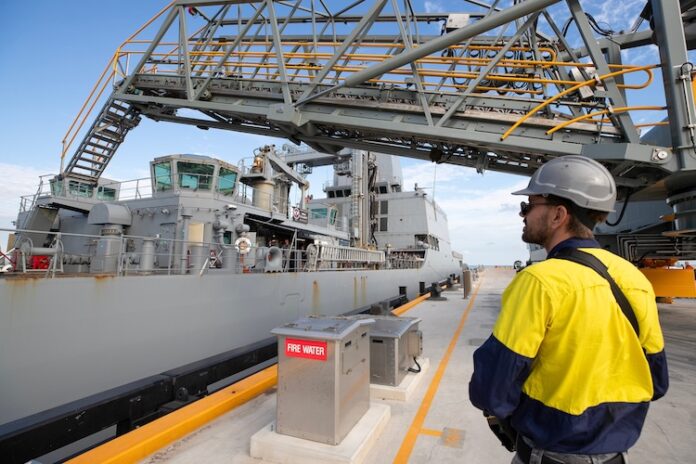
The Darwin Ship Lift is approaching operational readiness. It is designed as a common user facility capable of supporting substantially larger vessels than the existing syncrolift, with integrated hardstand, wet berths and maintenance capability. Its intent has been described as a northern analogue to the Australian Marine Complex. That reflects a system model built on aggregated demand and shared use.

Darwin should not be considered in isolation. It sits within a broader northern sustainment system that includes Cairns and Brisbane. Together, these locations provide distributed capacity across the north and east, supporting routine maintenance, surge and contingency. Redundancy in this system is geographic, not duplicated side by side. Cairns and Darwin, despite the distance, provide alternative pathways. Brisbane adds further depth and industrial scale.

That system logic matters when considering the role of the syncrolift at Coonawarra.

The syncrolift supports patrol boat class vessels and delivers immediate response for emergent work. It will not accommodate the larger vessels entering or planned for the future Navy or Army fleets. Its role is therefore narrowing. At the same time, Darwin’s workforce remains constrained. Splitting demand across two adjacent maintenance systems within the same location does not strengthen the system. It fragments it.

This is where the debate needs to be more precise.

Defence is not wrong to own critical infrastructure. It is wrong to treat it as cost free and to use it for tasks that could be delivered more efficiently through commercial or shared facilities.

That does not mean Defence should become the anchor tenant of the Darwin Ship Lift. The facility is designed as a common user precinct. Its long term viability depends on a mix of Defence, commercial and other government demand.

But Defence does need to provide a clear demand signal and support.

Without it, industry will hedge investment, workforce will disperse and the facility will operate below optimal scale. The result will be higher system cost across the north, even if no single budget line reflects it.

The signal required is not dominance. It is commitment.

Defence should clearly indicate that the Darwin Ship Lift will be the primary location for planned maintenance of Darwin homeported fleet units within its capacity. That intent should be reflected through contracted baseline usage, including access for cyclone preparation and contingency support where appropriate.

This approach aligns the system.

Routine maintenance is predictable. It benefits from scale, standardisation and workforce depth. A common user facility aggregates demand and supports a more sustainable labour market. That is how precinct models function effectively, including the established relationship between HMAS Stirling and Henderson, where facility choice is driven by the services required rather than by ownership.

Emergent maintenance is different. It requires immediate access and control. That is where organic capability retains value. The syncrolift at Coonawarra could continue to support short notice lifts, small scale work and priority tasks, including cyclone preparation.

The mistake is allowing that role to expand by default into routine maintenance simply because the cost is not visible at the point of use.

Darwin does not need duplication within a single location. It needs integration within a wider system.

If Defence does not provide a clear signal, the outcome is predictable. Parallel facilities competing for the same workforce, both operating below scale, and continued reliance on infrastructure perceived to be cost free.

If Defence does provide that signal, the outcome is different. Aggregated demand at Darwin, complementary capacity across Cairns and Brisbane, and a northern sustainment system that balances efficiency, resilience and readiness.

The syncrolift is not a free good. It is a valuable but limited capability. The future fleet will not fit on it. The workforce cannot sustain duplication within Darwin. And the cost of maintaining parallel systems does not disappear simply because it is hidden.

The question is not whether Defence should use the Darwin Ship Lift.

It is whether it is prepared to commit to it as part of an integrated northern system.

*Nick Tate is a retired captain of the Royal Australian Navy with senior experience in defence infrastructure and sustainment. He now works in industry, focusing on capability delivery and the integration of estate, logistics and workforce into operational readiness.


LEAVE A REPLY

Please enter your comment!
Please enter your name here