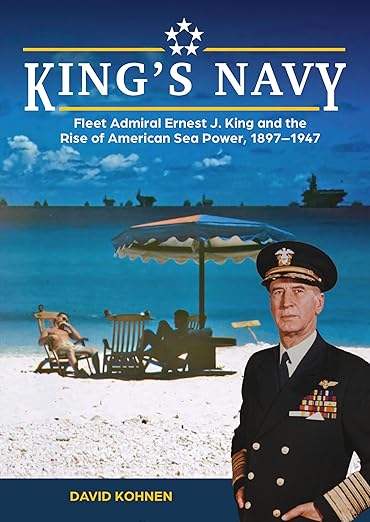
King’s Navy: Fleet Admiral Ernest J. King and the Rise of American Sea Power, 1897-1947. By David Kohnen. Schiffer Military History, Atglen, 2024
Reviewed by Dr Mark Bailey
King’s Navy is magisterial on several levels. The author, David Kohnen, portrays Admiral Ernest King, US Navy Chief of Naval Operations (CNO) and Commander-in-Chief (COMINCH) as the thematic centre of how he and his peers fused sea power into the American military identity, defence and foreign policy.
King was the central figure in the forced maturity of American sea power. King was uniquely qualified as a submariner, aviator, Bureau head and fleet commander. He battled ignorant continentalist politicians, navalists, and interservice rivalry as Army’s internal war with the nascent USAF.
The book is of excellent physical quality, printed on high-quality paper and well bound. There are some minor editorial flaws; however, ‘King’s Navy’ is a deeply researched analysis of how the USN developed global seapower and the role King and others played.
King has been obscured by myth and misinterpretation; an example is his ‘Anglophobia.’ Kohnen addresses the intricate internecine politics of the US defence system in Washington, the complexities of alliance relationships and how Allied strategy was managed. The author outlines the development of US sea power in the 20th century from primary sources. The bibliography is remarkable and the text reveals previously unused sources, particularly private papers and the notes preserved by Buell (a previous King biographer).
King’s Navy is a valuable addition to sea power scholarship. Kohnen focusses on how King shaped the Navy’s structure. Throughout his life King fought bureaucracy and the wasteful expansion of its normal inefficiencies. Kohnen shows how and why King kept his COMINCH HQ small, rotating successful officers from sea into staff positions, then sending them back to sea. King was a taskmaster who rewarded hard work of high quality, and Kohnen also covers his human side – and his failures. King failed to ameliorate the drive to unification and to counter the false claims of the ‘strategic airpower’ propagandists.
King was a warm-hearted and generous family man with seven children. His six daughters mostly married Army husbands: these and their networks gave King a deep network of familial allies throughout the US military structure. He made friends easily but infrequently, but those friends were friends for life and most were very high-quality people like Admiral of the Fleet Sir Roger Keyes. In some cases, he continued to support them when he should not have.
Kohnen’s work does not only focus on the Second World War or the United States. It is an exciting work of national sea power development; yet is more than a biography of a critically important historical figure because it covers the myriad influences, connections, private life, social networks and professional military education that led to the development of King and his extraordinary influence on American sea power.
King’s Navy fills a major gap in naval historical scholarship to increase our understanding of the policies, personalities, decisions and formational fabric of American sea power.