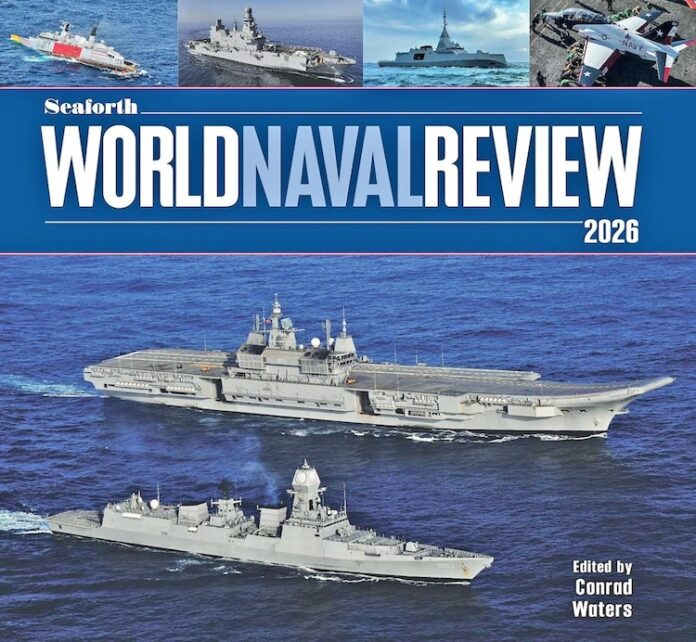
World Naval Review 2026. Conrad Waters (editor). Seaforth Publications, Barnsley, Yorkshire.
Reviewed by Tim Coyle
World Naval Review 2026 leaves no aspect of world navies’ orders-of-battle, both current and projected, selected Significant Ships, World Naval Aviation and a range of naval Technologies unexplored.
The 2026 edition of World Naval Review follows the publication’s established format of:
- An Overview.
- World Fleet Reviews – divided into regional geographical groupings in which the navies’ current orders-of-battle are backgrounded – supported by Tables – and projected new construction described. Additionally, Fleet Reviews look in detail to selected navies; this year it is the Russian (‘The Russian Navy: Retaining Strategic Importance’, and the United Kingdom (‘Royal Navy: New Rules for a New Hybrid RN’).
- Significant Ships. The editor has selected an interesting mix of ships: ‘The Milgem Family; Spearheading Türkiye’s Naval Renaissance’, ‘Mogami-class Frigates; Japan’s Compact Multi-Mission Combatants’, and ‘Vikrant; India’s Project 71 Indigenous Aircraft Carrier’.
The ‘Milgem’ (an acronym of the Turkish words for National Ship’) undertaking arose from a national movement to modernise the Türkiye Navy through designing and constructing a range of surface combatants. This led to 31 vessels (corvettes, frigates and Offshore Patrol Vessels) having been either completed or ordered, and a further six for export. Described in detail, the Milgem design and production successes illustrate the capability of a middle-power to establish an innovative, efficient an adaptive national asset.
Australian readers will be particularly attracted to the extensive coverage of the Japanese Mogami-class Frigates, the class selected by the Royal Australian Navy to fulfil its 11-unit General-Purpose Frigate requirement. Mogami emerged the winner of an extensive international competitive process.
The commercial and strategic implications for Japan and Australia are ground-breaking. Having forged a strong political-military defence relationship over many years, the Mogami is not only a major contractual achievement for Japan, but a unique event. Under the Japanese postwar pacifist constitution, the country renounced war and, consequently, banned military exports. Changed strategic and alliance circumstances now allow for selective military sales and Australia has benefitted with the acquisition of these truly remarkable vessels with design, construction and sustainment support for a generation. Of the 11 RAN ships, three will be constructed in Japan and the remaining eight in Australia.
The political-military implications aside, the article provides fine grain details of the Mogami-class, showing them to be a triumph of modern surface combatant design. The RAN will be receiving the upgraded Mogami, which is larger and has double the missile Vertical Launch Systems of its predecessor and improved radars and combat data systems. So keen was Japan to market the Mogami to Australia, they offered to reschedule their own building program to accommodate Australia.
The third Significant Ship described is the Indian Navy’s new aircraft carrier, INS Vikrant. For many years India has followed a policy of developing military materiel indigenously, of which Vikrant is a formidable example. The gestation period was extensive and execution much delayed by design alterations and extended materiel delivery shortfalls.
The Indian Navy has had many decades of naval aviation experience through its operation of the British-sourced carriers Vikrant (1) and Viraat. Its acquisition of the incomplete former Soviet/Ukrainian carrier Kiev – renamed Vikramadita – was agonisingly slow and hugely expensive.
It was therefore unsurprising, and in accordance with Indian Defence policy, that India would seek to replace its first generation of carriers with an indigenous designed and built ship.
Laid down in 2009, Vikrant was commissioned in 2022 and will operate the navalised Mig-29K. The very severe challenges met by the Indian shipyard and the Navy are fully described as is every aspect of the ship. Despite the Indian Navy’s extensive operational carrier experience, Vikrant’s design and construction was ambitious and highly challenging; however, the carrier’s entry into service is undoubtedly a major achievement in a Navy now recognised as one of the world’s most powerful.
- Following Significant Ships is the Technology Review comprising ‘World Naval Aviation’, ‘RIM-116 Rolling Airframe Missile’, ‘Ship-Based ASW ‘and ‘Rolling Out the Future – HMS Venturer’s Launch Highlights Evolving Shipyard Techniques’.
In ‘World Naval Aviation’, David Hobbs (well known to Australian Naval Institute members) reviews ship-based aviation, detailing the major navies and smaller naval airpowers. These latter include Bazil, Indonesia, Iran, Portugal and Türkiye. The emergence of the drone carrier will doubtless feature more frequently in future editions. The smaller navies are moving towards acquiring these vessels and the article shows an interesting graphic of two Damen drone carrier designs offered to the Portuguese Navy.
David rounds out his review with ‘The F-35B Lightning II – The Experience To Date’. Though in service with several major navies there have been operational and technical shortfalls in their management and operations. One of the operational issues is the heat generated in the landing sequence necessitating modifications to protect decks from melting. An associated severe limitation is the ‘hardware technology refresh’ which David exhaustively explains. In effect these upgrades are so complex as to potentially limit the platform’s operational capability. David concludes in summarising the F-35B as beset with ‘software problems, the need to cool the hot hardware to retain stealth capability and the consequent inability to integrate weapons of choice’. He also speculates (darkly) that, in the current highly politicised security environment, ‘any operations not approved by the USA could lead to software being blocked (and) are many factors of concern to export customers of the F-35B.’
- ‘RIM-116 Rolling Airframe Missile; Ship Self-Defence for the Close-In Fight’. This long-running program, initially conceived as a joint German-US project, remains as relevant today as it was when it was developed as a close-range anti-ship missile to meet Cold War requirements. The missile is exhaustingly examined in the article by Richard Scott.
- Norman Friedman needs no introduction as one of the foremost naval technology commentators of both historical and contemporary warship design, weapons systems and sensors. His ASW expertise is reflected in his forensic study of ‘Ship-Based ASW; Anti-Submarine Warfare Weapons for Surface Ships’.
- Demonstrating the eclectic range of topics selected for Technological Review, is the final article ‘Rolling Out the Future; HMS Venturer’s Launch Highlights Evolving Shipyards Techniques’, by World Naval Review’s editor, Conrad Waters.
Conrad uses the ‘floating out’ of HMS Venturer, the first of the Royal Navy’s Type31 frigates, in preparation for its ‘launch’ by floating barge. The process signifies the changing technology in ship launching and effectively signals the end of the traditional ‘dynamic’ launch via slipway.
World Naval Review 2026 leaves no aspect of world navies’ orders-of-battle, both current and projected, selected Significant Ships, World Naval Aviation and a range of naval Technologies unexplored. The Review’s long and consistently high standards of analysis provides the naval enthusiast with an unrivalled source of contemporary world naval developments at a reasonable price which can be enjoyed through the year until the new edition in 2027!