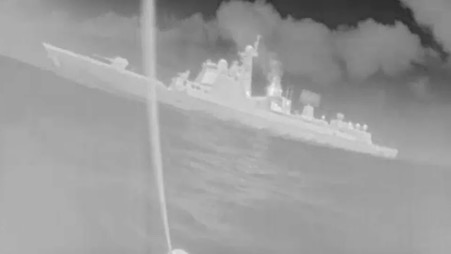
During a long-endurance trek across the Pacific, a small uncrewed surface vessel (USV) owned by a California company had an encounter with a Chinese guided missile destroyer near the Philippines. The Lightfish USV, owned by Seasats, came close enough to the Type 052D guided missile destroyer that it was able to capture the warship on video, the War Zone reports.
The incident highlights the growing presence of USVs, and especially in some of the world’s most contentious locales. The USV coming so close to the Chinese surface combatant also underscores the potential danger USVs can pose even to an advanced warship, a fact TWZ has frequently reported on. It also raises questions about the rules of engagement that navies, and even some merchant vessels in troubled areas, will have to adopt for when they happen upon USVs that come close without explanation or clear intent.
The incident in question took place about 73 miles northwest of the Philippine island of Luzon, Seasats CEO Mike Flanigan told TWZ. The Luzon Strait is one of the world’s most strategic waterways and a potential flashpoint. It sits south of Taiwan and north of the Philippines, in a channel that provides access from the greater Pacific to the South China Sea and vice-versa. This is an area that is highly trafficked in the air, sea and undersea by major military players in the region and commercial shipping. If a conflict were to break out over Taiwan, this area would be turned into a super weapons engagement zone. In a future war, due to its unique littoral geography and importance, it would be a prime hunting ground for USVs of many kinds.
The encounter involved a Lightfish USV, a 12-foot-long, 305-pound USV that can travel great distances for up to six months with the help of its solar power panels paired with its hybrid powertrain, according to the company. Lightfish is not a speed boat. It prioritizes extreme endurance over anything else, so it couldn’t have ‘chased down’ the warship in question, but many other USVs are very capable of doing just that.
“The Lightfish tracked the Chinese vessel on radar from a range of ~10 nm and visually to a minimum range of several hundred meters,” Flanigan explained in an email. “It took place in the evening Pacific time on June 15th and our team was alerted to it immediately by our watch team that monitors vessel traffic in the vicinity of our deployed USV fleets.”
The Chinese destroyer spotted the Lightfish and took evasive action.
“We don’t know the intent, but we were able to observe the vessel altering course and generally observing the Lightfish USV,” Flanigan noted.
The company discussed it with the U.S. military after the event, but Flanigan declined to offer any details.
The company shared with us two videos of the Lightfish’s view of the Chinese warship. In it, the destroyer appears to be moving very slowly if at all.
The videos are eerily reminiscent of scores of videos released by the Ukrainian military showing its USVs attacking Russian warships, although in this case, the Lightfish had no such capability or intent.
As we have reported extensively, Ukraine has demonstrated the devastating potential of USVs against the Russian Black Sea Fleet. The Magura family of drone boats, among others, has been central to that campaign, and has taken on a wide variety of roles. Repeated successful strikes against Black Sea Fleet vessels and naval infrastructure forced Russia to relocate much of its fleet from occupied Crimea to the relative safety of bases in mainland Russia.
Yemen’s Houthi rebels were at the forefront of employing kamikaze USVsoperationally prior to Ukraine. We first reported on the capability in January 2017, after an explosive-laden Houthi drone boat struck a Saudi frigate. The modern version of this concept traces back to Iran, which developed a variety of rudimentary one-way attack USVs before transferring the capability to its Houthi proxies, who became the first to use them successfully in the Red Sea in 2017. They have since used them repeatedly, targeting shipping during their intervention following the events of October 7th and Israel’s invasion of Gaza.