By Tom Sharpe*
The Conservatives propose investing up to £10bn in Britannia Shield, a new missile and drone defence system, that would have “a minimal deployable capability” within their first term in office.
This is good news. Britain’s air and missile defence ranges from poor to non-existent and anything that helps even start the conversation to improve it is welcome. Britannia Shield has certainly done that.
The amount of investment could be criticised. General Sir Richard Barrons, who wrote the most recent strategic defence review, is on record as saying that £80bn over 10 years would be needed to buy the UK “entry level” air and missile defence.
That, I would argue, is what it would cost under traditional procurement models: gold-plate the specification, try and cover everything and wait a decade. I believe that we can achieve useful things with only £10bn, as suggested by James Cartlidge, the shadow defence secretary.
The threats this system will need to tackle are many. Russian hybrid activity is already here. An explosive drone came close to destroying a plane carrying munitions to Ukraine at Germany’s Leipzig airport in August.
Drone incursions, widely suspected to be Russian, have recently closed Copenhagen and Munich airports. An Iranian drone has hit RAF Akrotiri in Cyprus and Iran has fired missiles at the joint US-UK military base on Diego Garcia in the Chagos Islands.
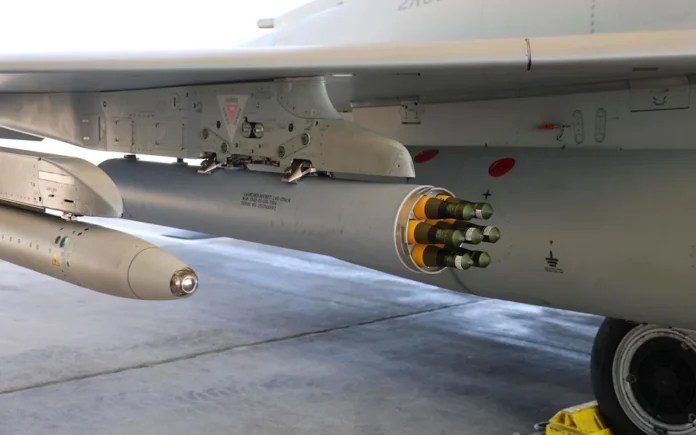
Cities, ports, dockyards and airfields all need cover. Between the Army’s Sky Sabre anti-air missiles, the RAF’s Typhoon fighters – now equipped to carry cheap Advanced Precision Kill Weapon System (APKWS) drone-busters in large numbers – and the Royal Navy’s Type 45 anti-air destroyerswe have some of the parts to do this. But they are not integrated and they are too few. Britannia Shield plans to fix that.
My initial instinct was that this problem should be tackled at sea, using the forthcoming Common Combat Vessels, alongside the uncrewed Type 91 missile platforms and Type 94 sensor sloops planned for the Hybrid Navy fleet.
But on reflection, some land options make sense too given the number of very short-range threats that our bases and airfields could face. Firing weapons over the sea is simpler than firing over land, particularly built-up areas, but when it comes to layered defence, different options with built-in redundancy are the best solution.
The first part of the problem is detecting incoming threats. Australia leads the world in phased array radar these days: the Aussies are even ahead of the United States on this. The MoD has signed a statement of intent with CEA Technologies in August, though Canberra owns the business enterprise and guards it closely. This is a good thing as we need to sort ourselves out on radar.
The first thing to note is that any new land-based radars should be movable. This is distinct from mobile. Mobile means able to roll to a stop and be up and running in minutes, like Sky Sabre’s truck-mounted Giraffe. The radars in question require a sizeable platform that can be moved, albeit not at high speed, and would probably take hours rather than minutes to set up.
The RAF already has fixed radars scanning UK airspace but Iran, Ukraine and common sense tells us that these will be struck early in any air strike and mobility is the best form of protection. Being at sea on a moving ship and being able to work while moving is better still, hence the Type 94 uncrewed surface vessel will form part of this new shield.
Ship or shore, however, surface radar is of limited use against low-flying threats. Height is vital when it comes to extending your radar horizon. At present, our only operational airborne radar capability is the Navy’s Crowsnest system, carried by helicopters. Earlier this year, they were deployed to Cyprus to detect low-flying Iranian drones that could target the island again.
Eventually the RAF’s Wedgetail airborne early-warning aircraft will help us here, although that procurement is approaching Ajax levels of inefficiency and embarrassment and will only, under current plans, deliver three aircraft – not enough to keep even one airborne and watching for any sustained period.
More promisingly, the RAF is in the process of buying 16 “Protector” drones – a special UK version of the General Atomics MQ-9B SkyGuardian, which is already in service with Italy, Japan, the Netherlands, Poland, Spain and the US. Sadly, despite us having ordered ours 10 years ago, not all have been delivered and none are yet judged to be at even initial operational capability. That’s particularly upsetting as Germany expects to go from order to delivery of its MQ-9B force in just two years.
But then, we didn’t just buy our MQ-9Bs from General Atomics: we insisted on British industrial workshare. Apparently there are 200 UK companies involved in Protector. Other cases where we selected a proven overseas design but demanded significant UK workshare include Watchkeeper, Wedgetail, Ajax and Apache – all massive procurement disasters. Cases where we chose proven overseas designs but didn’t demand workshare include Chinook, Hercules and C-17: all solid successes.
However, hopefully one day we will have some working Protectors, and it’s worth noting that in May, General Atomics flew an MQ-9B with Saab’s LoyalEye early warning radar pods. We haven’t ordered that, and the radar on Protector at the moment is no great use for air defence, but such equipment would really help to rectify the deficiencies of Wedgetail. It’s one to think on.
In any case, once we have managed to detect a threat, we need to alert the appropriate weapon system to deal with it. At the high end, the Navy’s Type 45 destroyer has French-made Aster missiles, proven against drones and a short-range ballistic missile in the Red Sea. Plans are in hand to upgrade this to deal with medium-ranging ballistics, but not full-blown intercontinental missiles.
Then we have the Army’s Sky Sabre, shorter ranging and good for defending point targets such as bases, as is the Lightweight Multirole Missile used by RAF ground defence units.
At the moment, however, the Navy has just two Type 45s out of long-term drydock. Nobody is up for buying any more and it may be some time before the planned unmanned missile sloops appear, so we need something else to deal with higher-end threats.
In my view the logical solution is a land-based version of the Type 45’s Aster missile system. This already exists: the not so snappily named Sol-Air Moyenne Portée/Terrestre – Nouvelle Génération (Surface-to-Air Medium Range/Land-based – New Generation) or SAMP/T NG for short – uses mobile launchers mounted on heavy military trucks, each carrying eight Aster 30 missiles. Denmark selected it over Patriot last year and Ukraine has the earlier version.
The next generation of Aster 30, known as Block 1NT, has passed its first qualification firings. Once operational, it will give it better capability against faster and higher missiles – including moderately capable medium-ranging ballistic missiles, something which to date has been Aster’s Achilles heel.
The US navy’s Aegis system will always be the gold standard in ballistic defence, but it is witheringly expensive. It would also not be quick to acquire as the US has recently shot away huge amounts of its missile stockpile fighting Iran and will not have manufacturing capacity to spare for exports for some time. Britannia Shield aims to avoid the delays and cost overruns that have plagued other programmes. Without such safeguards, costs could soar towards the £80bn envisaged by Sir Richard, rather than the £10bn proposed here.
So where do we start?
The first £5bn buys some credible equipment: five or six Aster batteries, some lighter close-range missiles, the radars and the integration. At about £2m a round, the second £5bn would buy roughly 2,000 additional Aster missiles, or a mix of 500 Asters and 2,000 to 4,000 shorter-range CAMMs for close-in defence.
Clearly there is a lot of fag-packet maths going on here, and there will be many other costs that I have not considered. But the overall message is that the £10bn suggested for this is not as inadequate as the gloomier coverage has suggested. This is not a lot of money in the context of this year’s total government spending of £1.42trn. Such a plan should be taken seriously by the current Government, whose response so far has been to attack the Tories’ record rather than engage with the problems.
If we consider 0.7 per cent of one year’s government expenditure to be affordable we can have defences that will be an enormous improvement on what we have now. This is like the Hybrid Navy: it’s not the ideal solution but it could work well.
And it needs to. The likelihood of a drone attack in the UK is now high, in my judgment. The risk of a missile attack is thankfully low, but the effect of such a strike could be catastrophic and it must therefore be anticipated. Ultimately this is about looking stronger than we currently do so that the risk of attack goes down. The calculus also involves striking back and it is worth remembering that as well as a shield, Britannia also ought to have a hefty trident.
There is an almost unimaginably long list of other things that the Ministry of Defence needs to rectify, including those as fundamental as housing and training, which should be priorities. But assuming we can focus on more than one thing at a time, this is an affordable solution to a knotty problem based on largely existing technology. Is it the best solution money can buy? No. But it is one we can afford.