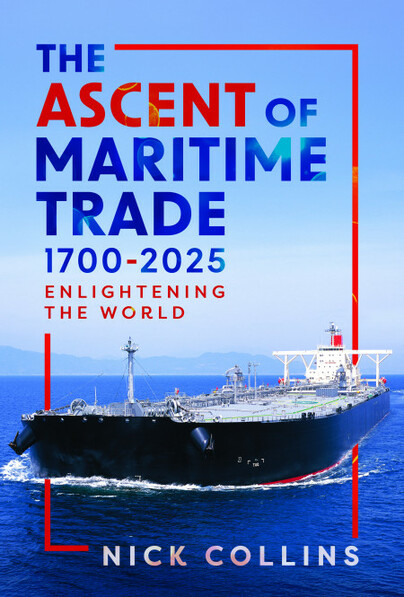
The Ascent of Maritime Trade 1700-2025. By Nick Collins. Pen and Sword Maritime, Barnsley, Yorkshire 2026.
Reviewed by Dr Mark Bailey
This book is of modest print quality, well bound and crisply printed in an unusually small font. This and the concentrated form of the select bibliography initially indicated something unusual.
This is best treated as a research-library-in-miniature, as Collins has obviously had to ‘compress’ his length by at least 50% while reducing both footnotes and bibliography. This extreme ‘compression’ has impacted the work. On the initial skim the approach seems so fractured as to make the reasoning difficult to follow. This damage to the narrative flow means is that it cannot be read conventionally.
The work was probably two volumes originally. The six thematic parts (‘books’ per many 19th century historical works) have 46 chapters. This is a clear thematic skeleton: below this level the internal structure and narrative flow has been stripped out. Each chapter resembles a military brief. The story is not being told conventionally. There is evidence of inadequate editing, spelling errors and such.
‘Compressing’ the work has created many non sequiturs, which would have irritated James Goldrick because they were a particular vexation of his.
That’s all the adverse news.
The good news is that this is an exceptional source of both data and thoroughly researched facts. It is the third book in a series tracing a ‘grand strategic argument’ that maritime trade and the maritime cultures (and by extension seapower states) they spawned have, historically, been the primary driver of both human civilisational progress and human prosperity. This argument supports and expands the concepts developed in Professor Andrew Lambert’s ‘Seapower States’. Collins’ series explains global history through the prism of maritime trade; generating a mechanism to understand both historical and contemporary global events.
Collins: “Too often current events and our history are served up purely in political terms. The world works best when maritime trade allows products to be shipped where they are needed, promoting economic growth. Since 1945 it has lifted billions out of poverty.” What he describes is how maritime trade both broke down authoritarian structures and lifted the bulk of the human race out of poverty after about 1820. This global historical-economic driver expanded and popularised wealth creation through technological innovation which lowered transport costs to the point where all peoples could build wealth.
The importance of Collins book cannot be overstated. This is the work to open the eyes of even the most sea-blind, such as the Australian government. It is critically relevant to the island states like Australia as maritime trade is the engine of growth, an engine Australian governments have long abandoned.
The book follows Britain’s rise to global economic dominance through maritime power from the 14th century. British governments deliberately promoted maritime trade to create wealth. They then used that maritime dominance to destroy global slavery, part of what Collins calls a global Maritime Enlightenment, as momentous as the Industrial Revolution itself.
Collins describes the postwar breakdown of British civilisation while global trade expanded at unprecedented speed. Uniquely, post-1945 Britain deliberately abandoned the formula which created its historic success. He analyses the profound institutional failure of Britain’s political class from the mid-19th century, tracing development of the current British ruling class contempt for that maritime-oriented culture and trade which enriched the British population.
Collins’ lesson for Australia is complex. Following the post-1950 British governance failure to understand the importance of maritime trade is a route to mediocrity at best and civilisational failure at worst. The example of Britain’s declining interest in maritime trade and descent into poverty is contrasted against the post 1945 rise of Japan, South Korea, Taiwan, China and Singapore, all of which encouraged growth of shipping and maritime trade to build wealth.
As the ANI membership wants to encourage this same path for Australia, this book, structured as it is, provides a genuine one-volume (of three) research library with pre-built research vignettes on which to base arguments and articles.
Highly recommended.