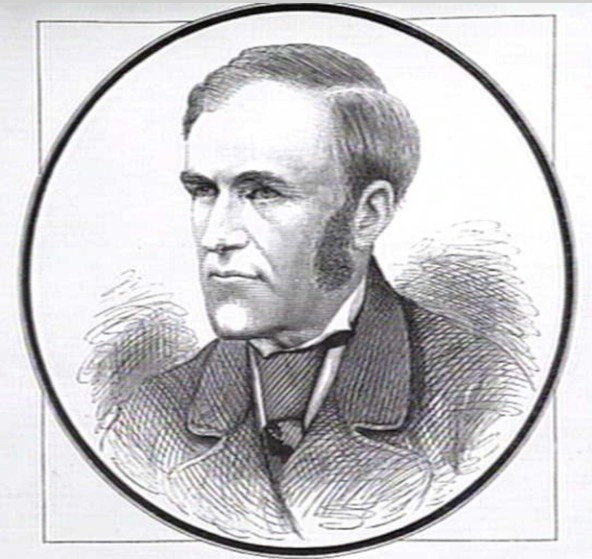
Naval humour occasionally shined through the pages of the Journal of the Australian Naval Institute. One such offering from the submarine community was ‘Operation Goodenough’ which appeared in the July/September 1997 edition.
The following letter was found by an ANl member in London. It is a reply to Admiralty letter NL. 2859/62 requesting details of the location and condition of the grave of the late Commodore James Goodenough, RN, Commodore of the Australian Station until 1875.
On receipt of Admiralty letter ND.2859/62 dated 21st January, 1963, the following action was taken. A probability area was established in the centre of the North Shore Cemetery, St. Leonards, and a search force was dispatched. In view of the importance of the mission I decided to take command myself, the other member being a Petty Officer. Conditions for grave spotting were good, with the sun still high and visibility at least 20 miles. On arrival at the cemetery the search force formed up in line abreast distance apart two graves with a North South search axis and search turns ordered at each boundary wall 1. After 45 minutes, the area had been fully covered and no firm contact gained, though several possibles had been investigated and subsequently classified as nontombs. I was about to withdraw my force, on whom the heat was beginning to tell when the three badged A.B. truck driver on hearing of the failure of the search, suggested having the Commodore piped for. It was realised almost at once that this remark was probably flippant and in any case we had no bosun’s call. I decided therefore to withdraw my forces. Although discouraged, I was torn between asking the Admiralty for a “Gridlock” or the Almighty for an “on top”. The situation as I saw it then could only be described as “not good enough.” The next 48 hours was spent in obtaining local intelligence which revealed that apart from the already searched cemetery which is kept well stocked by the hospital next door, surprisingly few people die in St. Leonards. In fact only one other small cemetery was pinpointed.
A second search force was therefore dispatched on Saturday afternoon consisting of myself and my twin daughters. It was intended this time to take advantage of the well tried Mk.I Feminine Intuition Equipment. It had been my original intention to order a gum tree search, but on arrival it was found that none existed in this area, and the usual line abreast search was ordered. Distance apart of ships being reduced to one grave, in view of the height of eye of my consorts (both only laid down in 1955). Conditions were excellent and visual contact was gained almost at once by HMS Annabel on the port wing, who was immediately joined by HMS Virginia acting on her own initiative. Having positively identified the target, which was in obvious need of attention, it was decided not to carry out an urgent attack, but to mark the datum and return to base with photographic evidence only. The target was subsequently attacked for three days with fire, grasscutters. phosphoric acid, red lead and paint, and the results of these attacks duly photographed. I was about to recall the SAU. confident now that I could report to their Lordships “Operation Goodenough completed”, when with exquisite timing, a rather lugubrious individual who had been watching the operation for the past three days remarked that the new Sydney to Newcastle express motorway now being built, was scheduled to pass straight through the cemetery. “Whilst it is appreciated that the Department of Main Roads will be doing the job regardless of expense, only Their Lordships can really judge as to whether or not this treatment is good enough for Goodenough.
– Commander L H. Oliphant RN, Commander Fourth Submarine Division, Balmoral Naval Depot Sydney
About Commodore Goodenough
Commodore James Goodenough CB, CMG RN (1830-1875) joined the Royal Navy in 1844 and initially served in HMS Collingwood mainly in the Pacific. He then joined HMS Cyclops off the coast of Africa, before returning to England late in 1849. He went on to serve in the Second Opium War being present at the capture of Canton in 1857. Promoted to captain in 1863, he was given command of HMS Victoria and then HMS Minotaur. He served as Commander-in-Chief, Australia Station, from 1873. He died of tetanus aboard HMS Pearl off the coast of Australia, resulting from wounds inflicted from poisoned arrows in an attack by Santa Cruz Islanders.
Confusingly, the Australian Dictionary of Biography states that he was buried in the cemetery of St Thomas’s Church of England, North Sydney, between two of his men. But Commander Oliphant classified his contact as a CERTSUB and this classification is supported by the Naval Historical Society who state the Commodore was buried at St.Leonard’s Cemetery.
Commodore Goodenough’s widow, Victoria Goodenough, published parts of his journal and became a lady-in-waiting to Queen Victoria. In 1876 Goodenough Royal Naval House was established in Sydney by public charity to continue his welfare work for naval men. A bay and island on the Papuan coast were named after him. A stained glass window in his memory is in St Thomas’s, North Sydney, a bust by Prince Victor of Hohenloe is in the Painted Hall at Greenwich and another by Achille Simonetti is in the Art Gallery of New South Wales. One son, William, became an admiral.