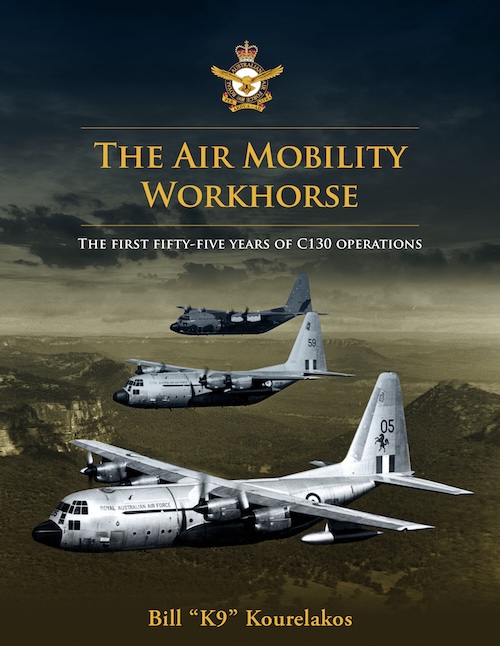
The Air Mobility Workforce – C-130 Hercules Aircraft in Royal Australian Air Force (RAAF) Service. By Bill, “K9” Kourelakos. Newport, New South Wales: Big Sky Publishing, 2025. 438 pages over two hardback A4 volumes; slip case; $89.99
Reviewed by Tom Lewis
I had three thoughts when receiving my copies of The Air Mobility Workforce, all about the Hercules in Australian service, so I thought I’d better write the thoughts down before they escaped.
The first was “how many Hercs have I ridden around in?”; the second was “I wonder if people think that the Hercs they see flying around today are the same ones they might have seen in the 1970s,” and the third thought was “what a handsome pair of books this publication is!” So, I’ll deal with them in order.
The first thought is one that many, many Australian Defence Force veterans would have. Hercules C-130s have been the preferred heavy lifter of choice of the Air Force for decades. As this thoroughly researched book tells us, they first appeared in the late 1950s, so they have been the ride of dictated choice for ADF people in all sorts of operations, from civil disaster support to going to war. Thousands of Aussies have sat in those web seats positioned sideways along the fuselage, or in other configurations. And many a veteran of recent wars, yours truly included, may have done a “tactical descent” or two: a spiralling dive into a foreign airport to avoid being effectively targeted by enemy missiles. The ultimate fairground ride!
Second thought: the Herc’s basic configuration has stayed the same throughout its four models in RAAF service. It’s a high wing carrying four engines using propellers, with a tailgate allowing effective loading and unloading and indeed parachute drops of personnel and supplies.
From then the Hercules C-130, flown over six decades with 48 aircraft over four models, has been a mainstay of RAAF heavy transport. Utilised in wartime and in disasters from floods and fires to Cyclone Tracy relief and refugees, these venerable machines have been both reliable and enormous in their capacities.
After evaluation of five other aircraft, in October 1957 an order for twelve C-130As was announced to replace the Dakotas of No 36 Squadron. Twelve aircraft were delivered from December 1958. By 1965 the demands of the Vietnam War, Australia’s increasing commitments in South-East Asia generally and ever-growing needs at home saw 12 of the more capable C-130E ordered for No 37 Squadron and delivered from August 1966. This was followed by the H model; and this book therefore tells the story of Australia’s A, E, and H-models from 1958 to 2012; the J being left for future coverage.
Coincidentally your reviewer has just finished a closer examination of the Hercules in operations with the release of Cyclone Warriors – “the armed forces in Cyclone Tracy”, published by Avonmore Books for the 50th anniversary of the massive storm that smashed Darwin. The mighty Herc was the first aircraft in on Christmas Day, after the city had endured around 12 hours of winds reaching up to at least 240 kph. Here is a description of that first approach and landing from one of the aircrew:
In Darwin, at 1000 local time, the Hercules, the first aircraft to make it into Darwin, touched down in what were described as “extremely marginal conditions”. Keith Kershaw, the flight engineer on the Hercules, remembers their approach to the devastated northern capital:
We began to feel the effects of the cyclone somewhere around Katherine as we began our let-down into Darwin. The method of approach was an ARA (Airborne Radar Approach) whereby the navigators used the aircraft radar to locate the runway. Because the radar waves are bounced off the runway into the ether the runway appears on the radar screen as a big blank rectangle. We saw the 7 kerosene flares on the left-hand side of the runway at about 500 metres. The distance is a guess as rain was blurring vision and is based on the length of time to land from first observation of the flares.
We landed firmly due to water on the runway, dead on centre line, and taxied to dispersal. Group Captain Hitchins met the aircraft and escorted the passengers and our Captain to points unknown. The rest of the crew remained to configure the aircraft for the return flight and maintain communications with Airforce Sydney. The link was used by Group Captain Hitchins on more than one occasion. We had to refuel with engines running and were notified sometime before sunup, that the most seriously injured were to be loaded shortly.[1]
It’s of course not just the unfortunately many civil disaster ops that are covered in these books; but also the C-130 going to war. Vietnam takes many pages and includes the memorable Operation Babylift; East Timor and the Bali Bombing are here. So too are Afghanistan and Iraq, and in the non-warfighting pages there are fire-fighting operations; moving Her Majesty the Queen’s coaches; yacht race rescues, and more. There is a wealth of technical detail included, but in a way that it is easily understandable: night vision flying; fuel bladder usage; radars and radios; fuelling and training – all are here.
A comprehensive list of Appendices are included:
- Paint schemes and nose art
- Operations
- Tail by Tail – a basic history of each aircraft
- C-130 Commanders
These are followed by a Bibliography and an Index, and in the second volume, a brief pen-portrait – and three photos – of the author, Bill, “K9” Kourelakos. He hailed originally from Canada where he served for 12 years before moving Down Under where he joined the RAAF. Retiring as an Air Commodore in 2020; his flying experience in Hercules has taken him across the world as far away as Central America, Croatia, Bosnia, Cambodia, East Timor, the Solomon Islands, Papua New Guinea, Indonesia, and on several humanitarian aid missions, so he’s uniquely qualified to write these books.
The third thought – that this is a most handsome pair of books – is borne out by closer examination of The Air Mobility Workforce. They are hard-cover works, of 223 and 215 pages respectively, in the large A4 format, with glossy page finishes to best bring out the many photographs utilised – more than one a page. Publishers Big Sky are using a large font, which looks like 12-point Times, an admirable habit they are becoming known for, the best to please older viewers I suspect.
For the technically minded there is more than enough detail here. Annotated photos; diagrams of such exotica as to how to load a pallet system, maps of operational deployments; graphics of how to parachute supplies, and more are included. Each chapter has comprehensive endnotes explaining where information came from, and also on occasion giving supplementary information. The construction of the C-130 models is discussed, as well as the peculiarities of flying them – for example the “rudder kick-back” problem of the 1970s, and even how to extract a bogged aircraft from a rudimentary airstrip.
In summary, this most impressive book set fulfills most capably a dual role: bringing the story of a remarkable aircraft in Australian service to the public’s gaze in an easy-to-read way, but also cataloguing the C-130’s history for the technically-minded and the RAAF member. Thoroughly recommended.
*Dr Tom Lewis OAM is a military historian. Two of his recent books related to military aircraft are Bombers North, and Eagles over Darwin, (Avonmore) both analysing WWII air actions over northern Australia.
[1] Kershaw, Keith. Aviation in the Aftermath of Cyclone Tracy. “Recollections Of Keith Kershaw C-130 Hercules Flight Engineer 37 SQN RAAF.” Website. http://www.adastron.com/cyclone-tracy/tracy-keith-kershaw.htm January 2012.