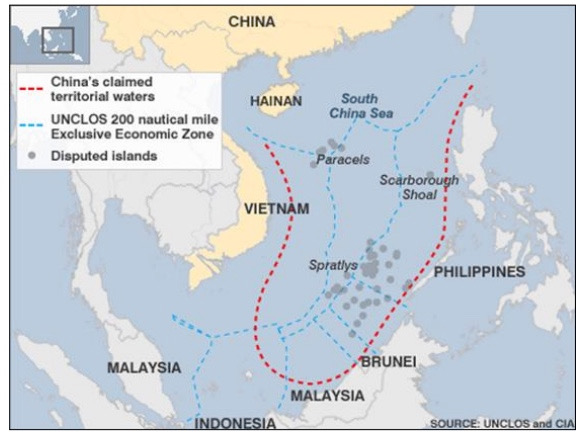
A new explainer published by the Australian Strategic Policy Institute (ASPI) argues that as China continues to aggressively pursue its objectives in the South China Sea, Indo-Pacific powers will need to work together to uphold the norms that maintain regional security.
In Ten years after the arbitration: The limits of rules in the South China Sea, ASPI Senior Resident Fellow David Dutton outlines how Beijing has continued to push the limits of the United Nations Convention on the Law of the Sea (UNCLOS) over the past decade, at times going well beyond those limits.
In 2013, the Philippines brought a case against China to Hague’s Permanent Court of Arbitration following China’s 2012 seizure of Scarborough Shoal. In 2016, the Philippines won the case, with the arbitral tribunal ruling that China’s territorial claims within its nine-dash line were invalid under the convention. This decision has become a basis for much of Manila’s pushback against Beijing.
The author explains that in the decade since this ruling, China has only increased its aggressive behaviour in the South China Sea.
“Control of the [South China Sea] is critical to China’s strategic ambitions as a great power: to promote national rejuvenation, change the military balance and create safe operating spaces, shape its relations with what it sees as the subordinate states of Southeast Asia, and control resources.”
“China’s conduct has gradually become more aggressive, intensifying since 2023 and, in the past year, exceeding its own precedents. On-water behaviour is more menacing, involving mobilisation of superior force in encounters, increased use of military assets, and the application of controlled violence.”
The explainer outlines that the Philippines has consistently opposed China’s actions and bolstered its regional presence in response, including through military modernisation and defence cooperation. Other Southeast Asian countries, however, have been less vocal, sometimes to the effect of normalising China’s behaviour. A “divergence of interests” across these countries prevents The Association of Southeast Asian Nations (ASEAN) from challenging Beijing.
The author argues that sustaining UNCLOS and preventing major conflict will require stronger cooperation between regional powers. While ASEAN is unlikely to “exert collective weight or resolve fundamental differences,” it should work towards “normative expectations, dialogue and risk reduction” rather than allowing China to slowly erode the rights of member states.
“There will be no return to the conditions of earlier periods of relative stability. States that want to sustain UNCLOS need to make more determined and concerted efforts to maintain
presence, deter aggression and impose costs when China denies the rights of others.”
Outside of ASEAN itself, countries should continue to pursue deeper, more diverse and more networked security partnerships, including with the United States and Australia. The explainer details that this would allow states to support rules and exercise rights, bolstering regional resolve against China’s coercion.