A conservation society in the United Kingdom is hoping to save one of the last surviving Royal Navy warships that played a role in hunting German submarines during World War I. The warship’s future, however, seems uncertain after she was ordered to leave her current dock, Maritime Executive reports.
The Q-ship Society, a non-profit organization, is spearheading a campaign to save the HMS Saxifrage, a British naval ship that was built for convoy escort and anti-submarine duties during World War I. Since 2016, Saxifrage has been moored at the commercial docks at Chatham, hidden away from public view.
The Saxifrage was among the Royal Navy ships that played an instrumental role at the tail end of WWI. Historical accounts show the ship was among the last examples of a Royal Navy sloop, a fleet of slow escort vessels that were small, lightly armed, and whose core mission was to hunt German U-boats.
The Saxifrage was built in 1917 by Lobnitz & Co. of Renfrew in Scotland. Commissioned in March 1918, she was an Anchusa-Flower class sloop, a fleet of ships that were named after different flower varieties. In her case, Saxifrage was named after the flower known as London Pride.
Records indicate that Saxifrage was one of a group of vessels that were commonly known as ‘Q-ships’ that were designed to appear as ordinary merchant ships. They were, however, armed with 4-inch and 12-pounder guns, giving them the firepower to launch surprise attacks on German submarines. The thinking was that a U-boat would be unwilling to use a torpedo on a small merchant ship. In essence, the logic would be for the U-boat to surface and sink the small merchant ship by gunfire or explosives.
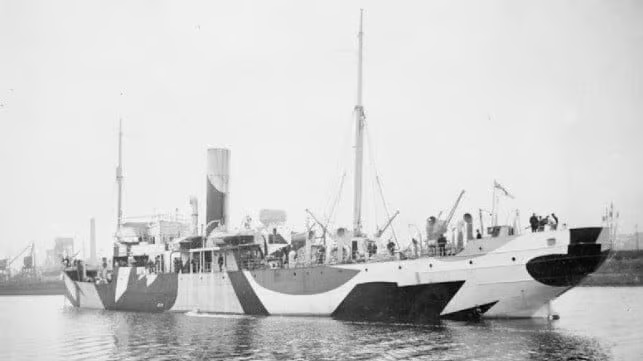
Considering that the mission of the Q-ships was to primarily lure and sink the U-boats, the guise was simple. The Q-ship crew would appear to be abandoning ship in panic when a U-boat surfaces. However, a small team of naval officers would remain on board to remove the covers disguising the guns and open fire on the U-boat once it was in range. Part of the Q-ships’ camouflage was being painted with the bold stripes known as “dazzle” designed to break up the sightlines for subs looking toward the vessel.
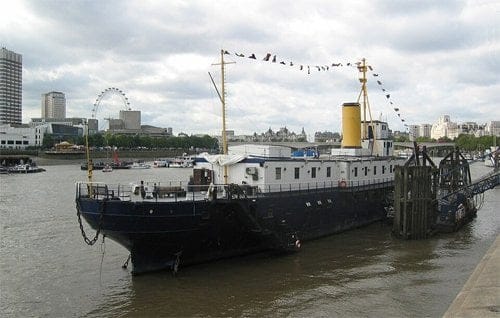
HMS President on the River Thames in London in 2004 (Gary Houston – CC0 1.0)
According to historical records, the British built and deployed a total of 366 Q-ships during WWI, 61 of which were lost in battle. Having been built towards the tail end of the war, Saxifrage also participated by escorting convoys around British waters. Though she came into contact with nine U-boats, she was never able to take one down.
Following the end of the war, the ship was renamed HMS President in 1922 and became a Royal Naval Volunteer Reserve (RNVR) drill ship. During the same year, the ship was saved from scrapping after her sister ship, the Marjoram, which was intended to be the next RNVR President, was wrecked while under tow to London. Saxifrage was selected as her replacement.