Tom Sharpe*
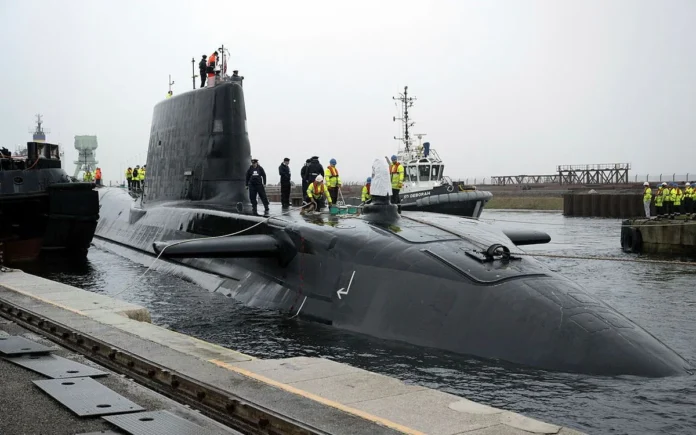
None of the Royal Navy’s attack submarines are currently at sea. A fleet of nuclear-powered hunter-killers all tied up alongside or in dock, every one of them, is a serious matter. This is not the first time it’s happened and last time it did, the Ministry of Defence trotted out the tired mantra “we continue to meet all our operational tasks”. We do not.
The excellent Navy Lookout website has set out the position boat-by-boat. HMS Audacious is only now leaving dry dock in Devonport in Plymouth; HMS Anson, the only attack boat to have been to sea recently, is alongside after a curtailed deployment to Australia; HMS Astute is undergoing a multi-year refit; and Ambush and Artful have not sailed in years. The site described the overall posture as “a disaster”.
The existing programmes intended to rectify matters – the submarine maintenance recovery plan, and the dock and infrastructure rebuilds at Faslane in Scotland (under Project Euston) and at Devonport – need to be pursued with urgency and, where possible, accelerated.
The scale of this feels uncomfortably like telling Sisyphus to stop loafing and put his back into it. Beyond that, the priorities are reasonably clear: return more existing boats to sea, build resilience at Faslane, expand industrial capacity for the next generation, and protect Aukus – the security partnership between Australia, the UK and the United States – and the continuous deterrent. In the long term, Aukus is the answer.
This much is grim but largely known. The more important question is what it means in practice for right now.
Consider the geography. The Bear Gap – the stretch of water between the North Cape of Norway and the southern tip of Svalbard, about 400 miles across – is the front door to the Norwegian Sea. About 1,000 miles to the south-west lies the GIUK gap, between Greenland, Iceland and the UK (specifically Scotland) which forms the back door.
Get through that undetected and you are in the North Atlantic, which is 30 times the area and includes most of our critical undersea infrastructure. The role of the Royal Navy historically, alongside Norway, the United States and others, is to contain the Russian submarine fleet behind the front door, or at least to maintain enough presence to detect it passing.
There are several ways to hold that line, but the SSN (ship submersible nuclear) remains the most effective, and the most feared. The fear factor is important when deterring someone who only understands strength. When was the last time we sent a boat up there? Such patrols were once routine for submariners; they are now exceptional, and a generation of hard-won experience is now lost.
Stories of what boats got up to up there during the Cold War are the stuff of legend, as are the men who operated the subs. Importantly, by the time a submarine captain went up there in command, he had already completed dozens of such patrols as a junior officer.
When we are trying to track the enemy’s boats there are many things to consider. Conducting anti-submarine operations in the Arctic operational theatre requires a working understanding of the water columns and oceanography, which in turn requires a regular presence, as well as familiarity with the acoustic signatures of the boats being tracked. We have accumulated a working knowledge of the Russian Akula class SSN, but when was the last time we trailed the newer (and quieter) Yasen-class? And, whisper this: how long before one of those trails one of ours?
The same picture looks different from the Russian side. To Moscow, those doors open the other way, and “the bastion” as they call it is something to be defended rather than penetrated. The Russians have no wish to see Western submarines operating up north, because that is where their own ballistic-missile boats routinely operate. Again, previous patrols saw us not just up there, but right into the Barents Sea lurking outside their main bases. Most of the detail remains locked away.
Beyond experience in the High North and the ability to contain the threat there, a good deal else is lost as the boats remain alongside. The SSN is an important means of deterring interference with undersea cables and pipelines. It is our primary land-strike platform and the only thing we have able to launch the Tomahawk. It is our primary anti-ship platform by a distance. It contributes to protecting the deterrent at sea, which is less directly connected than sometimes claimed, but still real.
The SSN allows the carrier group to remain undetected. Those who think drones or missiles or something have rendered a carrier obsolete often fail to grasp just how much more dangerous an enemy SSN is in this regard.
In an era where we have become politically afraid to deploy our carriers, we should not make it easier by forcing naval officers to say “actually, if we haven’t got an SSN in company, then we shouldn’t go”. Even today, Royal Fleet Auxiliary Lyme Bay is approaching the Strait of Hormuz and really should have an SSN nearby. And finally, nuclear subs provide covert capabilities: intelligence-gathering and special-forces support, rarely used but valuable when required.
Those are the operational effects. Beneath them, other things are being eroded. Safety suffers as crews lose currency. Training is increasingly being run on borrowed foreign boats. This one worries me a lot as these things can erode so slowly, no one even knows it’s happening. Morale declines as experienced and ambitious personnel sit alongside with little to do. Or conversely, end up doing family-breaking long patrols because only one boat is available. All the while credibility is affected, with allies who notice the absence of presence. None of this is easy to measure, and all of it will take years to rebuild.
I was in a wargame recently in which, as Britain under Russian attack, I was allocated two working SSNs. I used both of them in the first turn of the game – one to shadow (and eventually engage) a Russian group of surface warships, the other to go round the top and provide strike options. With both so allocated, we couldn’t use the carrier because we couldn’t protect it against the unlocated enemy SSNs. And that was with two, which felt like a luxury. Today’s figures bear that out.
I have always argued that if you were to delete every capability the Royal Navy has, from bottom to top (an exercise the Treasury would no doubt welcome), the last two standing would be frigates and submarines. Without the former, you don’t have a navy. Without the latter, you lose the ability to deter through fear. We are at least building frigates: too slowly and not in sufficient numbers, but we are building them.
The position with our submarines is worse. The maintenance recovery plan is under way, but progress is painful. Money has been allocated, perhaps proving that it can’t fix everything, but it sure helps and more is needed – along with a new way of managing vast and expensive defence projects more generally. Atlantic Bastion, the plan to dominate up to and including the Bear Gap using uncrewed systems, is a complex and commendable addition.
But it must remain an addition, not a replacement. Undersea autonomy is likely to be the last warfare area in which crewed systems will be operationally surpassed, if it happens at all. Besides, if you could develop an AI that can think like a submariner, you’d probably shut it down in short order…
Meanwhile, without allies, the Bear Gap – the front door – remains open. The GIUK back door can be covered at a stretch, by a single frigate and whichever of the nine P-8 aircraft are serviceable. That returns the problem to our allies, with whom we have stopped being a lead and someone to look up to, and have become a burden.
As much pain as that causes me to say, that is where we are with submarines. All the while, we as a country, and our SSNs, are becoming less safe every day. The rest of the once mighty Royal Navy is not far behind. And still the Government does not accept the case for a proper increase in defence spending.
*Tom Sharpe OBE served for 27 years as a Royal Navy officer, commanding four different warships.
This article was first published in The Telegraph and is republished with permission.