By Tom Sharpe*
US marine corps missile vehicles landed on Jan Mayen, a remote volcano island in the High North (August 2026)
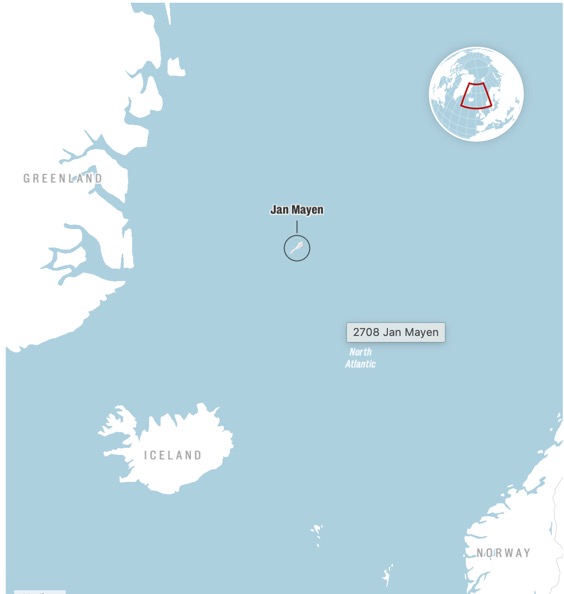
It is 560 miles north-west of Vesteralen in northern Norway and 370 miles north-east of Iceland, and named after the Dutch whaling captain who found it in 1614. It has an indigenous population of zero but will often house up to 35 scientists and military personnel: more, right now. The runway is a 1,585m dirt strip which normally sees nothing but a Norwegian transport plane about eight times a year.
Now, Jan Mayen is hosting Operation Atlantic City: a Second World War name – the US base there in the 1940s was called that – for a thoroughly modern Cold War task.
The force deploying to the island is trinational. The Americans, as usual, bring the muscle: US marines, special operations MC-130 Hercules transport planes and a High Mobility Artillery Rocket System (Himars) unit belonging to the New Hampshire National Guard. Himars vehicles can launch basic GMLRS precision rockets, much more powerful and longer-ranging ATACMS ballistic missiles or the ATACMS’s successor, the Precision Strike Missile.
The Norwegians, the island’s owners, have brought their navy and Home Guard troops. Britain has sent Royal Marine commandos and A400M Atlas transports from the RAF.
Nobody has said what is in the rocket launchers yet and I don’t think it matters this time around. This is not a shooting exercise, it is a command and control and logistics test: sensors, command nodes and a missile system wired into what the US marines call a “joint kill web”, deployed to the slopes of a volcano in the middle of the Arctic Ocean.
Get this right and you know you can do it with weapons that can dominate the sea around, mounted on an island which – admittedly – cannot move about but which also cannot be sunk. The Himars vehicles can move about to avoid being targeted and the ground troops can prevent them being neutralised by an assault landing.
Then, the Precision Strike Missile Increment 2 – which flew for the first time in March – carries a seeker built to hit moving ships at over 300kms (186 miles). That would fit perfectly. So too would NMESIS, the mobile land-based version of the Naval Strike Missile. Land-based anti-ship fires have not featured in these waters since the Cold War, but they are clearly coming back. If Nato has missiles on Jan Mayen, access to the Atlantic for Russia’s Northern Fleet is badly curtailed.
The island is no stranger to military activity. Norway garrisoned it in 1941 and ran weather stations there through the war, alongside various American outfits. Meteorology will be a key part of this latest operation too. Understanding the air and water columns you wish to operate can be modelled from afar only up to a point. Sooner or later, you have to go there in person and get the “actuals”.
This deployment is one of a series in the North right now. Nato’s two standing northerly naval groups, one of frigates, one of minehunters, each from a dozen nations, have spent the week running out of Keflavik, Iceland, on exercise Northern Viking, with the Greenland-Iceland-UK gap as their focus. This forms the southern gate (the Bear Gap being the northern) through which Russia likes to try and sneak nuclear-powered submarines undetected. If successful in this, there are many kinds of villainy they can get up to. They are not successful, but keeping it that way is a job that has had to be done since the 1950s, without let up.
Our aircraft carrier HMS Prince of Wales and her task group have also been in the High North on and off since May on Operation Firecrest, contributing to Dynamic Mongoose, Nato’s badly named annual anti-submarine exercise.
Next month, off the Hebrides, the Royal Navy and US navy will finally conduct Atlantic Thunder, sinking the retired US frigate Klakring in a test of coordinated firepower. During the Cold War, this pace of activity would have been routine. Lack of resources means it is uncommon now, but at least it is happening.
The “why now?” of this is pretty simple. Russian activity up there is increasing. Their Mediterranean squadron is at zero for the first time in a decade, but activity around the UK is up by 25 per cent on last year. In July alone, four of our warships spent 21 days shadowing two Russian frigates and a procession of shadow-fleet tankers.
In April, an Akula-class nuclear attack submarine ran a diversion while Russia’s “Gugi” deep-water spy ships went for the seabed cables. And it’s not just us. Cables are cut in the Baltic, drones make airspace incursions up and down the Nato line. Much of the task of meeting and monitoring Russian activity falls on our ageing fleet of Type 23 frigates. We currently have five left and despite being well beyond their design life they are being run hard.
But very little of this work needs a specialist anti-submarine ship to do it, it just needs a credible warship. This is why the Type 31s, Common Combat Vessels and autonomous vessels of the planned Hybrid Navy cannot come soon enough. The noises and plans for all this are good; the pace is painfully slow.
The architecture as outlined in Atlantic and so on is all sound too. The Finnart terminal on Loch Long, bought by the Ministry of Defence in July as a fuelling base and as an autonomous ship hub, is another sign that we are moving in the right direction. So are the ongoing efforts to improve nuclear submarine availability (currently at zero subs for 86 days and counting). The trouble is, you can go mad when you look for actual movement and the idea that the new Prime Minister, Chancellor and Defence Secretary were going to unlock funds and up the pace looks less credible by the day.
To me, this all teases out two things, one negative, one positive. Russian out-of-area operating tempo is increasing and our ability to even monitor it is diminishing. Plans to correct this are in place but going very slowly.
The good news is that Nato forces are out there in strength just now to compensate. American muscle, logistics and intelligence sit at the core of this effort, as they always have. This isn’t about fighting or being aggressive, it’s about giving Russia pause for thought should they wish to escalate.
Noises from Washington would have you think otherwise, but for now – this week – the military alliance that forms the backbone of our security remains strong.
*Tom Sharpe OBE served for 27 years as a Royal Navy officer, commanding four different warships.
This article first appeared in The Telegraph and is republished with the author’s permission.