On Remembrance Day, the thing worth remembering is the interval between the wars, and what the generation that built our memorials did with it. (From: SI vis pacem, para bellum)
Edward George Honey, a Melbourne journalist working in London, wrote to the Evening Newsasking for “five silent minutes of national remembrance” on the first anniversary of the Armistice. King George V tested the idea, found five minutes too long, and on 7 November 1919 asked the Empire for two. Honey lived to see only three Armistice Days. He died of tuberculosis in 1922, at thirty seven. After the Second World War the Australian and British governments renamed the day Remembrance Day, because Armistice Day no longer described a day that would carry the dead of two wars, and in 1997 Governor-General Sir William Deane proclaimed the one minute silence we keep now.
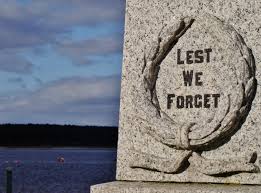
When the minute ends, someone will say ‘Lest we forget’, and most of us will hear a promise to the dead: that we will remember who they were and what they gave. That is a good meaning, and I would not take it from anyone. It is not, however, the first meaning of the words, and the first meaning is the one I think we most need this year.
A warning written for a jubilee
The phrase comes from Rudyard Kipling’s Recessional, published in The Times on 17 July 1897, as Queen Victoria’s Diamond Jubilee drew to a close. A few weeks earlier Kipling had watched the jubilee naval review at Spithead, where one hundred and sixty five vessels assembled. Britain was at the height of its power, and the empire had spent a month celebrating that fact.
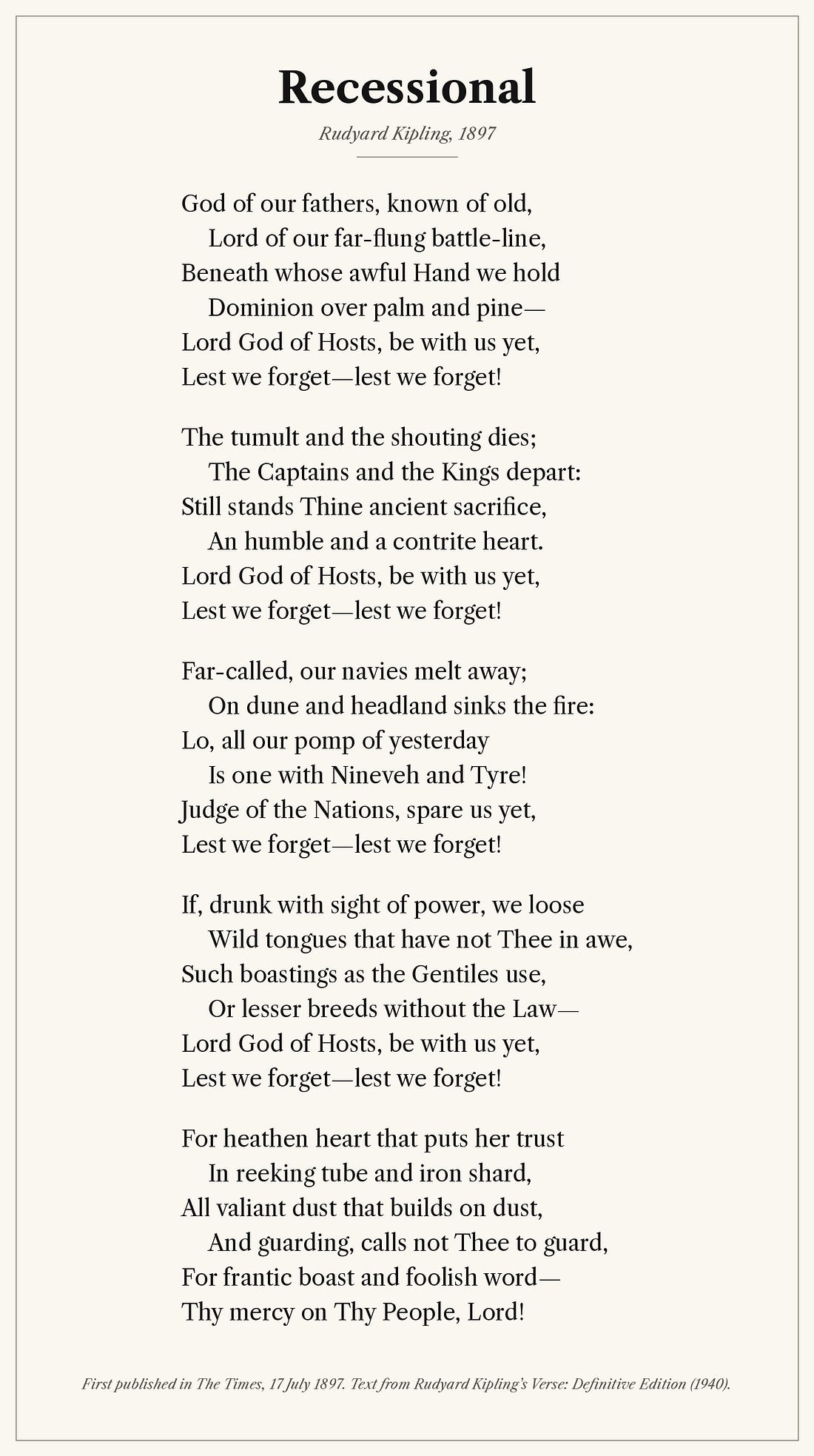
Kipling wrote not a celebration but a prayer against complacency. Its root is Deuteronomy 6:12, Moses warning a people about to grow comfortable in a land they had not built: “beware lest thou forget”. Kipling turned the singular into the collective, and the refrain closes four of the poem’s five stanzas. Its second stanza looks past the festivities to the morning after:
The tumult and the shouting dies; The Captains and the Kings depart:
and its third imagines the fleet he had just watched simply going away:
Far-called, our navies melt away; On dune and headland sinks the fire:
In 1897 ‘Lest we forget’ was addressed to the living, and to the powerful among them. Its fear was that a people at ease would forget that the peace and plenty they enjoyed were held, not owned, and would let the means of keeping them run down. The poem carries the empire’s prejudices too: the same text speaks of “lesser breeds without the Law”, and we should say so plainly rather than pretend it reads cleanly today. The warning stands anyway. It is a warning about forgetting in the good years.
Eighteen years later Kipling’s only son, John, was posted missing at the Battle of Loos on 27 September 1915, weeks after his eighteenth birthday. His parents never found his body. Kipling joined the Imperial War Graves Commission in 1917 as its first literary adviser, and it was he who chose the words “Their Name Liveth For Evermore” for the Stone of Remembrance in the larger cemeteries, and “Known unto God” for the headstones of the unidentified. By the time ‘Lest we forget’ was being carved on war memorials across Australia, its meaning had turned from the living to the dead.
 |
Charles Bean conceived the Australian War Memorial at Pozières in 1916, resolved that the men he had watched fed into that “ghastly giant mincing machine” should not be forgotten. The foundation stone was laid on 25 April 1929, and the Depression stopped the work almost at once.
The Memorial finally opened on 11 November 1941, twenty three years to the day after the Armistice. More than five thousand people came, among them the Prime Minister, John Curtin, and eighteen holders of the Victoria Cross. The Governor-General, Lord Gowrie, opened it. A press report of the ceremony, carried in New Zealand the next day, described mothers from all over the country wearing the badges and decorations of the last war, and others wearing new mourning for sons lost in this one. Gowrie spoke of the bitter irony of the occasion: to the names of the Great War’s dead inscribed on the Memorial, another war was already adding new ones.
Eight days later HMAS Sydney was lost off Western Australia with all 645 men aboard. Within a month Japan had entered the war, and within a hundred days Singapore had fallen and Darwin had been bombed, which I traced in The Battle For Australia. The generation that had carried the memory of 1914 to 1918 for twenty three years, and built the country’s memorials to hold it, now had to fight again, and not from where it would have chosen to start.
The Memorial’s own history magazine has a plain title for the years between the wars: The Years of Decay. In it Jordan Beavis sets out what happened to the forces of a country that hadenlisted 416,809 men for the First World War from a population of fewer than five million, and lost more than sixty thousand of them.
The cuts of 1922 and 1923 reduced the planned citizen army to thirty one thousand men with sixteen days of training a year. Under the Singapore strategy the Navy was cut back to a seagoing squadron of three cruisers, three destroyers and a sloop, and on 12 April 1924 the battlecruiser HMAS Australia, the Navy’s first flagship, was towed out past Sydney Heads and scuttled under the terms of the Washington Naval Treaty. The Navy’s own historians judge that loss more symbolic than material, since the ship was worn and outclassed, but the symbol was understood at the time. On 31 October 1929 the Scullin Government announced that universal military training would be suspended from 1 November, “pending a general review of defence policy”. The Militia fell almost overnight to twenty five thousand of all ranks. The Permanent Military Forces were cut to fifteen hundred officers and men. By 1933 the Navy had shrunk to 339 officers and 2,483 sailors. As late as 1938, Beavis records, the Army held four obsolete three inch anti-aircraft guns, no two pounder anti-tank guns at all, and thirty six Bren guns.
His verdict on the Army is the sentence I would put in front of anyone tempted to think the interwar years were simply a time of rest: “War in 1939 would find the Australian Army less militarily capable than it had been in 1919.”
None of this happened by accident, and none of it happened in Australia alone. In August 1919 the British War Cabinet told its services to frame their estimates on the assumption, in its own words, “that the British Empire will not be engaged in any great war during the next ten years, and that no Expeditionary Force is required for this purpose.” Later in the decade Churchill, as Chancellor of the Exchequer, made the Ten Year Rule roll forward automatically, so that the decade of safety always began again tomorrow. Australian defence policy rested on British assurances and on the promise of a fleet at Singapore. The rule was dropped only in the early 1930s, and then, in the historian Stephen Roskill’s phrase as James Goldrick quotes it, it was “quietly allowed to lapse”.
They did not forget the dead
It would be easy, and wrong, to tell this as a story of a careless generation. The men and women who cut the forces were the men and women who had fought, nursed and grieved through the Great War. They remembered it with a precision and an emotion we cannot match. What they remembered was the cost, paid in blood, and ‘never again’ was a reasonable thing for a country that had buried sixty thousand of its young to want. The Scullin Government made its cuts while the Depression was tearing the budget apart, and cuts to military spending were, as one history of the period puts it, popular with the electorate.
The record also complicates the clean version of the story. Rearmament began well before the war came. The Lyons Government started a three year programme in 1933–34, and its Minister for Defence, Sir Archdale Parkhill, could report in 1936 that spending had risen from £3.2 million in 1932 to more than £8 million that year. Beavis himself concludes that the Navy was the service best prepared for war in 1939 and that each service entered the war with foundations to build on. The country of 1939 was not defenceless, but it was late, and the lateness was paid for in 1942 in the north, at sea and on the Kokoda Track.
So the failure of the interwar years was not a failure of memory. It was a failure to hear the whole of the phrase they carved. The generation of 1919 heard ‘Lest we forget’ as a duty to the dead, and kept that duty faithfully: in Bean’s memorial, in the dawn services, in the Shrine of Remembrance and the honour boards in country halls. They did not hear it as Kipling had meant it, as a warning that peace is held only as long as the means of holding it are kept, and that the comfortable years are when those means quietly melt away.
I do not think we are in 1938. I do think we are in an interval, and that we know it, which is the difference between us and the British Cabinet of 1919.
For most of the half century to 2020, Australian defence planning assumed that the country would have about ten years’ warning of a major conventional attack, an assumption with an obvious family resemblance to the British rule. In July 2020 the Defence Strategic Update said in terms that “Australia can no longer assume a ten-year strategic warning time is an appropriate basis for defence planning.” The Prime Minister of the day spoke of echoes of the 1930s, and James Goldrick observed that the Government had been much more explicit about the change than the British were when they let their own rule lapse. Credit is due there, to both sides of politics, since the 2023 Defence Strategic Review and the 2024 National Defence Strategy both kept the judgement. I traced the long history of that warning time assumption in Time, Strategic Surprise and the Wisdom of Hindsight.
This year’s National Defence Strategy goes further. “The concept of deterioration is no longer adequate to describe Australia’s strategic environment,” it says at paragraph 1.3, and “the coming decade will likely be defined more by fracture, rivalry and disorder.” Those are among the bluntest lines an Australian strategic document has published.
Naming the interval is not the same as using it well. In Mobilising the Nation, Part 2 I described the gap Australia now sits in as the Valley of Vulnerability: the strategy places the danger in this decade, while the submarines, frigates and air and missile defence arrive across the next, so the country’s security in the meantime rests on what is already in service, what is already in the warehouse, and who is already trained. The forces of 1939 were built in the interval of 1919 to 1939, or they were not built at all, and the same will be true of whatever we have on the day we need it.
The interwar record suggests the risk now is not open neglect. The risk is the pattern Beavis describes: a review pending, a programme deferred to a better budget year, a capability that exists on paper, a public that honours the dead sincerely and is never asked to think about the living. In earlier posts I have argued for the parts of that work that are cheapest and most often left undone: a count of who the country has and who it could not spare, which no one in Canberra yet owns; a civil half to national defence that has not yet been built; and a habit of governments speaking to citizens about what a war would ask of them, which I described in The Custodial Habit. None of these needs a new submarine, and each of them has to be done inside the interval if it is to be ready on the day it is needed.
Remembrance Day asks very little of us: one minute, once a year. Honey asked for five minutes, the King settled on two, and we have made it one. I have no quarrel with the minute. It is the right length for grief, and grief is owed.
But the words that close the minute were written for a different purpose, and the generation that built the Memorial shows what happens when only half of them is heard. The mothers at the Memorial in November 1941 wore both kinds of mourning at once: the badges of the war their sons had been told was the last, and black for the sons that war’s successor had already taken. Tomorrow, when someone says ‘Lest we forget’, it is worth hearing all of it: a promise to the dead, and a warning to a country at ease that the peace it enjoys is held, not owned, and is kept only as long as we keep the means of keeping it.