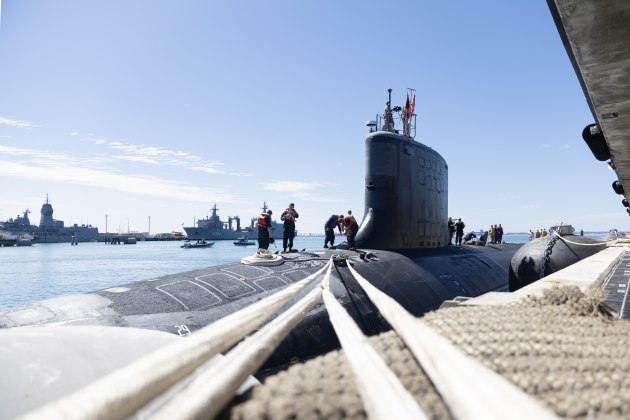
The head of Anduril Australia says the US administration’s decision to stand up a new shipyard to build components for Virginia-class nuclear powered submarines significantly derisks Australia’s planned acquisition of nuclear submarines from the US Navy, Australian Defence Magazine reports.
David Goodrich, Executive Chairman and Chief Executive Officer of Anduril Australia and Asia Pacific, told ADM this was a momentous development.
Currently US nuclear-powered submarines are assembled at two yards operated by General Dynamics Electric Boat and Huntington Ingalls Industries’ Newport News Shipbuilding but they’re turning out new boats substantially slower than what the US believes it needs to counter a rising China.
Under the proposal announced this week by US President Donald Trump, Anduril in the US will fund what’s called Arsenal-2, a new shipyard backed by a US$3.7 billion private capital investment from Anduril Industries.
That will be located in Baltimore, producing components, modules and super modules which would be transported by rail or barge and assembled into complete submarines at the other two yards.
A super module could be an entire section, such as the bow, including sensors and torpedo tubes.
Goodrich said some sceptics had pointed to the risk that the promised used US Navy SSNs would not be forthcoming for Australia.
“I think what has been announced by the president in the United States yesterday certainly significantly de-risks that for Australia and for the United States Navy,” he said.
“We’ve been working on it for almost two years now and we wanted to make sure that we applied all of the rigor before we committed 3.7 billion US dollars in acquiring the shipyard in Baltimore.
“We did the research. We put a big team on it. We studied the process. We walked the lines. We studied the supply chains and we actually felt that there were opportunities for us to work within that rigid and robust and rigorous kind of process that has to be for a crewed submarine, but still bring efficiencies and modern production ideas to the table.”
“We have got some detailed design done already. Assuming things go to plan, we expect to start operations in Baltimore in 2030, which is extraordinarily quick compared to other infrastructure builds for something of this scale.
“The scale of it’s breathtaking. It’s about 200,000 square meters of production space.
“It’s also being supplemented by another 16,000 square meter facility in Orange County, near to our headquarters facility.”
Under the AUKUS pathway, Australia is set to acquire two used Virginia-class SSNs which are now in service with the US Navy.
That’s early next decade and subject to US approval at the time. The issue for Australia is whether the US Navy could actually spare those boats as US submarine yards haven’t been producing new hulls fast enough to meet projected requirements.
Goodrich said the production rate currently sits around 1.33 boats a year when it needs to increase to 2.3 boats a year which is necessary for AUKUS to be activated.
There could be work in this for Australian companies, delivering useful experience for when Australia launches production of the SSN Aukus subs in Adelaide.
“We’re talking with the government about how we can translate some of these capabilities to Australia for the Australian builds,” he said.