Indonesia Navy takes the up-ramp

0
1304

By Tom Lewis*

Indonesia has upped the ante with the arrival of a new modern warship and the signing of a purchase order for an aircraft Italian helicopter carrier. Together they signal a big step-up for the green water navy of this immense archipelagic nation.

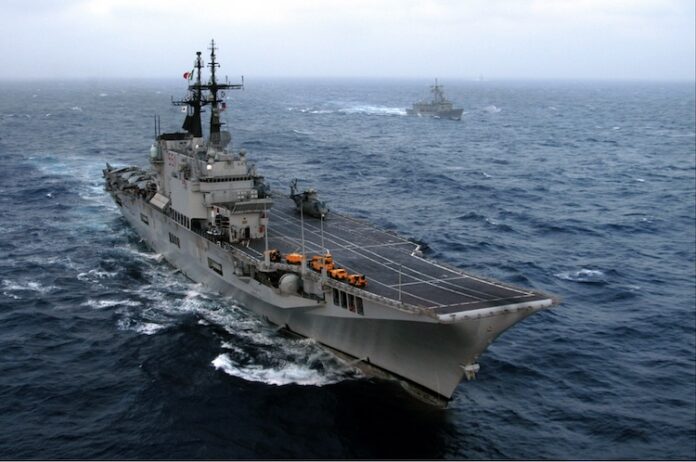
Taking the most significant announcement first, the aircraft carrier in question, Giuseppe Garibaldi, served in the Italian Navy from 1985 until retirement in October 2024. Indonesia has approved foreign loan acquisition of a $US450M loan to buy the ship and fund new helicopters for onboard use.

Garibaldi used to operate Harrier IIs, but there is no suggestion of fixed-air, although some ASW helicopters can be expected. Some sources have hinted that unmanned aerial vehicles would be the main flying platform on board. At Indodefence 2025, a local firm exhibited the Turkish Bayraktar TB3 UAV, which Indonesia has expressed interest in buying. It’s further thought the Indonesia’s defence industry has signed agreements with Baykar and Republikorp for the local production of 60 TB3 drones and nine Akinci UAVs. The TB3 is capable of using ski-jump takeoff which is what Garibaldi is fitted with.

Furthering the Italian connection, the frigate KRI Brawijaya recently arrived in Indonesia. Originally constructed as Marcantonio Colonna for the Italian Navy, the ship has been undergoing trials and a sea passage. She reached SE Asian waters in September 2025.

Although this ship and sister vessel KRI Prabu Siliwangi are not fitted with missiles, they can be added easily enough, as the ships are fitted “for but not with.” At a full displacement of 6,170 long tons and a length of 143 metres, these vessels are another step up – alongside the carrier – to a frigate force as opposed to one of numerous small fast missile attack boats. They will be added to another ambitious program, that of five Arrowhead 140 frigates being built through Babcock International. With keel laying for the first two ships completed in Surabaya, Indonesia, in recent years, none appear to be in the water yet. Along with two Turking İstif class frigate, being built by TAIS Shipyards, these ships all together would certainly raise the capabilities of the Indonesian National Military-Naval Force, to give the navy its full name, or TNI-AL, as it is usually known.

Is the navy up to the challenge? The missile frigates are one thing, but purchasing an aircraft carrier 40 years old is a big ask for any naval force. Garibaldi will need a skilled complement of 550 personnel to operate the ship, and another 280 for its air operations. Finding 830 naval members who can operate the vessel effectively will be difficult.

It is not known how much of the carrier’s self-defence systems came with it. That included two eight-cell SAM launchers firing Aspide missiles, and three Oto Melara Close-In Weapons Systems. There were also countermeasures, including two twenty-barrel launchers for chaff, decoy, flares, or jammers, including the SLQ-25 Nixie and SLAT anti-torpedo systems and ECM systems.

The biggest challenge will be however operating a vessel such as the Garibaldi to its full potential. The largest ships TNI-AL now operate are the Makassar-class landing platform (dock) at 11,583 tons (full load). The Giuseppe Garibaldi is two thousand tons bigger at 13,630 tons. However, the flying operations will likely be the biggest challenge for TNI-AL, although that will only be if they want to work the ship up to whatever its full final capability may be.

Will this lead to a regional carrier arms-race? Malaysia, Indonesia’s immediate neighbour and sometimes-rival, does not operate such a prestigious vessel, and will likely view the acquisition with a degree of jealousy. The only other SE Asian carrier is Thailand’s Chakri Naruebet, the world’s smallest aircraft carrier, which was acquired brand-new in 1997, ironically also from Spain. Although a small show of operating VTOL aircraft was made some years ago, the Thai fleet leader has spent almost all of its career tied up in port. It’s doubtful the Garibaldi’s arrival will stir it.

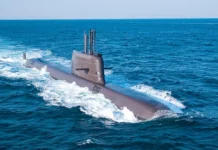
This all is the most exciting time for the Indonesian Navy in decades. In early 2024 TNI-AL announced its intended acquisition of two improved Scorpène-class submarine, which will be built by in Indonesia with France’s Naval Group. They will join two coastal ex-Korean submarines and the rather lonely KRI Cakra, a 1981 variant of a type 209 diesel-electric attack submarine. Her sister vessel Kri Nanggala sank following an implosion north of Bali in April 2021 with the loss of all 53 on board.

Improved frigates; modern submarines, and now a helicopter carrier. We can only all wish the Indonesian Navy well in its new challenges.

*Dr Tom Lewis OAM is the naval correspondent for UK’s Warship World Australia-SE Asia region. His new book Australia’s Coastal War, encompassing the enemy surface, submarine, and air attacks of WWII, has just been released by Big Sky.

LEAVE A REPLY

Please enter your comment!
Please enter your name here