Since its inception the ANI has allowed contributors to its journal to write under a pseudonym if they chose. Sometimes it was because the author did not want his or her junior rank to have their ideas dismissed. In some other cases it was because of the seniority and position of the author. In all cases the identity was kept confidential and the article stood on its merits. In Headmark 128 published in June 2008 ‘Girgis’ discussed a particularly Australian view of the sea – is it a highway or a barrier, or both.
The Sea is a Highway, not a Barrier
The US Navy, Marine Corps and Coast Guard recently released A Cooperative Strategy for 21st Century Seapower, which states:
The oceans connect the nations of the world, even those countries that are landlocked. Because the maritime domain – the world’s oceans, seas, bays, estuaries, islands, coastal areas, littorals, and the airspace above them – supports 90% of the world’s trade, it carries the lifeblood of a global system that links every country on earth. Covering three quarters of the planet, the oceans make neighbours of people around the world. They enable us to help friends in need and to confront and defeat aggression far from our shores.
Australia, like the US, is a maritime nation that should consider the sea as a highway of opportunity, rather than as an artificial barrier. The sea acts neither as a fence along the Australian shoreline; nor as a defensive moat, and our adjacent seas do not constitute an air-sea gap in any real military, economic or strategic sense. The theoretical construct that Australia should be defended by an air-sea gap to our north was developed during the 1970s and 1980s by academics often labelled as the ‘Defence of Australia’ school. Although the Australian defence debate has moved on since those times, many commentators have remained in the ‘gap’ mindset.
Defence 2000: Our Future Defence Force essentially limited Australia’s defence policy to sea denial:
The key to defending Australia is to control the air and sea approaches to our continent, so as to deny them to hostile ships and aircraft, and provide maximum freedom of action for our forces.
But the authors of the Defence 2000 appear to have misunderstood the nature of modern maritime strategy. In practice the RAN has, and continues to plan for
and conduct operations involving a full range of maritime tasks. These include many diplomatic and constabulary activities in addition to military ones. The military role is also not limited to sea denial but includes sea control, and power projection. Such operations do reflect Defence 2000’s lesser requirements ‘to maintain the ability to support Australian forces deployed offshore’ and ‘to contribute to maritime security in our wider region’. However such statements tend to minimise the RAN, and often the wider Australian Defence Force’s, involvement in global operations. It has been suggested that Australian contributions are small, primarily symbolic and limited to niche capabilities. However such assessments tend to underplay the extent of our global commitments. With maritime forces, the Australian Government has the ability to deploy adequate forces rapidly where required, to act as a deterrent where possible, but to be on hand with the option to ramp-up if the situation escalates. Maritime forces may be deployed in Australian waters, in our region or across the globe. They are inherently flexible and mobile, while ships are unique in their ability to move highly capable military force over great distances. Australia’s National Security: A Defence Update 2007 has partially recognised these aspects of the practical application of Australia’s maritime strategy.
The RAN operates in places that most Australian’s would rarely if ever visit. If we live near the coast we may visit the beach or marvel at the sea views, or when travelling overseas we fly over great expanses of ocean, but we rarely, if ever, reflect on the importance of the sea to our security and way of life. The reality, which has not changed since the first British fleet arrived in 1788, is that most goods move by sea and most people in the world live within easy reach of the sea. Australia is one of a number of maritime nations that are fundamentally reliant upon the sea.
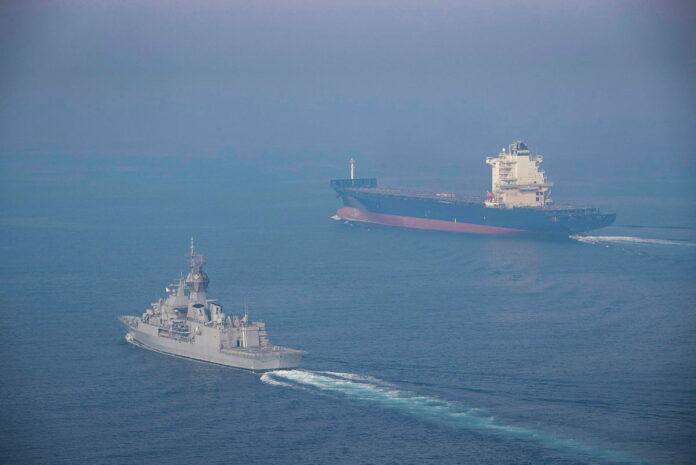
The sea remains the primary and the most cost-effective means for the movement of international trade. In Australia’s case, about 75% by value of our total exports and imports go by sea. In terms of weight, nearly 100% is transported by sea. For 2005-06 some A$249 billion worth of international sea freight travelled in and out of Australia. While Australia is largely self sufficient for most resources, it is dependent upon petroleum imports to meet domestic demand, particularly in heavy crude oil. Australian bulk exports, including iron ore, coal, meat and cereals, provide the critical export earnings necessary to maintain a stable economy and to promote industries and employment in many parts of the country. The nation’s economic wellbeing depends upon the maintenance of our international trade and the security of our sea lines of communications along which that trade flows. Coastal shipping not only plays a substantial role in Australia’s domestic transport network, but its free movement is essential to the survival of many cities and towns in the north and west.
Our major trading partners are also acutely dependent upon maritime trade. Japan is totally dependent on seaborne imports for energy and raw materials, as is South Korea. China is also a major user of the sea. It is reliant upon energy imports from many nations, including Australia, but its critical petroleum imports from the Middle East rely upon secure sea communications through the Strait of Hormuz and the Malacca Strait, which are some of the world’s most intensively used chokepoints. Chinese exports reach worldwide markets via the sea. Provided the seas are secure, sea transport is relatively inexpensive and international trading partners are effectively brought closer together. It now costs more to transport a car from Adelaide to Sydney than it does to ship it from Korea to Sydney. Many of the items that fill our shopping centres are transported by sea from nations on the other side of the world. It is hard to conceive of an Australia cut-off from its international imports for very long, as it is also in the interests of the exporter that the goods get through. So threats to one nation’s trade are a threat to all trading nations many of whom would respond in a cooperative manner. The sea unites the world rather than divides it.
We need to remind ourselves that Australia is a maritime nation. In the early years of the Australian Commonwealth, our forebears recognised that Australia could not be defended along its coastline as the sea offered too many opportunities for an attacker. The only viable option was to build a seagoing fleet, the embryonic RAN that would be capable of threatening potential attackers closer to their bases so that they would be deterred or forced onto the defensive.
The early months of World War I saw an Australian fleet participate in a campaign that cleared the German fleet from the Pacific. When HMAS Sydney sank the German raider Emden, she removed the threat to Australia’s Indian Ocean sea lanes. Although the Australian mainland was safe from German raids and our neighbouring sea communications were secure, Australian interests did not end there. Australia’s economic well being was inseparable from the British imperial trade system, a global trade system not unlike the globalisation which exists today. The collapse of imperial trade would have isolated Australia, led to the collapse of industry and threatened our way of life. Such conditions would have quickly destabilised the Australian Government and brought about political unrest. In addition, our intellectual and spiritual links with Great Britain and the other members of the British Empire were fundamental to many of the structures of Australian society and culture at the time. Australian democratic culture could not have survived in a world dominated by Germany. Clearly, to protect Australian interests and values, it was necessary for Australians to fight globally in defence of the British Empire, imperial trade and sea communications. And indeed this is what Australia did.
If you lived in a port 100 years ago, the importance of sea communications would have been obvious. Many Australians doubtless at one time or another witnessed the flotillas of merchant shipping tied up in harbour or alongside wharves near the centre of major towns and cities. As new container facilities have moved to designated seaports this is no longer the case. It is even less obvious, if you live inland, although many Australian primary producers know all too well how fluctuations in international prices can affect their export potential and in turn their livelihood. If we return to the isolationist policies of the past, we could reduce Defence expenditure in the short term but we would suffer the consequences arising from an insecure and unsafe world, which may be much more costly in the long run. We have not learnt from our grandparents who experienced the failure of similar isolationist defence policies of the 1930s.
But what of those who think Australia should only be concerned about the security of our continent? As the sea is a highway not a barrier, we can understand that places like Saudi Arabia, and Iraq are much closer to Australia than some might think. Conversely, maritime forces have great reach upon the world’s seas, and are much closer to enemy bases than its adherents may suppose. Current operations in Afghanistan confirm this. It stands to reason that if we can use the sea, so can others.
The RAN is on-duty everyday in seas both around Australia and across the globe, and is already effectively contributing to a global maritime security partnership. Since Federation, Australian participation in the global maritime environment has always depended more upon interoperability with our coalition partner’s naval, army and air force units, than it has upon Australian joint forces. Perhaps our way of life will never willingly accept the level of resource commitment that is required for strategically significant and independent joint forces.
We cannot rely upon a policy limited to sea denial in Australia’s approaches. In cooperation with other maritime nations, we must be capable of controlling the seas when and where required. Only in this manner can we protect the sea communications. We must also have the ability to project power globally, as part of a global partnership, to assist those who need help, to deter those who may be tempted to abuse their power, and to punish those who aim to bring down the international system. The new Defence White Paper needs to recognise that Australia’s maritime strategy properly includes sea control and power projection.
The key to defending Australia is to employ a maritime strategy to control access to the sea and to influence events ashore, as necessary, in Australian waters, throughout the region and across the globe.