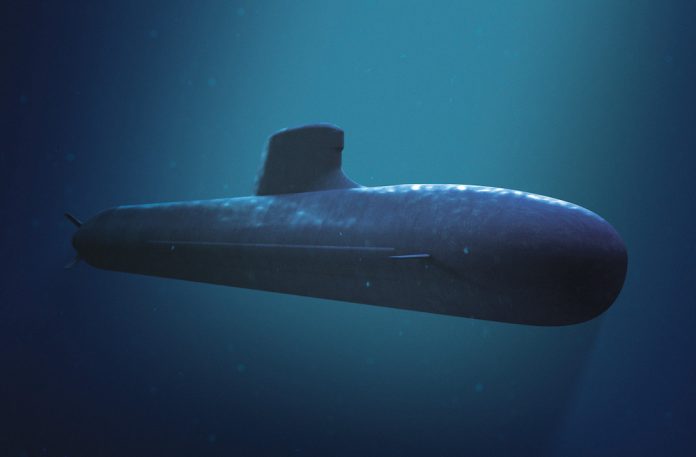
Continuing the submarine theme from the last week’s ‘From the ANI Archives’, Headmark 135, published in March 2010, an article by ‘Girgis’ advocating that the RAN should acquire nuclear power submarines. There is much in Girgis’s article that is still relevant to today’s discussion, although ‘Girgis’ may be somewhat surprised at the costs for AUKUS Pillar 1.
Australia’s Need for Nuclear Powered Submarines
The May 2009 Defence White Paper announced that 12 future submarines would be acquired for the ADF, in what is set to be the largest single defence project ever undertaken by Australia. The Australian Government has placed great emphasis on our future submarine force and, although such emphasis is not out of place, the level of prescriptive detail on these submarines that is contained within the Defence White Paper contrasts markedly with the largely intangible and at times ethereal requirements for other capabilities.
It can be argued that this detailed public statement was done for political reasons which have more to do with the inputs of a few defence analysts and industry representatives, who have disproportional influence in the Prime Minister’s office, than with the actual capability needs. Indeed, there seems to be a long-held misconception, held by politicians forming the current Government and a group of their senior advisors, that the RAN has a historical dislike for its submariners and hence inherently fails to recognise the strategic value of submarines. It follows that the assumed RAN bias can only be overcome by Government direction at the most senior levels. The whole process appears to have the cart before the horse, with Government setting the detailed requirements and effectively pre-empting ‘First Pass’ approval before the needs and requirement’s phases has been completed within the Department of Defence.
The strategic environment
Concurrently professional serving officers and civilian staff, employed by the Department of Defence, continue to assess our strategic needs and force structure requirements. That Australia needs to have strong underwater warfare capabilities, today and in the future, is beyond question. Submarine numbers in the Asia-Pacific region are increasing along with their technical sophistication.
The modernisation of the world’s nuclear powered attack submarines (SSN) is of even more concern to Australia’s defence planners. Today six nations deploy SSNs: the US, Russia, France, the UK, China and India, in addition, several other nations, including Pakistan and Brazil, have declared an interest in acquiring them. Nations which exclusively operate SSNs – the US, the UK and France – continue to demonstrate their advantages over conventional submarines – which are more correctly described as submersibles. This sends a potent message to other nations that nuclear power is better, and that nations that acquire SSNs are members of a ‘special club’.
During the 1950s the US led the world on SSN development (USS Thresher), and they subsequently helped the UK develop their first SSN (HMS Dreadnought). Most people would agree that the US’s new Virginia class SSNs coming off the production line are the most advanced large-size submarines in the world. The UK has since produced their own SSNs, with the latest Astute class SSN starting seas trials in November 2009.
France, learning from the US and UK experiences and after delays due to priority being given to their ballistic missile submarines, eventually developed their own unique nuclear power plants for their SSNs. The future French SSN, the Barracuda is now under development and the first submarine should enter service around 2017.
Not to be left behind in the Cold War arms race, the Soviet Union also opted for indigenous nuclear power plant development for its first SSN in 1959, NATO designation November class. Russian-designed SSNs kept pace with their US counterparts until the fall of the Soviet Union, but since that time the Russians have not had the economic strength to maintain their technological edge. However, the Russians still have a submarine force to be reckoned with, the Akula II (Project 971) and Graney class (Project 885) SSNs are some of the best in the world, but Russian economic limitations have led to the drying-up of SSN research funding and the cancellation or delay of SSN production. Despite such set backs, the Russians have provided valuable technical assistance to the Chinese and Indians navies which has helped those nations to develop their own indigenous nuclear power plants for their SSNs.
In the Asia-Pacific region the introduction of new advanced SSNs by China and India is changing the way we must plan for Australia’s future defence. No longer can we rely upon US military primacy in the Pacific Ocean to guarantee sea control when we operate in the Indian and Pacific Oceans, as it has since the beginning of the Cold War when the US Navy effectively bottled-up the Russian Pacific Fleet in North Asian waters. The US Navy now has more than enough to do to protect its own national interests in the Asia-Pacific and hence the possibility of Russian, Chinese or Indian SSN deployments in Australia’s area of interest has increased from a rare and unlikely occurrence to a likely prospect.
As indigenous Indian and Chinese SSN production increases all ADF operations at a distance from Australia will have to take the possibility of other nation’s SSNs into account. The Chinese have taken several decades to absorb and improve upon SSN technologies, but they have now turned the corner and are able to produce nuclear powered attack submarines that are at least comparable with those of other powers.
The latest Chinese SSN, the Type 093 Shang class, was officially revealed early in 2009. The Chinese People’s Liberation Army-Navy (PLA-N), with a fleet of such submarines would have the potential to deploy a SSN from bases around the South China Sea into the South-West Pacific and Indian Oceans for extended periods, and not necessarily for purely warfighting purposes – such a presence would be a valuable political tool that, if declared, could put extreme diplomatic pressure upon Australian political leaders and the leadership of less stable nations in our region.
In the meantime, India’s long pursuit of nuclear powered attack submarine technology is finally coming to fruition. The Indian Navy is now leasing the Russian Akula II class submarine, to be commissioned as INS Chakra, for a period of ten years. Such agreements are possible because nuclear submarine sales are permitted under the 1968 Non-Proliferation Treaty, which treats nuclear propulsion as an acceptable nuclear activity. The development of an Indian indigenous nuclear powered attack submarine is now also moving rapidly ahead following the launch of the Advanced Technology Vessel (ATV), INS Arihant.
Australian submarine requirements
According to the Defence White Paper 2009, the ‘future submarines will have greater range, longer endurance on patrol, and expanded capabilities compared with the current Collins class submarines’. In addition, a doubling of the existing submarine fleet from six to 12 is required ‘in order to sustain a force at sea large enough in a crisis or conflict to be able to defend our approaches (including at a considerable distance from Australia, if necessary), protect and support other ADF assets, and undertake certain strategic missions where the stealth and other operating characteristics of highly-capable advanced submarines would be crucial’.
For most international defence analysts, an unbiased assessment of the Australian submarine operational requirements, reflecting Australia’s strategic geography and the great distances involved, would suggest that the future submarine should ideally be a nuclear powered attack submarine, i.e. a SSN. The need for SSNs is even clearer if we consider the need for Australian submarines to have long endurance, great stealth and large payloads capable of projecting power and defending ADF assets at a considerable distance from Australia – in environments where enemy SSNs will be operating. It is thus somewhat surprising that the Defence White Paper 2009 states that the ‘Government has ruled out nuclear propulsion for these submarines’. Unfortunately there has been very little public debate on this issue, and the statement seems to be more a declaration of belief by Government, than a rational well thought out policy.
The advantages of nuclear powered submarines are clear – they are even taught to recruits in the US Navy. Nuclear boats are truly independent of the surface. They generate their own fresh water and oxygen and never need to surface to run diesels to recharge their batteries. SSNs have an indiscretion rate of zero, meaning they can stay submerged in an area of operations, essentially remaining invisible to an enemy, for periods measured in months rather than hours. The nuclear reactor is capable of generating great amounts of power compared with a conventional diesel-electric power plant, and hence SSNs can operate at high speeds for long periods of time – they can transit across the Pacific and Indian Oceans faster than any conventionally powered ship or submarine. This means SSNs can operate with, or in advance of, maritime task forces which include aircraft carriers, amphibious ships and other surface vessels. Modern nuclear power plants have the ability to provide much more energy than can be used by any combination submarine domestic services (hotel load), combat systems, and propulsion systems; in addition they do not need to refuel for at least 20 years.
A SSN, in addition to its inherent stealth characteristics, has the added advantage of high speed and unlimited endurance. It is a hunter-killer of conventional submarines. A conventional submarine, even with the most advanced AIP system, does not have adequate speed and endurance to move from home port to distant operational areas quickly, and remains especially vulnerable during any long transit. The development of conventional submarines has reached a technological dead end.
The decreasing number of nations that continue to design and build large conventional submarines has been noted by the Submarine Institute of Australia (SIA), and Australia is now one of the few nations that are still seriously considering building large conventional submarines. But the facts should speak for themselves, large conventional submarines have been superseded by their nuclear powered colleagues, and in matters of defence being second best is just not good enough.
What must Australia’s future submarines do?
Even though large conventional submarines can undertake some sea control and power projection tasks, only modern nuclear powered submarines are capable of conducting maritime operations in advance of a joint expeditionary force. With a speed of around 30 knots SSNs are able to deploy at short notice well in advance of a joint expeditionary force travelling at around 20 knots. The SSN can transit underwater over great distances, without being detected, and can then conduct a range of tasks in the operational area as part of an advance force. Their primary role is to detect, deter and where necessary destroy enemy submarines in the planned area of operations.
The modern SSN is a manoeuvrable, stealthy and quiet adversary that can hunt down and kill enemy conventional submarines, however, in most circumstances the enemy knowing that a SSN is in the area will avoid contact and likely destruction. Thus a SSN acts as a submarine deterrent that can help to attain underwater sea control in the area of operation for the duration of that operation. While the most important role of the submarine is to seek out and destroy other submarines, they also have a well proven capability to detect and attack enemy surface forces. But a submarine cannot achieve a strategic effect by itself; other elements of the ADF must be present to achieve sea control over the rest of the battlespace: in the air, on the water, on the land, in space and within the electro-magnetic spectrum.
In addition to helping to ensure sea control, submarines need to prepare the battlespace for the arrival of the joint expeditionary force. Submarines, while continuing to seek out and destroy other submarines and to detect and attack surface forces, contribute to amphibious operations by undertaking intelligence, surveillance, and reconnaissance (ISR) tasks and land strike tasks. This typically would involve landing and retrieving Special Forces and other advance parties; deploying sea mines and unmanned underwater vehicles (UUVs); and even land strike.
The ability to approach close to oppositions forces and monitor their operations and movements whilst remaining undetected is a classic capability of the submarine. Using modern video technology or digital photography a submarine, able to approach a coastline in shallow water, can make a significant contribution to the intelligence collection effort prior to any subsequent land or maritime action. Land attack cruise missiles, such as the Tomahawk, provide submarines with a land strike capability. Such a weapon allows the submarine to influence the land battle by posing a threat in the period prior to hostilities and, after hostilities commence, the use of highly accurate and lethal warhead against important targets which may otherwise be relatively invulnerable.
If an enemy were to deploy one or two of their SSNs into our area of operations, our mission would be severely imperilled and the lives of many Australians endangered, unless we also had SSNs to counter them. To illustrate this point, you must have a Formula One racing car to compete in a Grand Prix race: a V8 Supercar just would not make the grade. We must have a 5th Generation aircraft to fight for air control over other 5th Generation aircraft: a 4th Generation aircraft just will not do. Similarly only modern SSNs can hope to fight for sea control in the underwater domain against enemy SSNs: conventional submarines, whether large or small, are not capable of fighting and winning at sea against a technologically superior opponent. SSNs have superior speed, range, endurance, and sustainability.
Unfortunately this truism, although well understood by maritime nations across the globe, is not well understood in Australia. The ADF’s ability to attain sea control at a distance from Australia, when there is an enemy submarine threat, is predicated on the availability of SSNs. In the absence of Australian SSNs, the ADF would have to either rely upon the cooperation of SSNs belonging to an allied nation to help attain sea control, or lose the option of deploying to that area.
Modern maritime operations are predicated on the ability of a number of elements within a nation’s armed forces working in a joint environment to achieve the military effects desired. The ADF, alone or in coalition, must work as a layered system of systems, or alternatively as a series of nodes within an integrated network. If an Australian submarine was to act in isolation within an area of operation it may itself be subjected to the anti-submarine warfare efforts of the enemy. In such circumstances the Australian submarine could be deterred from performing its tasks or even destroyed.
Sea control over the complete battlespace is essential for maritime power projection and sea control must be achieved before the ADF can influence events ashore.
An Australian nuclear industry
If the RAN requires SSNs because large conventional submarines are second rate when compared to SSNs, why don’t we want to purchase them? The SIA claim that the introduction of SSNs into the ADF order of battle was ‘not a practical proposition’ has now become somewhat of a clarion call for those who reject SSNs. These claims do not hold-up under close examination.
The proposed timescales for a future submarine project are predicated on an Australian design of a large conventional submarine based upon the Collins class that does not apply to a cooperative Australian build within an existing SSN construction program. For example, if Australia wanted two new Astute class SSNs we could readily achieve our desired timescales. We could even start training Australian submariners, alongside our RN colleagues in the UK, next year. The point is that once the decision is made and the funding allocated, the long term investment into Australia’s nuclear energy future would commence. Given the current status of the Australian submarine force and the current low threat environment, we could even make significant savings by reducing the number of Collins submarines in operational readiness and reallocate such monies to the nuclear submarine program.
The SIA statement that ‘Australia lacks the critical regulatory regimes, industry capacity, nuclear technology infrastructure and educational institutions to prepare and sustain appropriately qualified personnel’ is correct, but it does not follow that a decision to employ SSNs can only follow Australia’s decision to adopt nuclear power for electricity generation. Rather the requirement for Australian SSNs will help generate the necessary nuclear infrastructure. More importantly we cannot dismiss the nuclear option because of an assumption that we don’t have a fully fledged nuclear industry. Australia needs to develop its nuclear industry and help it to grow over time: in such an approach all we really need is a conception.
Practically, Australia will not be able to design and build a nuclear submarine for many years, but we can purchase an Astute SSN. We will need to operate and maintain the submarine, and to do so will require some training in nuclear reactors. Actually most of the maintenance activities on a modern nuclear submarine relate to nonnuclear systems and machinery. There is no difference between changing a valve on a cooling water system on a conventional or nuclear submarine: each situation is critical to safety. As modern SSNs like the Astute class do not need to be refuelled at all, and as SSNs are globally deployed and can transit long distances in a matter of days, it may even be possible to conduct most depot-level maintenance on the nuclear reactor in the country of origin.
The SIA is right in highlighting the significant political and public concerns that would need to be overcome before implementing such a project. This, in truth, is the only reason for why Australia does not have SSNs. Despite the SIA’s support for nuclear submarines and a nuclear industry in 2005, which made many statements that are echoed in this article, the push for technologically superior submarines has faded into a fall-back decision to accept second best as good enough. Why? An Australian Financial Review article suggests that political interference was the cause of the SIA about face. The submariners were warned by Lieutenant-General David Hurley, at that time Chief of the Defence Capability Development Group, that ‘pushing nuclear power could risk any replacement for Australia’s conventional powered Collins-class submarines.’ So the real debate on Australia’s future submarine requirement was stifled within Defence for reasons other than capability requirements or technology limitations.
It is apparent that many of the current Australian leaders see that developing a nuclear power industry is politically untenable. This may be nothing more than an intergenerational problem, as the children of the 1950’s and 60’s have tended to reject nuclear issues ‘on principle’ without worrying too much about the contradiction that results from Australia selling uranium to other nations or from Australians relying upon the US nuclear umbrella to help deter other nuclear powers from harming us.
Importantly younger Australians and future leaders may not be able to reject the nuclear power option ‘on principle’ if their very way of life is threatened by economic and social collapse and climate change. Of course Australia cannot ask its navy to operate SSNs if their use is objectionable to most of our citizens, but surely the Department of Defence and in particular the RAN are the most important organisations capable of informing the Australian public on such a critical issue. But alas the silence is deafening and the debate is lost because of Defence’s reluctance to state the real issues in public. Nuclear propulsion plants are not nuclear weapons – they are a relatively cheap, safe and environmentally friendly means of generating power. In future Australians will need to decide whether it is better to develop a safe nuclear industry or to reduce their dependence upon generated power to pre-industrial revolution levels. It is not conceivable that any modern society could actually return to such an agricultural utopia without suffering a massive social upheaval and a significant reduction in population. Australian society cannot reduce the effects of climate change while relying upon a dwindling supply of fossil fuels to supply our energy needs, and our future energy needs can only be met by a nuclear power industry. A future Australia must depend upon nuclear power generation combined with other environmentally friendly carbon-free forms of power generation.
If we consider the six nations that operate and maintain nuclear submarines, China, France, India, Russia, the UK, and the US, for each the defence requirement for nuclear energy has helped develop the infrastructure for a national nuclear industry. Without the defence assistance it is unlikely that the infrastructure for an Australian nuclear industry would be economically feasible in the short term. It needs to be given a kick start in order to develop: without such a kick-start we may never be able to develop a nuclear industry capable of meeting Australia’s long-term energy needs. If the RAN operated SSNs it would help build the infrastructure for an Australian nuclear industry.
Is it possible to introduce SSNs into the RAN before 2022? Yes, if we start soon. It took almost twenty years to build up the Australian submarine force with the introduction of the Oberon class submarines and it would take about the same time to introduce SSNs. Let us say we wanted to purchase two SSNs for the RAN under the existing British Astute build program. As with the Oberons, Australian submariners could become familiar with Astutes through training and operational exchange programs. The design and build of the Astutes has already been done in the UK. The RN plans to use the Astute class SSNs for global operations and missions that are similar to the Australian one, and we could operate the Australian Astutes using the RN’s logistic support arrangements.
Many of the current Australian submarine facilities could be used or modified to help support the SSNs in country. Such close liaison with an allied nation is common for other high value defence assets owned and operated by the ADF, such as the Joint Strike Fighter. Australia’s future submarines need to be SSNs Estimates vary on how much it will cost to replace the existing six Collins class submarines with 12 ASC designed modern large conventional submarines but, by my calculations, they would cost about A$25 billion (2009 prices) to acquire and A$80 billion (2009 prices) to operate and support over 20 years. Such figures demonstrate that large conventional submarines that are designed for long-range operations are expensive beasts. This magnitude of capital outlay obviously requires careful consideration if we were purchasing a world class submarine force, but it would be a dangerous waste of taxpayer’s monies if we purchase submarines that would effectively be obsolete death-traps by 2020.
What are the alternatives if we do not purchase large conventional submarines to replace the Collins class? The requirement for sea control and power projection involves submarines operating in advance of, and in support of, an ADF joint expeditionary force. Such submarines need great endurance and reach; they need to move at 30 knots or more for days as they transit from one ocean to another underwater. They need to be stealthy, with a zero indiscretion rate, as they must be able to fight and destroy enemy nuclear submarines on at least equal terms. Only nuclear submarines, SSNs, can meet this requirement.
In the Australian context, a nuclear submarine is required to work with an ADF joint expeditionary force, as part of the ADF anti-submarine network, whenever such a force is deployed in a medium to high intensity environment. Two SSNs will be required to guarantee the availability of at least one SSN during any joint expeditionary force deployment. Although the second SSN may require mandatory maintenance, recent naval experience in high intensity operations confirms that it is often possible to deploy all SSNs rapidly in crisis situations, through the use of flexible support arrangements. In most crisis situations, the future Australian submarine force would be capable of deploying both of its SSNs in support of a high-intensity ADF operation. But what will this cost us? In the past, nuclear powered submarines have been written-off from the choice of capabilities because of their inherent cost. Unfortunately such estimates have been biased and have represented the political will – not to have nuclear submarines – rather than accept the reality that a purpose built Australian class of 12 large conventional submarines would be much more expensive than procuring between two and four SSNs as part of an ally’s existing submarine program.
Assuming we decide to purchase two SSNs from one of our allies, say from the British, and then we decide to use their depot level maintenance facilities for the pressurised nuclear reactor, the nuclear option is affordable. My estimate is that two SSNs will cost around A$6 billion (2009) to acquire and a further A$14 billion (2009) to support over 20 years. The through life support costs would also be significantly less. Such figures, even if the exact costs may be argued and refined, reveal that Australia really can afford what it needs as far as a future submarine force is concerned.
Even though we know that the major powers in the Asia-Pacific region are already using or building nuclear powered submarines, are we really prepared to avoid any likely confrontation because we don’t like nuclear power? Australia and Canada together have the largest amount of unprocessed uranium supplies in the world. Can we expect other resource starved nations to sit back and watch us rest upon this resource mountain without a stick to ward off those who desperately need to access our uranium reserves?