One of the few operations undertaken by Australia’s pre-Federation navies was by some of them being involved in dealing with the Boxer Rebellion. In this article from the Autumn 2003 edition of the Journal of the Australian Naval Institute, Commander Neil Westphalen describes the medical aspects of the Australian involvement.
Australian Naval Medicine and the Boxer Uprising
1900-01
The Boxer Uprising began for the foreign legations (embassies) at Peking on 20 June 1900, when they came under siege by a secret society with the covert support of the Chinese government. Allied reinforcements at Tsientin were also trapped until they were relieved by 20,000 men on 13 July, and, when it became known that the legations were still (just) holding out, they were relieved on 14 August. The siege received the Hollywood treatment in the film 57 Days at Peking.
The Australian colonial response to a British request for assistance led to the departure of HM Ships Mohawk, Lizard and Wallaroo from Sydney for China on 2 July. Midshipman A.L. Fletcher left his impressions of the RN medical branch at the time,
The surgeons were about 75% ex-Trinity College, Dublin, 20% Scottish universities and the odd 5% English. Perfect dears but very thirsty when young. Their medicine may have been crude but they know a lot about malaria and VD. My chief memories of the sick bay were No.9 pills, almost atomic in action, for internal disorders, santonin for worms – very prevalent in the East – and vats of zinc ointment for everything else.
The British also accepted 200 Victorian and 250 NSW sailors for service ashore, plus the South Australian gunboat Protector. However, all three contingents were delayed by pay wrangles and this cost them any chance of seeing action. This article describes some of the medical aspects of these deployments.
Protector‘s Deployment
Five days after requesting clothing allowances for Protector‘s crew, her commanding officer Captain C.J. Clare added, “A doctor may also require an allowance for uniform when appointed. Will the Hon. the Chief Secretary please approve this slight alteration if required.”
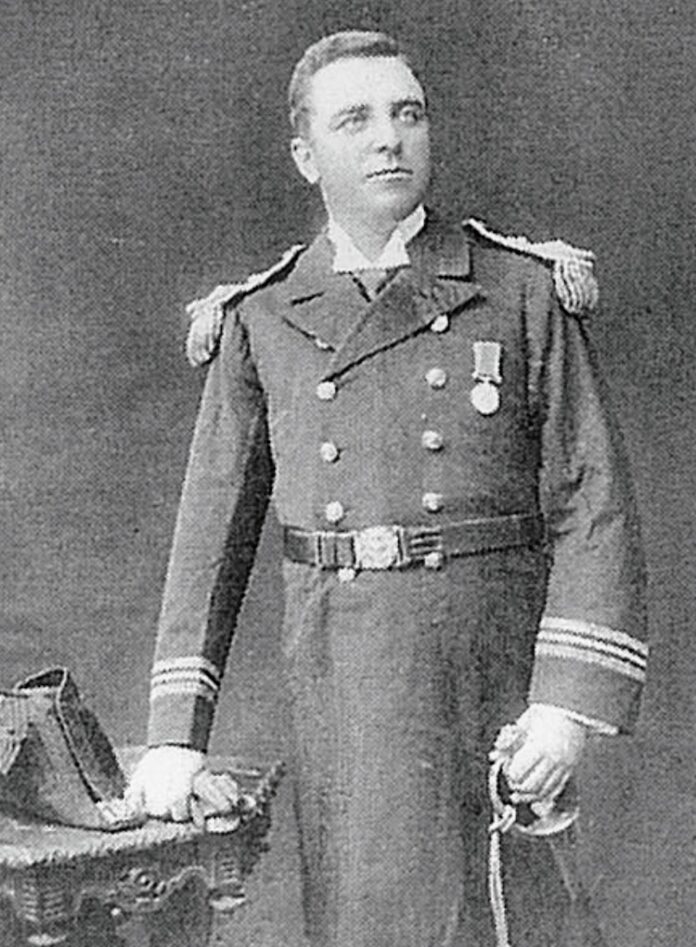
As a result, Dr Bedlington Howell Morris was the last member to be appointed to the ship. Born in Wales in 1868, he had graduated from Durham University in 1893 and migrated to Adelaide in 1896.
His daughter-in-law recalled him as a charming, upright, straightforward man, who loved burlesques. Founder of the RAN Captain William Creswell later wrote, “ …Surgeon Morris, in whom the success of the expedition owed much, quite the ideal man for the work under such temporary conditions, and earned the confidence and regard of all on board.”
Morris arrived in time to generate a bill for £7 13s 2d from F.H. Fauldings before Protector left Adelaide on 6 August. On arrival at Sydney on 10 August, Morris expended another £74 17s 1d on medical stores. Creswell joined four days later in Brisbane and Protector reached Hong Kong on 9 September, after a horrendous voyage at the height of the typhoon season. En route Creswell drilled his crew hard and ‘Our Correspondent’ for the Herald (not identified) wrote, “…the port watch were given an hour’s lecture on ‘First Aid’ by Doctor Morris, who is interesting, instructive and amusing at the same time. Imaginary limbs were bound up, arteries and veins stopped from bleeding, until some advanced pupils began to handle bandages and tourniquets as if they wished for a real subject on whom to show their efficiency.”
Protector arrived at Wei-hai-wei on 30 September, where Creswell was interviewed by Vice Admiral Seymour. In 1924 Creswell wrote: “Sir Edward Seymour plied me with questions, asked and noted many details and particulars of the ship.
‘And how many sick do you have?’
‘None sir, the fact is there’s nowhere to put them’. I told him of our gruelling trip to Hong Kong.
‘Well if you have no sick. I’m hanged if I see why anybody else should have any sick.’
I learned later that a battleship anxious for a run to Japan had submitted a big sick list in support of her request.”
In the event, apart from mine clearance duties. Protector spent most of her time in China carrying dispatches.
Captain .I.R. Jellicoe (later commander of the Grand Fleet at Jutland) complimented Protector that ‘she was never sick or sorry, and always ready for work.’
Protector was released on 2 November and after stopping in Sydney to celebrate the new Commonwealth of Australia, she returned home on 6 January 1901. The Adelaide Register recorded the following excerpt from an interview with Captain Clare on her return,
“Q: What has been the general impression concerning the men?
“Claire: Throughout I may say the opinion expressed has been complementary. It is interesting to know that ours was the most healthy ship on the station. While nearly every man-of-war had 15 to 20% sick, our sick-list was practically nil, with the exception of a few cases of influenza.”
In 1900 the Victorian Navy had five part-time surgeons, including Staff Surgeon Charles Alfred Stewart. Born in Hobart in 1855. Stewart had qualified in 1879 and became Principal Medical Officer (PMO) to the Victorian Navy in 1885. He was paid £383 5s per annum plus imperial pay rates and 4s. 4d. per day field allowance in China, compared to his usual rate of £41 13s.4d. per month. He conducted all the medicals for the Victorian contingent, aided by Sick Berth Steward (SBS) William Stanley Patchett. Born in 1S70, Patchett was a permanent member of the Victorian Navy and had only recently married.
Most NSW officers were commissioned reservists with little seagoing experience, while the Victorians had mainly ex-sailor Warrant Officers. In 1900 the NSW naval forces had seven part-time medical officers, led by Fleet Surgeon Thomas Knaggs, who had introduced St John first aid training to Australia in 1881. This pre-empted the first official Australian St John organisation (formed in 1883 in Melbourne).
Slow recruiting for China led to numbers being made up by 24 men who were originally going to South Africa. These men became the NSW Marine Light Infantry (NSWMLI). the only Australian Marine force in its history. The contingent also included an 18-man Ambulance
Party led by Staff Surgeon John James Steel, which had been raised at Newcastle in 1896. Born in Scotland in 1855, Steel was educated in Sydney, Edinburgh and Paris before qualifying in 1878. He rapidly acquired an extensive practice in Sydney and was appointed into the
NSW Naval Brigade in 1896. A widower with one daughter, he was proficient in languages and a student of Shakespeare. He received £500 per annum for his China service.
The medicals were performed, “… with wonderful celerity and tact by Staff Surgeon S.T. Knaggs, Staff Surgeon J.J. Steel and Surgeon G.L. O’Neill. The men were admitted to the offices by squads and then subjected to several tests. At the outset the volunteer had to pass the sight test – reading different sized capital letters backwards and vice versa with two eyes and then with a single orbit at a distance of seven or eight paces. He was then ordered to stripe to the waist, when he was well sounded and critically inspected and his height and weight were taken. As was anticipated the percentage of ‘rejects’ was exceedingly small – a sure proof of the stamina of the men comprising the naval forces.”
It seems the pass rate was improved by only examining the candidates from the waist up. There was however, “One poor fellow who was desperately anxious to get away, and who looked strong and fit for anything, burst out crying so great was his disappointment at being refused. He pleaded with the two doctors, but whilst they were sympathetic, they were implacable.”
The transport Salamis sailed on 8 August, after her civilian Chief Steward shot himself and a sailor fractured his ankle falling off a tram. Just prior to sailing lymph was obtained for smallpox vaccinations, a NSWMLI member was landed ill and it was found Steel’s name was omitted from the list of personnel receiving field allowance. One wonders how long it took Steel to receive his money.
The voyage north had the Ambulance Party performing vaccinations while exercising both bandaging and cutlasses (reflecting their somewhat ambivalent role prior to the 1907 Hague Convention).
Second-in-command of the NSW contingent. Commander Edward Connor, wrote of many men feeling side effects and also referred to ‘one poor chap with a nasty haemorrhage of the lungs.’ Despite the allegedly ‘rigorous’ examinations, four men from the NSW Contingent were invalided home from Hong Kong.
Salamis arrived at Taku on 9 September and on 15 September the Australians moved to Tsientin, where 300 men began a forced march to attack a fort. Lieutenant H.E. Lofts NSWMLI wrote, “The water was from a village moat and verv dirty. Fuel to boil it was from thatch, even so tea was good, although we had been forbidden from bringing mess tins we had to find tins thrown away bv some Russians to boil it in. None that I know of except the Doctor [probably Stewart] got dysentery.”
As men fell out with exhaustion and sunstroke. Steel was at their side, bringing in four stragglers overnight before collapsing himself. He was carried unconscious back to Tsientin and returned to camp three days later to an enthusiastic ovation. As the remaining Australians camped near a swamp, 25% soon developed dysentery, influenza, ‘fever’ and ‘ague’. Most were evacuated to the British hospital at Wei-hai-wei, but on 6 October Private T.J. Rogers NSWMLI died of influenza. He had almost been sent home from Hong Kong with rheumatic fever ‘but … was given the benefit of the doubt.’
Both contingents were assigned to attack Pao-ting Fu city (population 200,000), before taking up winter garrison duties at Peking. However, the NSW Contingent was ordered directly to Peking and they left Tsientin on 10 October. The move included 20 sick, while another nine MLI personnel were left behind due to illness. The latter arrived, “ …scarcely able to crawl. They were left behind without anyone to attend to them and without food, but we soon fixed them up as well as our resources permit for we were not very flush with rations.”
The Victorians departed for Pao-ting Fu two days later, leaving behind Boy Albert Gibbs who died of fever aboard the hospital ship Carthage on 19 October and was buried at sea. On arrival they were spared laying siege when the city surrendered. Disaster was narrowly averted on the way back when an ammunition junk exploded with over 90 casualties, although no Victorians were hurt. Back at Tsientin they moved into a godown (storehouse) until they left China five months later.
At Peking the NSW contingent split into three groups for police duties, although ‘mission creep’ soon had them setting up other municipal authorities. Able Seaman J. Hamilton died on 6 November of dysentery, followed four days later by Steel himself. He had been ill since his collapse and Connor wrote on 8 November that the PMO (Principal Medical Officer) came round and invalided Vine, Conwell and Oliver. He was hoping Steel would go too. Two days later he wrote, “Poor Steel died this morning! Awful day blowing a gale and oh! so dusty. Rode over to HQ to find out about Police patrol then took Major Nawal St Dula there and lunched with the 1st Sikhs. Called on Roberts and came back. Had a yarn with Steel before dining. Germans came over for whist and I went over and read papers which degenerated into a chinwag about Malta. Back at 10 – Passing the Dr’s cabin I looked in and saw the bed empty. Not seeing him at the rear I looked in again and saw him lying on his side near the door with his great coat on. I picked him up and found his face quite cold but his hands were warm so he could only have just died. Sent over for Hazelton and the Civil Dr also came up. Took the body over to the hospital.”
Steel was known to be taking a ‘sleeping draught’ and an inquiry assumed he had accidentally overdosed on chloral hydrate. He was buried at the British Legation and was re-interred in a British cemetery located near the current Beijing Hotel. His burial records were lost during the 1968 Cultural Revolution.
Lofts wrote of the revised medical arrangements for the NSW Contingent, “A small party of ambulance men, mostly enthusiastic young fellows from St John’s Association consorted and marched with the Marines. After the death of Surgeon Steele (sic) Captain Moore Indian Medical Service and later Dr Cope a civilian surgeon took over the medical duties but did not leave China with us on our return to Australia.”
The medical inspection of 8 November did not prevent the death of Able Seaman Eli Rose from pleurisy on 6 January. On 31 December 14 men were in hospital, including one with smallpox, while two men sent to Wei-hai-wei ended up in Japan.
Meanwhile the Victorians sustained several wounded in scrapes with foreign troops, including Able Seaman J. Harding, who sustained sabre wounds from some Germans.
A report in mid-February stated that the health of the contingents was excellent after the smallpox case had been discharged. However, the prospect of relief proved too much for Able Seaman Arthur James Bennett, who shot himself on 14 March. A veteran from the 1885 Sudan contingent, his apparent suicide possibly resulted from being demoted, after assaulting Chief Petty Officer J.G. Sparkes while drunk.
The Australians were relieved on 23 March and left China aboard the transport Chingtu on 5 April. On the way home Stewart diagnosed Corporal Thomas Symonds NSWMLI with chickenpox, but the ship was quarantined on arrival in Sydney on 25 April when the quarantine MO confirmed he actually had smallpox. Although Symonds recovered, Private Charles Smart NSWMLI died of smallpox instead. The Victorians boarded a train for Melbourne on 3 May, where those whose
vaccination status was in doubt and had another enforced holiday at the Portsea quarantine station.
Aftermaths
Stewart was promoted to Fleet Surgeon in 1901 and retired in 1905 ‘ Patchett transferred to the Commonwealth Naval Forces and was court martialled in 1906, after being dismissed from the navy for prejudicial conduct. He appealed, requesting either an impartial review or a court martial and received two letters; one refused both requests and the other granting the court martial. The court martial found him guilty and he was sentenced to be discharged anyway! He died in 1949 and was buried in the Cheltenham New Cemetery. Leading Seaman Connor served in the Boer War and in World War I. Able Seaman Field also served in France, and his China Medal is at the Australian War Memorial. Able Seaman C.A. McDonald served during World War I with the Army in Australia, Able Eaman Pascoe served in France, and Able Seaman Whitelaw served with the RAN Bridging Train. Able Seaman Hidden served with the Australian Naval and Military Expeditionary Force to New Guinea, and later also went to France.
Morris was promoted to Fleet Surgeon in the Royal Australian Naval Brigade (later the RAN Reserve) in 1910, retired from the RANR in 1924 and died in 1936.
Conclusion
Although no medical journal appears to have survived, his favourably reported first aid training and lack of illness on board suggests that Morris did well. The fact that the requirement for medical support came late in deployment planning remains a consistent theme today. Other medical themes with the shore contingents include performing pre- deployment medicals en mass at short notice and sustaining the obligatory casualty-on- departure (not to mention MO pay blunders). One can only hope these recurring problems will improve during the next 100 years!
With seven deaths out of 460 men in six months (30 deaths/1000 men per annum), the Australian shore mortality rate greatly exceeded the 5.4 deaths/1000 men experienced by the RN in 1899, or even the 7.2 deaths/1000 RN personnel in 1900, associated with the Boer War. By comparison, Australia lost only 11.7 deaths from illness/1000 men per annum in South Africa. Of the seven deaths, one may have been prevented if he had been sent home, while another may have been prevented by an effective smallpox vaccine. Steel’s death appears to confirm the axiom that the doctor who treats himself has a fool for a patient.
Despite their Ambulance Party, the NSW contingent had six of the seven deaths, as well as 17 invalided home compared to six Victorians. It seems likely that individual sailors, lacking collective training and led by amateurs, did not perform as well as a homogenous group led by ex-sailor officers. It also seems likely that the Ambulance Party’s first aid training was of little use for managing infectious disease, although conditions in China may have created a daunting task for medical personnel whatever their level of expertise.
About the Author
Dr Neil Westphalen graduated from the University of Adelaide in 1985, joined the RAN in 1987 and transferred to the Reserve in 2016. During this time, he accumulated 2 1/2 years afloat in the Red Sea, southeast Asia, southwest Pacific and southern Indian Ocean, while also undertaking multiple clinical and staff roles ashore in NSW, VIC and WA. His postgraduate medical qualifications include a Master of Public Health and a Diploma of Aviation Medicine, and Fellowships of the Royal Australian College of GPs, the Australasian College of Aerospace Medicine, and the Australasian Faculty of Occupational and Environmental Medicine. He also completed a history PhD at UNSW Canberra in July 2025, entitled By Constant Care: health support for Australian naval operations, 1901-1976.