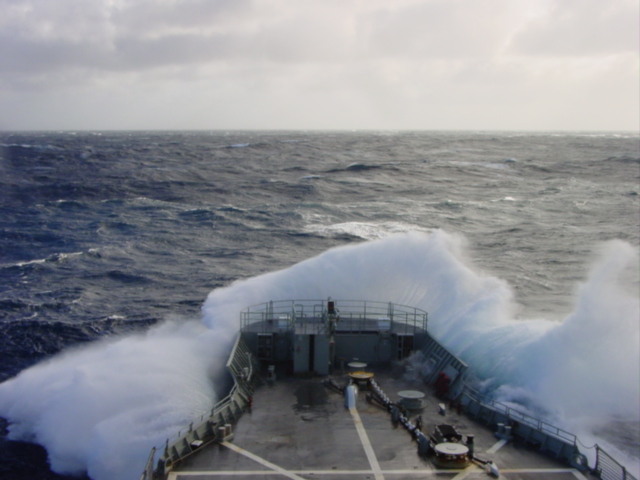
From its outset the ANI sought to promote the professional development within the service. One of the central pillars is seamanship. In the Autumn 2007 edition of Headmark, the then Captain Martin Brooker wrote an article about handling ships in heavy weather. This was based in his experience commanding the LPA HMAS Manoora.
The Perfect Storm – Handling Ships in Heavy Weather
The handling of ships in all environmental conditions is just a part of our business as mariners. Our professional grounding comes not only from the training but the great knowledge contained in the Manuals of Navigation and Seamanship.
Back in May 2003 when HMAS Manoora was on a passage “south-about” to Western Australia in the Great Australian Bight, the guidance provided in the Manual of Seamanship on handling ships in heavy weather, came to the fore with gusto when the ship experienced conditions of Sea State 4-6 for three days somewhere south of Ceduna.
Manoora had departed Fleet Base East earlier in the week with Sea Training Group embarked, for a staff covered training in preparation for a Mission Readiness Evaluation, prior to deploying to the Middle East area of operations. The ship had enjoyed smooth conditions for four days, and with the majority of Sea Training Group (STG) activities completed the ship arrived off Adelaide’s outer harbour to transfer the majority of the STG personnel ashore, and shape course for Western Australia, and slow time preparations for the ‘final assessment’ with Commodore Flotillas. As the ship departed the Adelaide area leaving Kangaroo Island to port, the majority of the ship’s company took some time out in similarly smooth conditions to watch the sunset and to contemplate the work still required to pass the Mission Readiness Evaluation (MRE) next week.
The low pressure system that was brewing 1000 miles south of Albany was not even a factor at this stage. However, as the low moved north east it started to deepen and dominate the conditions in the Bight. By the following evening, with the ship south east of Esperance, the weather and seas deteriorated significantly with Manoora experiencing winds in excess of 35 knots and swells of 9-10 metres, occasionally to 12 metres.
The conditions were such that the ship was unable to maintain headway along the mean line of advance for long periods, as the ship’s period of pitch started to increase significantly and the risk of significant damage forward also increased. The period between successive waves also started to increase. As per the Manual of Seamanship, when the period of wave crests approaches synchronisation with the period of pitch then the ship’s motion will be violent. This was clearly evident in a LPA with the significantly flared bow structure under the forward flight deck.
Not surprisingly the Manual of Seamanship provides a couple of pages of advice on steaming head to sea, with the sea abeam and running before the sea. Steaming head to sea was proving problematic, and consideration of the pitching of the ship and resultant strains of hogging, sagging, and pounding were uppermost in my mind along with concern about the amount of water being taken on the forward flight deck.
For three days the ship was manoeuvred a number of times into and out of the weather and building seas to maintain position and avoid being forced into the upper latitudes of the Bight. As the ship ran down sea for extended periods the dangers of broaching-to or being pooped were ever-present. Consideration of the ship’s speed against the speed of the waves was a key determinant and again the Manual provided sage advice on the considerations at this time – the key risk reduction was to keep the ship well below the wave speed backed up with constant supervision of the steering by the Officer of the Watch (OOW), and a reduction of the length of tricks at the wheel.
Turning in heavy seas provided the biggest some of the bigger risks and challenges. The Manual states that “good judgement is required to select the most suitable moment to start the turn.” I would liken it to trying to do a ‘U- Turn’ across three lanes of heavy traffic where picking your moment is the difference between success and catastrophe. As we chose our wave, the technique outlined in the Manual again proved spot on – the navigator and I would pick the wave and then use short bursts of power and full rudder to get the ship going in the right direction. With the significant paddle wheel effect achieved in a LPA using the inboard engine it would not take long before we were turning, and could then apply power half way through to complete the turn and then settle down; either beating into the sea at slow speed or heading down sea at a speed far less than that of the prevailing seas.
Despite the conditions the ship’s company and routine remained focussed on the planned workup activities. As you would expect the ship’s company continued to work hard in spite of the arduous conditions to prepare for the forthcoming MRE and were rewarded for their efforts with COMFLOT assessing Manoora as Mission Ready. Looking back at that weekend in the Bight, there are couple of things that stand out from the experience.
Firstly, no matter what the conditions faced in the maritime environment there are not really any new lessons. The training and the manuals of our profession provide a very, very solid foundation for dealing with the myriad of situations that we might face at sea. Back that up with the experience one develops as whether you are an OOW under training, on through to command, then there is not too much that would not be within our capacity to deal with.
Secondly, while Command has the ultimate responsibility for the safety and ship handling it absolutely takes a team effort in dealing with the severe conditions sometime presented to us at sea. The team effort on the bridge, the navigator’s deep specialist advice, the high level of machinery availability and the ability of the Ship’s Company to get on with the job at hand in keeping it all going, despite the conditions, is something special and not to be taken lightly.
About the Author
Commodore Martin Brooker CSC RAN (retired) joined the Royal Australian Naval College in 1978. His sea going service culminated in the command of HMAS Manoora. During his tenure the ship took part in Operation Slipper in the Arabian Gulf from May-June 2003. He later served as Deputy Commander of Australia’s Joint Forces in the Middle East and Afghanistan. His shore appointments included Program Director for Navy’s New Generation Navy change program. Martin Brooker retired after 37 years’ service in the RAN and is now a speaker, facilitator, executive coach.