From 1997 until the early 2000s the RAN, with support from the RAAF and the Army, undertook a handful of long-range fisheries protection interceptions in the Heard Island and McDonald Island Exclusive Economic Zone (HIMI EEZ). The operations were to apprehend illegal fishing vessels catching the Patagonian Toothfish.
Operating in the Southern Ocean is most challenging, as Commander John Vandyke, the Commanding Officer of HMAS Warramunga, outlined in his article published in the Summer 2005 edition of the Journal of the Australian Naval Institute.
Operation Celesta – January 2004
On 14 January 2004 HMAS Warramunga sailed from Fleet Base West at HMAS Stirling for the HIMI EEZ. The reason for the patrol, to seek and apprehend any fishing vessels found to be fishing illegally in the HIMI EEZ.
Preparations had proceeded at a frenetic pace in the previous week with training and re-qualifications for the boarding party in fast rope insertions the most crucial. Storing also proceeded apace with the most important aspect being the embarkation of the cold weather stores, most notably the clothing. There were some members of the ship’s company who were going to the HIMI for a second time but nothing they could say would prepare us for the cold, a most significant aspect of operations in the Southern Ocean.
The transit to the HIMI took one week. The first two days were used to hone the fast roping skills of the Boarding Party and fully integrate HMAS Canberra‘s Seahawk, which had been loaned to Warramunga for the operation. The reasoning for concentrating this training early in the transit was the expected worsening weather that might preclude further training. This proved to be the case as predicted, with the temperature and barometer plummeting, the further south we went. This was made all the more noticeable having sailed away from a WA summer.
During the transit the planning continued with daily meetings of the Command Team, the embarked Australian Fisheries Management Authority (AFMA) officers and Customs officer. The concept of operations that had been decided on quite early remained the broad plan and was refined during the transit. With weather the primary factor, the aim was to approach any vessels detected after the passage of a cold front. These fronts pass through the area every 36 hours or so and the weather abates for several hours after the passage of the front permitting boarding operations. Discussions were also conducted about how a man overboard might best be recovered noting the expected very low water temperatures. The plan was that the helicopter would remove the fast rope and then lower the harness to the person in the water and recover him – simple it was thought. This plan was briefed and all the boarding party was taken through the routine of putting a harness on. The AFMA officer’s warning to remember that ‘they are only fish’ was a very subtle reminder though of the conditions, and dangers, likely to be encountered.
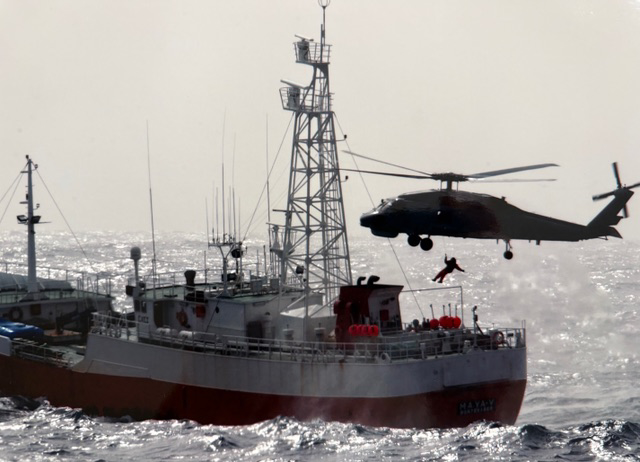
Warramunga commenced her patrol about a week after leaving Stirling and as luck would have it, detected a vessel on radar at dusk the following evening. The gas turbine was brought on line and we started closing. The contact increased speed but Warramunga was easily able to overtake the vessel and commenced trying to gain radio contact with it. Eventually the vessel identified itself as the Uruguayan-flagged Maya V. Close passes were conducted on the vessel using the 10-inch signal lamp for illumination, confirmed it as Maya Vand she was instructed that we would board her the following morning.
At sunrise the weather was assessed as suitable for helicopter operations and boat operations, a requirement in the event of the helicopter ditching. The helo was safely launched and Maya V was instructed to stand by to receive the boarding party. After a reconnaissance, the decision was taken in the helo to insert the boarding party amidships, just forward of the bridge. The rope was deployed, the first man slid down the rope, was lost from sight on Warramunga‘s bridge and was quickly seen to float clear astern of Maya V. MAN OVERBOARD!! The plan that had been briefed was executed with the fast rope being disconnected from the winch hook and recovery strop hooked on. The helo made an approach to the man and the strop was lowered. It quickly became apparent on Warramunga‘s bridge that he was struggling to get into the strop due to the very quick effect the water temperature had had on his dexterity, and the obstruction of his backpack. The decision was quickly taken to launch a rigid hulled inflatable boat (RHIB) to recover the man. This went smoothly and the RHIB swiftly closed the man and safely recovered him into the boat.
The RHIB returned alongside Warramunga with four people in the boat, the two boat’s crew, the casualty, and a member of the ship’s medical emergency team. The medical sailor was forward shielding the casualty, who was lying in the bottom of the boat; the bowman went forward and safely connected up to the boat rope. The weight of these three people forward though, combined with a freak wave, saw the RHIB fill with water and slowly turn turtle, tip all into the sea, break the staghorn from the boat, and float clear astern. There were now four members of Warramunga‘s ship’s company in the near freezing water: 2oC, and an air temperature of -13oC with wind chill.
The response from those on board was totally professional in the face of this life-threatening situation. The second, and only remaining RHIB, was quickly readied for launch, and when the ship was on an appropriate course, it was lowered. The people in the water had reacted in accordance with their training and were grouped together providing support for the original man overboard exactly as per the book. The RHIB arrived alongside them, and after some difficulty, noting the hypothermic state of the people, safely recovered all four.
The next challenge was to get all back on board Warramunga safely. The requirement for the first man to be hoisted as near to parallel noting his hypothermia was the most pressing factor. The XO proposed using the man overboard recovery davit on the bridge wing with the RHIB keeping station beneath; this was done. Noting the concerns about the first man, a double lift was undertaken with the swimmer of the watch being lowered and two strops being placed on the hypothermic man to bring him up, essentially in a ball, to avoid a vertical position with its attendant dangers. This was successful, with the swimmer of the watch sustaining two broken ribs in the process. The remaining men were all successfully recovered from the RHIB whilst it kept station under the davit. The RHIB itself was then safely recovered. The whole evolution, from the lowering of the fast rope to the recovery of the boat, took approximately 58 minutes. The professionalism and courage displayed by the whole ship’s company throughout was nothing other than exemplary, and all lived up to the ship’s motto, ‘Courage in Difficulties’. Of particular note though is the exceptional bravery of the first man down the rope and the RHIB crews.
Any further attempts to board that day were suspended due to the worsening weather, which was predicted with the passage of the cold front. That afternoon both ships returned to where Warramunga had first detected Maya V. This was to search for any buoys that might be in the vicinity. Due to the vigilance of the lookouts, some were sighted and several were recovered
The recovery was risky in itself however noting the conditions, with the recovery lines on the forecastle cutting through the guardrail like the proverbial knife, and then parting, shooting a grapnel hook across the forecastle. Sufficient buoys were safely recovered however, again displaying tenacity in the ship’s company that was conspicuous.
The next day dawned fine with unexpectedly suitable weather for flying and boat operations. The decision was taken to board Maya V and boarding and flying stations were piped. Following the insertion of a member of the aircrew, the fast rope was dropped onto Maya V and the first stick of the boarding party was inserted. ‘Low Threat’ was quickly called and the embarked fisheries officer was lowered to the deck. He subsequently found sufficient evidence to apprehend the vessel on the suspicion of illegally fishing in the HIMI EEZ. Noting the unpredictable weather the steaming party transfer commenced immediately via a high line transfer. Despite a defect in the helo half way through which caused a momentary lapse in the momentum of the transfer, it was completed successfully and the long transit to Fremantle was commenced.
Two days later Warramunga rendezvoused with HMAS Success. Whilst in company with her the opportunity was taken to transfer a fisheries officer and several others, plus some stores. The weather was marginal for fuelling though and noting the sea state and low water temperature, and the proven long range of Warramunga, the decision was taken not to fuel and Success was detached to proceed in accordance with previous orders by Warramunga as CTG.
Warramunga arrived in Fremantle on 1 February, after some 18 days at sea, in at times appalling conditions, having achieved what she had been sent to do: search for, board and apprehend any vessels suspected of illegally fishing in the HIMI EEZ. There was a large media contingent on the wharf on arrival and the ship was met by the Minister for Customs, the Minister for Fisheries and the Maritime Commander. Two days later the Prime Minister also visited to personally thank the ship’s company of Warramunga for a job well done.
Maya V‘s cargo is the largest cargo of Patagonian toothfish apprehended to date.
About the Author
Captain John Vandyke joined the RAN in 1979 as a seaman officer and spent his seagoing career exclusively in DEs, FFGs and DDGs, serving as an Officer of the Watch (OOW), Assistant Principal Warfare Officer (A/PWO), Air Intercept Controller (AIC) and PWO(Direction). He was promoted to Captain following command of HMAS Warramunga and undertook a range of roles in that rank, the highlight being Commanding Officer of HMAS Creswell and Captain of the Royal Australian Naval College. John Vandyke retired from the permanent service of the RAN in 2017 after 38 years. Subsequently, he spent six years as a part-time Reserve officer serving as the President of the Officer Selection Boards.
Postscript
The 54 metre Maya V had a catch of 202 tonnes of Patagonian Toothfish and 64 tonnes of sardines (bait) onboard. On 23 August 2004 a Perth court placed three crew members of the Maya V, on a good behaviour bond for illegally fishing in Australian waters. They were placed on a $6,000 five-year good behaviour bond and were ordered to each pay a fine of $1,500. Judge Peter Martino said that while the offences were serious, he had imposed a lenient sentence in the hope it would deter the men from fishing in Australian waters again. The catch was sold by the Commonwealth by tender for about $1m. Maya V was later released and sold. Her current owners and status are unknown.