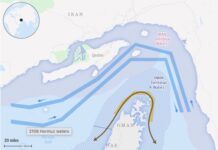
The 2026 Iranian War has once more highlighted both the importance to and vulnerability of petroleum products to Australia. This issue was canvassed by the ANI in its 2019 and 2022 protection of maritime trade reports. It was examined even longer ago by the then Lieutenant Commander Mathew O’Loughin in an article that appeared in the Autumn 2006 edition of Headmark. Some of his points in this article are quite prescient.
The Emerging Energy Crisis – Our Primary Foe
The RAN is procuring ships, submarines and aircraft, a process that typically takes about a decade, which is followed by a service life of approximately 30 years. For a large program such as the Anzac ship project, Collins class submarines or the Joint Strike Fighter, this can also include a decade-long production run. All of this means that we may now be considering platforms that will be in commission in 2055.
It is no secret, but may come as a surprise to some, that the world is rapidly running out of its crude oil reserves. One significant outcome from this is the ever increasing cost of oil, felt by all of us in the increased price of fuel and follow on effects such as flight fare levies and increased transport costs pushing up the price of commodities.
The current significant major capital projects for the RAN are the Air Warfare Destroyer (DDG) and Landing Ship Helicopter Dock (LHD).
The options for the DDG are the US Gibbs & Cox design based on the Arleigh Burke DDG and Navantia of Spain’s F-100. These ships will be the RAN’s front line combatants for their commissioned life, with the first DDG projected to enter service in 2013.
The options for the LHD are the Navantia LHD and DCN Mistral, the first of which is expected to enter service in 2012. These are large ships with a displacement of greater than 20,000 tonnes. The aim of this paper is to highlight major long term issues with defence procurement due to constrained focus on propulsion systems.
A Brief History
Australia is an energy rich nation. We export coal, uranium and Liquefied Natural Gas (LNG), however we are a net importer of crude oil and crude oil products, with about 40% of our usage coming from international sources.
The RAN and our forbears have a long tradition of using different sources of propulsion, moving from sail to coal to diesel over a period of about 50 years. Since legacy World War I ships were decommissioned all our ships have been powered by forms of diesel, with the current form being F-76, a high grade marine diesel.
Peak Oil
The term “global oil-production peak” means that a turning point will come when the world produces the most oil it will ever produce in a given year and, after that, yearly production will inevitably decline. It is usually represented graphically in a bell curve. The peak is the top of the curve, the halfway point of the world’s all-time total endowment, meaning half the world’s oil will be left. While that is a lot of oil, there’s a big catch: it’s the half that is much more difficult to extract, far more costly to get, of much poorer quality and located, mostly in places where conflict may arise. A substantial amount of it will never be extracted.
The best estimates of when peak production will actually happen have been somewhere between 2005 and 2010. In 2004, however, after demand from burgeoning China and India shot up, and revelations that Shell Oil wildly misstated its reserves, and Saudi Arabia proved incapable of ramping up its production despite promises to do so, the most knowledgeable experts revised their predictions and now concur that 2005/2006 is expected to be the period of all-time global peak production.
The availability of diesel, a product of crude oil, is in decline, while the cost will only increase. We are facing the end of the cheap-fossil-fuel era. This cannot be over stated; reliable supplies of cheap oil and natural gas underlie everything we identify as the necessities of modern life – not to mention all of its comforts and luxuries: central heating and airconditioning, cars, airplanes, electric lights, inexpensive clothing, recorded music, movies, hip-replacement surgery, national defence — you name it.
Implications for the RAN
RAN ships patrol Australia’s waters, exercise locally and globally and deploy operationally across much of the world. Last financial year (FY05/06) the Navy burnt 87,391 CZs (87,391,000 litres) with the frigates consuming half of the total. While price may become an issue it should not be the focus of this paper, as in a time of crisis cost will not be a problem. In the long term it will be availability of fuel that will determine whether or not our ships can put to sea.
Renewable fuel sources such as bio-diesel, ethanol and hydrogen are possible sources of fuel in the long term, however these are all highly resource demanding. Current production of canola or sugar requires cheap and available diesel to plough, sow, harvest and transport the croр.
Hydrogen may be extracted from water through the process of electrolysis, however this production requires a great deal of energy. Such energy could be produced in the medium term by burning finite fossil fuels such as coal, or by nuclear power. It should be noted that the RAN is not the only consumer of fossil fuels and any replacements will be highly sought after and very expensive when compared to today’s energy prices. I will not discuss the environmental issue of burning coal to produce electricity, suffice to say that it is not the cleanest of energy sources. The environmentally friendly options such as using wind or solar generated power also have drawbacks, not only the enormous problem of scale but the fact that the components require substantial amounts of energy to manufacture and the probability that they can be manufactured at all without the underlying support platform of a fossil fuel economy.
A long term solution may be to switch to nuclear powered ships, a path that the US Navy tried in the 1960s, the result of which was the US Ships Longbeach, Truxton and Bainbridge. The Truxton was an attempt by the USN to build a frigate sized escort powered by a nuclear reactor; the result was a cruiser that displaced in excess of 9,000 tonnes.
The USA was the first country to develop the atomic bomb and have a well developed nuclear industry. All USN aircraft carriers are now nuclear powered. Australia does not currently have a domestic nuclear industry; the Australian Nuclear Science and Technology Organisation operates one reactor at Lucas Heights, NSW, for medical research. For the RAN to operate nuclear powered escorts in the long term would require immense research, development and training to start now, and would require significant investment.
Changing from F-76 to LPG or LNG could be an option in the mid term which would require moderate modification to gas-turbine powered plant, with larger modifications to the ships’ fuel tanks and supply system.
Strategic Fuel Reserves – How Much is Enough?
The RAN will have to carefully consider and prioritise the way we will conduct our business in a fossil fuel scarce world. Operational tasks such as border protection, UN/Coalition and regional security responsibilities may be the only activities that ships will be allowed to sail for, however this may be at the cost of burning precious strategic fuel reserves that are unable to be replenished. In such an environment the RAN cannot continue to burn 87,000 CZs each year. Smarter options such as simulation will have to be expanded, numerous bridge and operation room simulators will need to be linked together for our command teams to hone their skills. On the job training may be a thing of the past, as an operational environment does not make for a good classroom, therefore realistic trainers need to be developed for the maintainers to develop the required essential skills.
It should be noted that this is a global crisis and any conventional foe will be suffering the same fuel limitations as the RAN. Such limitations will have less an effect on unconventional warfare, such as that practiced by terrorists. The current technological advantage that we and our allies currently enjoy will be reduced by the demise of fossil fuels if we do not change our practices.
Should our current navy be required to fight a full scale conventional war at sea I would expect that the fuel consumed in a calender year would almost certainly be more than triple our current annual use, 300,000 CZ may be burnt per annum. Should crude be available the import may be hampered by opposing forces. How long can the RAN continue this effort? Any strategic war reserve should allow for our navy to be unconstrained for at least two years, as such, with our current fleet we require 600,000 CZ. In today’s environment this is feasible, but what of the future? And what do we do when the strategic reserve is exhausted?
It may be that the navy which can still operate in these times is the navy that controls the sea. Nuclear powered vessels may be the only unconstrained vessels operating in the future. The US and the UK operate submarine fleets that are entirely nuclear powered. As already mentioned the US also operate nuclear powered aircraft carriers and Russia operates the Kirov nuclear powered cruiser. Russia and France operate a mix of diesel powered and nuclear powered submarines and in our region China is commissioning new JIN class SSBNs and Shang class SSNs, while India has been actively developing a nuclear powered submarine since the 1980s. The range, power and endurance afforded by nuclear power make this form of propulsion ideally suited to large powerful ships and submarines. This should be given due consideration when the Collins class submarines are replaced.
The smaller patrol craft and escort sized frigates and destroyers that the RAN has traditionally operated are not so suited to the complexities of nuclear power generation. Fuel efficient propulsion systems allow any strategic reserves to go further. By using combined diesel and gas-turbine propulsion Anzac class frigates are approximately 40% more fuel efficient than the gas-turbine powered Oliver Hazard Perry class. Future escorts should both be highly efficient and able to operate on fuels that will be widely available in the long term.
The planned destroyers, which are expected to be in commission until 2045 do not currently match this criteria. The Gibbs & Cox evolved destroyer is based on the USN Arleigh Burke Flight IIA, which displace 9,188 tonnes and are powered by four GE LM 2500-30 gas turbines producing 100,000 hp (74.6 MW) which propel the destroyer at greater than 31 knots with a maximum range of 4,400nm at 20 knots. The other alternative, the F-100 displaces 5,850 tonnes and is powered by Combined Diesel or two Gas turbine GE LM 2500 gas turbines; 47,328 hp(m) (34.8 MW) or two Bazán/Caterpillar diesels; 12,240 hp(m) (9 MW) which propel the destroyer at greater than 28 knots with a maximum range of 4,500nm at 18 knots. Neither of these vessels compare favorably with our Anzac class which have a range of 6,000nm at 18 knots.
It is now in the initial planning, design and construction that efficiencies and alternative fuel options should be incorporated into the selected platform. Podded propulsors may be a viable alternative, where there is not the usual main engine, gear and shaft arrangements as in service with all RAN ships, but rather an electric generation plant, that may be located anywhere in the ship, possibly above the water line to reduce acoustic signature, and cables that go to podded electric dives. Such an arrangement is not new, and is proposed for both the LHD designs being considered. This could facilitate a more readily accessible power plant which could simplify the complex task of re-engineering to accept alternative fuels. Should such fuels be gaseous such as LNG, LPG or Hydrogen the task of re-engineering is much more complex and may see all vessels not so designed removed from service as modification may be more expensive than replacement.
The RAN’s dependence on F-76 will have to change as the age of abundant, cheap fossil fuels comes to an end. Renewable liquid fuels such as bio-diesel will be incredibly expensive in the future and may only be available to the RAN for a full-blown war, anything less and its consumption may not be warranted. In such times the reserves of renewable fuels will be quickly expended. Gaseous fuels, such as Hydrogen, LPG or LNG may be available in the longer term to power our surface ships, but this would require modification which will be far cheaper if incorporated during initial build. Adaptable propulsion systems should be given a high priority, as should fuel economy.
Australia should embrace nuclear power in the medium term, this is no small feat, initially universities and technical colleges have to amend their syllabus, this will then need to be followed by the development of a domestic nuclear industry to ultimately achieve a military one. The RAN should replace our submarine fleet with nuclear powered vessels, thus providing a reliable power source in the longer term and all the endurance that commanders desire.
The RAN currently uses simulation to train its command teams and key personnel. This should be expanded to allow full scale operations to be simulated with interaction between the entire fleet and allied units.
To fight and win at sea, first a navy must be able to put to sea. In an ever changing environment one must adapt early or perish. If appropriate consideration is given now the RAN will survive the impending crisis.
About the Author
Commander Mathew O’Loughlin joined the RAN in 1987 as an Electrical Technical Weapons sailor and attained the rank of Petty Officer. He was commissioned in 2001 as a seaman officer and completed a Bachelor of Science degree at ADFA and would later complete two Masters degrees. Mathew undertook the Principal Warfare Officers course and specialised as a Direction Officer serving the frigates Melbourne and Darwin. He later was the OIC of the Navy Synthetic Warfare Centre. Mathew’s sea commands were the patrol boats Ararat, Bathurst, Glenelg, Larrakeyah andPirie. With this minor war vessel experience behind him he was the Maritime Surveillance Advisor to the Marshall Islands (2016-2018). His extensive operational service was in Operations Astute, Slipper, Resolute and Manitou. In August Mathew will retire from full time service after 39 years.