Following the overthrow of President Saddam Hussein in the 2003 Iraq War, the focus of naval forces in the north Arabian Gulf (NAG) was to ensure the security of merchant shipping and the strategically important offshore oil terminals. In April 2004 that threat was realised with a terrorist attack. In the Spring 2006 Edition of Headmark, the then Captain Phil Spedding wrote an eyewitness account of the attack and its aftermath.
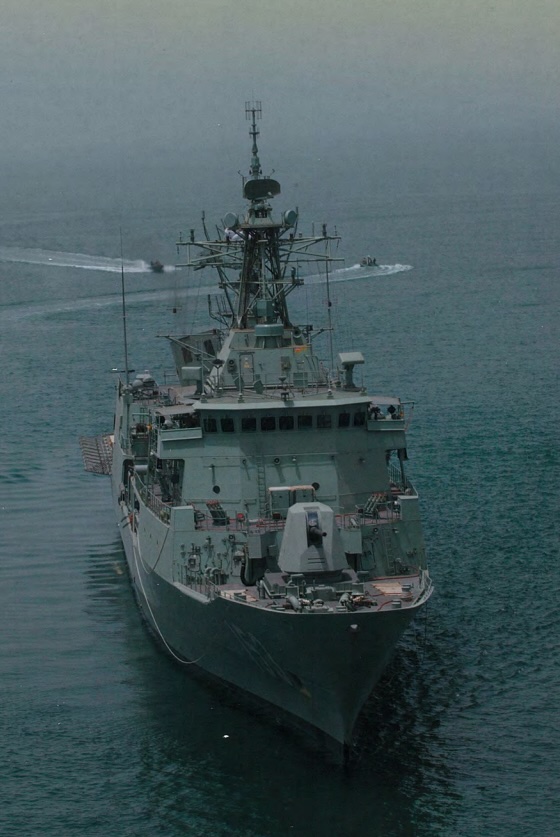
HMAS Stuart: Slipper Rotation 8
On the evening of 24 April 2004, three near concurrent suicide boat attacks were made against the Kwahr Al Amaya (KAAOT) and Al Basra (ABOT) oil terminals in the NAG. Coalition forces under Stuart’s control disrupted the coordinated attack and prevented catastrophic damage to the terminals, however a US Navy boarding party from USS Firebolt that intercepted one of the boats sustained multiple, serious casualties. The incident was probably the first time that most onboard Stuart were confronted with real danger, fear, injury and death. However, the officers and ship’s company responded in a most professional manner, and dealt effectively with the challenges of that night, and the days and months that followed. The purpose of this short article is to reflect upon Stuart‘s involvement in the incident, which was the defining aspect of Operation Slipper Rotation 8.
Arrival in the Gulf
Stuart started the workup process for Operations Catalyst/Slipper in January 2004, and benefited from the accumulated knowledge of some 15 years of RAN Gulf Operations. After a number of inevitable challenges, we arrived on station in the NAG on 14 April. That day my Operations Team received an INCHOP brief from the NAG Maritime Security Operations (MSO) Commander, CO USS Yorktown, and I admit to being somewhat surprised when I was told that MSO duties would be passed to Stuart the following morning!
As MSO Commander, the main responsibility was to defend the Iraqi offshore oil facilities, KAAOT and ABOT. These two terminals supply around 1.8 million barrels of oil per day, the revenue from which is vital to national reconstruction efforts. Additional requirements were the defence of coalition shipping, and the maintenance of Sea Control in the NAG and approaches to the two key waterways – the SAA (Shatt Al Arab) and KAA (Kwahr Abd Allah). Sea Control included the gathering of maritime intelligence, and prevention of the movement of prohibited cargoes. This was achieved through a comprehensive yet flexible boarding regime, targeting merchant shipping and dhows.
The Task Group (TG) assigned to the MSO Commander normally consisted of one or two Major Fleet Units (RAN, RN or USN), and two or three USN or USCG patrol boats. On 24 April I had stationed Stuart and Firebolt as the ABOT and KAAOТ guard ships respectively. To assist with the Sea Control task, USCGC Wrangel was stationed in the approaches of the KAA, and Yorktown in the deeper water to the South West of ABОТ. Of note, Firebolt had unexpectedly joined the Task Group early on 24 April when a programmed escort task had been cancelled. Had she not joined, Stuart would have been patrolling near KAAOT overnight.
A ‘security’ zone had been established around each of the terminals, and the guard ships were kept very busy escorting numerous fishing and cargo dhows that attempted to transit through their zones. Ship’s boats were regularly launched to investigate and warn-off the dhow crews, the intent being to inform and educate the Masters about the establishment of the zones.
Overnight on 23 April, a concentrated boarding program had been conducted against dhow traffic, with Stuart boarding some 36 and querying many others. Nothing significant was discovered and boarding and query operations continued without incident throughout the daylight hours of 24 April.
The Attacks of 24 April
Just on dusk (about 1914 local), the lookouts advised the onwatch PWO of smoke in the general direction of KAAOT. After being called, I proceeded to the bridge and could clearly see the reported smoke. However, I had no further information available and suspected that a fishing dhow or other small craft had suffered some form of mishap, something which we had seen before, and were to witness on a number of further occasions. Stuart was conducting Engineering Casualty Control Drills (ECCDs) and these were cancelled as a precaution, and the Engineering team restored propulsion in extremely quick time.
Sunset was at 1917 and shortly thereafter we received a frantic report via VHF that a fishing dhow had exploded whilst Firebolt‘s RHIB was alongside. The RHIB had capsized and six personnel were reported to be in the water (this was later amended to seven). I directed the OOW to close Firebolt‘s position at best speed, for at this stage I was still unsure of what had really happened, and was focussed on providing assistance to Firebolt over four miles away.
Stuart‘s aircraft was airborne conducting surface search, and was some six miles from Firebolt. The aircraft was directed to close and to assist with the location and recovery of personnel, and was the first asset to arrive at the scene.
The aircrew witnessed a scene of considerable confusion. Through their searchlights, they could see personnel struggling in the water amongst oil and large amounts of debris. Firebolt had only been about 400 yards away from her RHIB when the dhow exploded, and was now attempting to recover her personnel with lifelines and any other means available. Flares and searchlights added to the confused scene.
The aircrew initially attempted the rescue of a survivor who they could see had significant head injuries, but the casualty was unable to don the rescue strop for a winch recovery. With the survivor holding onto the strop, an attempt was made to drag him to Firebolt; however he was too weak to maintain a grip. Fearing imminent drowning, the decision was made to deploy the Sensor Operator (SENSO) into the water via a diver drop profile. The SENSO subsequently kept the survivor afloat until our RHIB arrived on scene. The RHIB crew then assisted with the recovery and transfer of casualties to Firebolt for initial treatment.
Whilst this rescue was being affected, a large explosion occurred in the vicinity of ABOT. On the bridge wing we first saw the smoke, then heard the loud blast and felt the heat on our faces. Distant small arms fire could be heard. It was at this point that I finally realised a coordinated attack of some sort was in progress, and was immediately conscious of how exposed both oil terminals were. Yorktown was ordered to close ABOT at best speed, and I decided to remain in Firebolt’s position so that Stuart could support her and also provide protection for KAAOT.
Stuart was brought to Action Stations and the surface warning was raised to RED. I left the bridge for the Operations room, where I believed I could exercise more effective control of the situation. The XO and Navigator, both experienced and capable, remained on the bridge. Six minutes later, a second large explosion was observed in the vicinity of ABOT. As additional protection for the terminals, Wrangel was also ordered to close ABOT, although she was some 20 miles distant.
At 2007 Stuart received her RHIB alongside, transferring the first three casualties. Two of these were serious trauma cases with multiple injuries. The third had ceased breathing on initial recovery to Firebolt, but EAR, then CPR had been commenced. Stuart sailors had continued CPR during the RHIB transfer, but the patient was declared dead on arrival by Stuart‘s Medical Officer (MO). The RHIB returned to Firebolt on a number of occasions, transferring equipment, casualties, and one sailor who was pronounced dead by Firebolt‘s medic. The RHIB crew was not stood down until approximately 2200.
At 2020 Stuart‘s aircraft conducted a medivac, via stretcher lift from Firebolt‘s focsle, of a critically injured sailor. He was brought onboard, assessed and stabilised by the MO and her team, and eventually transferred ashore to Kuwait. The aircrew had to contend with a change in destination mid-flight, a severe dust storm whilst on the ground, and deteriorating weather and visibility enroute to the ship, before they were finally recovered and stood down for tasking the following day. Sadly the patient was to die in hospital.
By around 2030, a clearer picture of what had happened at ABOT finally emerged. One of the tankers alongside reported that two small speedboats (approx 14 feet in length) had closed the terminals at high speed, coming under fire from the Iraqi security detail as they closed. Both boats had exploded prior to reaching the terminal, thus preventing any significant damage. Clearly, the fatal dhow explosion had been the trigger for the subsequent attacks against ABOT.
With Yorktown and Wrangel on station, and no further attacks forthcoming, by about 2230 I felt I could reduce the surface warning to YELLOW. Stuart remained at Action Stations until all of Firebolt‘s casualties were finally evacuated ashore. Two medivac aircraft from the carrier USS George Washington were provided, and the final casualties departed the ship by 0054 on the 25th. I fell Stuart out from Action Stations shortly thereafter.
We subsequently learned that a total of three USN and USCG personnel died from their wounds, and the remaining four were evacuated home for long term care and recovery. A number of days later, an explosive-filled dhow was discovered drifting in the Gulf – thankfully an unutilised element of the attack.
Command Considerations
The incident was a challenge for me in command. Throughout I was conscious of the need to balance the demands of Task Group Commander (CTG) and ship’s Captain. When the dhow explosion was first reported, I did not make the association with a terrorist attack. I assumed that the dhow had suffered some form of catastrophic accident, and Firebolt‘s initial reports indicated nothing to suggest otherwise.
As CO I felt obliged to help a fellow mariner in distress. When the first explosion occurred at ABOT, it was immediately clear to me that an attack was in progress, and I was conscious that ABOT was essentially unguarded except for the security detail. Although Yorktown was ordered to close ABOT, her draught in relation to the available depth of water meant that she could not transit directly, having to take a more circuitous route instead. I decided to remain with Firebolt to render assistance, and also to provide defence to KAAOT. I was to question the wisdom of this decision six minutes later when the second attack was conducted.
With Stuart at Action Stations, I had sufficient personnel available to handle and treat the multiple casualties that were being received onboard. I was also confident that sufficient measures were in place to ensure Stuart‘s safety. We held a large number of dhows visually and on radar, and these appeared no different to the dhow that had exploded. A small boat closed Yorktown at speed, totally unlit, and several warning shots were fired, but nothing further developed. An unidentified aircraft was also reported closing the terminals, which increased tensions somewhat.
As the CTG, I reallocated my limited resources to ensure the best ongoing protection of the Oil Terminals. The provision of a strike air package from George Washington was a welcome, if somewhat heavy handed, addition to my small force! I was conscious of the need for rapid reporting ashore, and saw very quickly the potential benefits of a same time reporting system like ‘chat. Whereas I only sent seven OPREP/SITREP messages on the incident, I maintained a near real time narrative report back to the USN authorities in Bahrain. This information flow was sufficiently effective that I was not pressed for any additional information, and my handling of the tactical situation was not hindered. The fact that I had previously worked within the NAVCENT Headquarters, and knew my Task Force Commander (CTF) very well, also assisted.
The XO and Navigator effectively controlled activities on the bridge, and I was able to concentrate my focus largely external to the ship. I used the WEEO and two CPOCSMs as a mini ‘think tank’ to help ensure that I had taken all appropriate Task Group measures, and left the PWOs to co-ordinate the majority of the activities internal to the ship.
This worked well, and allowed me to think as broadly as possible. However, as the incident stabilised, I was conscious I had not provided the level of information to the Ship’s company that I would normally have done without the Task Group responsibilities. I therefore conducted a walkaround of the ship immediately prior to falling out from Action Stations, briefing the Ship’s company on what had occurred, and what the plans were for the following days. The Ship’s company was in a good state, although some of the younger members were clearly shaken by their experiences. Interestingly, they made it quite clear that despite the incident overnight, and perhaps because of it, they still wanted to proceed with a planned ANZAC day dawn service.
Early next morning, we had to facilitate the movement of some 50 US Marines from ashore to reinforce the platforms, and also work out coordination and logistic support arrangements. This was an interesting task for the XO and Supply Officer! Additional surface ships began to arrive in the NAG, and within a week force levels had more than doubled.
With the increase in assets, and a heightened awareness of the threat to the terminals, it was clear that the NAG Concept of Operations required review. We convened a planning activity, with input from the Task Group, CTF staff, Naval Special Warfare planners, US Marines, and members of the Carrier Air Group. This planning was led by the WEEO (a staff course graduate) and the output was an appreciation of the tactical situation and the Task Group mission. This was forwarded to Fifth Fleet through the CTF, and helped to favourably shape the way NAG operations were conducted from that point. Stuart remained NAG MSO Commander until early May, when we proceeded off station for a port visit, and regularly held the duty again until our final OUTCHOP in mid-August.
Lessons and Reflection
What sort of lessons can be drawn from the incident? The scenario that presented on 24 April was initially a very confusing one, and not like anything we had specifically trained for. However, good training during the workup, on passage, and whilst in theatre, ensured that personnel were competent in their duties and able to respond to the new and difficult situation.
Delegation to key officers allowed me to concentrate on my CTG duties, and the Ship’s company reacted quickly, effectively, and most impressively to their changing circumstances. That effective training and delegation are critical to mission success is nothing new, and Stuart‘s experience vindicated the comprehensive force preparation that is provided to all deploying RAN units. The incident and the subsequent months on station also served to remind me of the inherent quality of our officers and sailors. They continued to serve effectively, and with good humour, through until our final OUTCHOP and return to Australia.
About the Author
Rear Admiral Philip Spedding DSC AM RAN (retired) joined the RAN in 1982. He served in the Permanent Navy and Reserves for over 40 years. A seaman officer specialised in anti-submarine warfare, his career included exchanges in Canada and the UK, service on domestic operations, and operational deployments to the former Yugoslavia, Northern Island, Fiji, and the Middle East. He commanded the Fremantle class patrol boats Townsville and Warrnambool, the frigate Stuart, and Australian and coalition forces as Commander Australian Task Group. He was awarded a DSC “For distinguished service as the Commanding Officer of HMAS STUART during Operation CATALYST and for inspirational leadership during a suicide boat attack on 24 April 2004.” Philip Spedding is currently the Western Australian Defence Advocate and also provides advisory services to a number of companies through his own consultancy business.