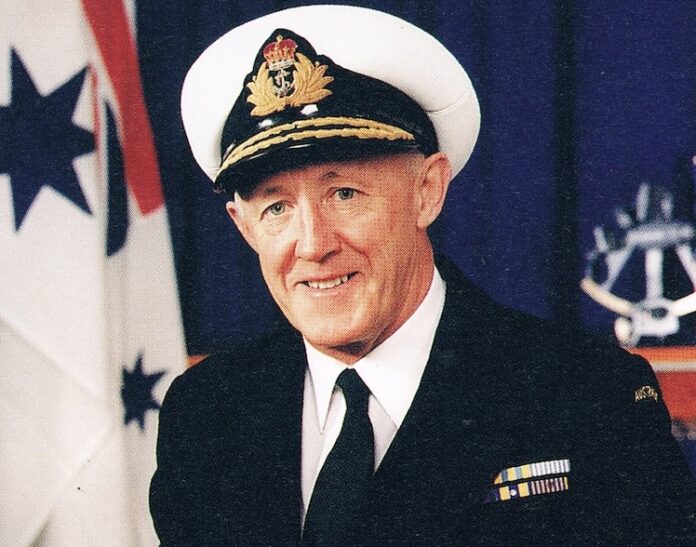
Admiral Michael Hudson was one of the most influential naval figures for the RAN in the late 20th century. On his passing in 2005, the then Commodore James Goldrick gave an illuminating assessment of his ‘old boss’. It was published in the Autumn 2005 edition of the Journal of the Australian Naval Institute.
Michael Wyndham Hudson 1933-2005
Michael Wyndham Hudson was born in Taree in NSW on 10 March 1933 and grew up in Sydney, close to Middle Harbour. His childhood was active and happy and it is fair to say that his upbringing did much to develop an inner confidence that was reflected not only in his individual career but his sense of what it was to be Australian. In time, Hudson would transmit this understanding and this confidence to the Royal Australian Navy as a whole. As Chief of Naval Staff from 1985 to 1991, he played an important role in the transition of the RAN into a more effective, complete and self-aware national organisation than it had ever been before.
Hudson briefly attended North Sydney Boys High before joining the Royal Australian Naval College at Flinders Naval Depot as a thirteen year old cadet-midshipman in 1947. This entry was an expanded one, reflecting the post-war revitalisation of the Navy which was then underway and its members were to enjoy a remarkable degree of professional success. Amongst the class were lan Knox, who became a Vice-Admiral and Vice Chief of Defence Force, and David Martin, later a Rear-Admiral and Governor of NSW. Hudson himself early established himself as a leader of the group, graduating from the College as the King’s Medallist. Soon afterwards, he went to sea as a midshipman and saw operational service in the aircraft carrier Sydney during her deployment to Korea in 1951-52. After courses and qualifying service as a junior officer at sea, Hudson sub-specialised as a navigator. His combination of intellect, precision and strong practical abilities meant that he excelled in the art and it was significant that he was sent as navigator of the cadets training ship Swan in 1959 on his return from exchange service with the Royal Navy.
In 1961, Hudson married Carla Suche, daughter of a Sydney businessman. Theirs was a long, close and happy marriage and they had three sons. Hudson, in a quiet and understated way, was devoted to his family and they became an important source of personal strength.
He qualified as a ‘dagger’ navigator with the RN in 1963, shortly after promotion to Lieutenant Commander and service with the United States Navy in the 1962-63 summer season in the Antarctic on Operation Deep Freeze. He always regarded the latter as a key formative experience.
Along with his extensive service in Southeast Asia, it played an important part in developing his understanding of one of the key strategic problems which Australia faced in meeting its security needs – that of distance.
Mike Hudson spent two years as executive officer of the destroyer Vendetta before promotion to Commander in 1966. Much of the ship’s time was spent in the Far East during Confrontation with Indonesia. His captain was Commander David Leach, later Hudson’s immediate predecessor as Chief of Naval Staff and, with such talent, it was a highly successful commission. Supporting the naval veterans of the Emergency and Confrontation would be an important concern for Hudson in his retirement. After Vendetta, he became Training Commander at the main naval training establishment at Flinders, HMAS Cerberus.
Hudson returned to Vendetta in 1970, this time in command. Here he began to establish the reputation as a highly effective ship captain that he would carry to and consolidate in his later commands of the Brisbane, Stalwart and Melbourne. He was soon marked out as having the potential to reach the highest ranks of the Navy. This was reflected in the succession of shore postings he enjoyed, which ranged between key operational and planning appointments and higher military education overseas at the US Armed Forces Staff College and the National Defence College of Canada. Promoted Rear-Admiral in 1982, he served as Fleet Commander and the following year returned to Canberra in the Joint post of Assistant Chief of Defence Force Staff (Policy).
Hudson was appointed Chief of Naval Staff and promoted Vice-Admiral in 1985. He was able to build on much good work that had been done by his predecessor, Vice-Admiral David Leach, in the immediate wake of the decision by the new Labor Government in 1983 to abolish the fixed wing Fleet Air Arm and cancel the project for an aircraft carrier, but he was also able to present himself as a fresh start. Whatever his personal views, and he had been the last operational captain of the aircraft carrier Melbourne, he accepted that there was no prospect of a revival of fixed wing naval aviation and that the RAN had to rebalance itself with that precondition firmly in mind.
Hudson proved extremely skilful at adapting himself and his plans for the Navy to the new strategic constructs which were being developed at the time. He operated effectively at the political level, particularly with the energetic Kim Beazley, and within the bureaucracy. However, his intent throughout was to refashion the Navy within the resources available into a force that would provide the maximum flexibility to government whatever form strategic policy took. Typical of the debates which took place was that for a 5-inch gun in the new Anzac class frigates. Although more expensive than the originally intended 76mm (3-inch) weapon, the 5-inch gave the ships much more operational flexibility, particularly in their potential to provide fire support to troops ashore. The decision to select the bigger gun was triumphantly vindicated by Anzac herself through the gunfire provided to assist the Royal Marines in their assault on the Al Faw peninsula in 2003. Even with Hudson’s long reign as CNS, it is sometimes difficult to determine what work he carried on from his predecessors and what his own successors carried from him to fruition, but there can be no doubt that the structure of the RAN of 2005 and its success in meeting the challenges of the last decade owe more to him than to any other single person.
Hudson was convinced of the need for active strategic engagement by Australia within Southeast Asia and the South West Pacific. While he was prepared to accept the defence of Australia as a force structuring mechanism, particularly if the implications of the distances involved were properly recognised (something that he did not think was necessarily the case on the part of all those involved in strategic planning), he firmly believed that Australia’s strategic interests required a much more proactive military and national security approach to the region. This was reflected in the Navy’s deployment patterns and a developing program of exercises with friendly nations, as well as Hudson’s own initiative to complement the American-led International Naval Seapower Symposium at Newport, Rhode Island with a regular Western Pacific Naval Symposium. In this, as in many other areas, Hudson was extremely successful at both supporting government policy and in assisting in its shaping.
Hudson was insistent that the Navy existed to be one of the readiest and most effective tools for the Government to use and it was clear that his period in office marked an increasing confidence on the part of the Government as to the RAN’s utility and eagerness to serve. It was certainly increasingly often called upon in contingencies – starting with the first Fiji coup in 1987. The Gulf crisis of 1990-91 saw the RAN providing the primary ADF response and Hudson worked hard to ensure that the Navy’s forces were as well prepared and supported as they could be. He had to operate within the newly developed command arrangements that had given operational authority to the Chief of Defence Force and there were frequent tensions amongst the senior personalities involved. Hudson never resiled from his belief that, as CNS, he was both the person most qualified and the person most appropriate to provide service specific advice to the CDF and, in turn, to the Government.
Hudson also oversaw many changes in naval personnel. Some he championed himself, such as his efforts to align and integrate the Naval Reserve more effectively with the Permanent Naval Forces. Other decisions he took more as a response to external pressures and in recognition of the Navy’s need to change with society. The most critical of these proved to be the progressive integration of females into the seagoing navy and it was true that he, as with most in authority, did not recognise the profound challenges that this would create for the RAN in coming years.
Hudson had some obvious wins. The RAN’s 75th anniversary celebrations in 1986 were an extraordinary success, particularly the Fleet Review staged in Sydney Harbour. The Navy’s year long effort to re-engage with Australians as a whole paid immediate dividends in the consolidation of national support and in recruiting. The review itself set a standard for major national events that still applies. A fall and a broken hip meant that Hudson played a much less active role in the Bicentenary celebrations in 1988, but he ensured that the Navy took as prominent a part as possible.
During his naval service, Mike Hudson presented a formidable and austere visage to the outside world and he did not suffer fools gladly. His real sentiments in complex situations were not often well understood, particularly by his subordinates. This was particularly the case in Navy Office, where the systems and attitudes which had operated under the old collective arrangements of the Naval Board had yet to properly consolidate under the new system which gave much greater internal primacy to the Chief of Naval Staff. He faced some unnecessary, if not self-indulgent resistance to his intent, which caused him justifiable irritation, but it was also true that he sometimes confused legitimate debate for dissent. He delegated effectively to people he trusted, but, in the event of a dispute or a mistaken assessment on his part, it was always important for subordinates to give him space and time to change his own mind in his own way.
Hudson also disliked much about the way he had to operate within the Department of Defence to be a successful CNS and he kept his own counsel over many of the decisions that he had to accept and implement in his six years at the top – to the extent that many thought that he supported some externally imposed measures which he in fact fundamentally opposed and which he had fought strenuously against within the Defence system. He was probably seen by some as too strong an advocate of the Navy and of the authority of the Services and their Chiefs of Staff for he was not selected to be the Chief of Defence Force. In many ways, however, he achieved the ideal of the loyal servant of the government and public. He took responsibility and he wore it well, but there was a price.
Hudson lacked the affability or common touch of some of his contemporaries, although he possessed a dry humour and a sense of the ridiculous that could sometimes be roused, particularly if Carla was present. His fairness and consistency, as well as his extraordinary practical competence made him a greatly respected commander at sea as well as an effective operator ashore.
Those who were close enough to him in his administrative roles soon came to realise his fundamental humanity and he was always good and frequently forbearing – to the young. Above all, he cared very deeply for those who served with him and for the welfare of the Navy as a whole and this was reflected in the attention that he devoted to many individual cases generally without publicity or fanfare. His essential kindness and concern for others became much more obvious after his retirement and organisations such as the Naval Association Australia received much support from him.
That retirement came in 1991, with the special recognition of promotion to full Admiral, a gracious gesture on the part of a government which owed him a lot. He had been created an Officer of the Order of Australia in 1985 and promoted Companion in 1987. Mike and Carla Hudson retired to the country, while maintaining a base in Sydney. He proved a very successful breeder of cattle and an energetic farm manager until his decision to sell up and spend more time in Sydney and at a much smaller property in Kangaroo Valley.
While he was always ready with advice and counsel and many senior officers benefited in recent years – he did not force himself on the active Navy. He limited his direct involvement in naval affairs, particularly during the term of his immediate successor, Vice-Admiral Ian MacDougall, but, in addition to his Naval Association and other charitable work, he took on part time posts such as the chair of the Antarctic and Southern Ocean Cooperative Research Centre. In the last few years, supported by Carla and his sons, he fought a valiant battle against lymphatic cancer. He died on 27 February 2005 at the age of 71.
About the Author
Rear Admiral James Goldrick AO CSC RAN served, as a Lieutenant Commander, on the staff of Vice Admiral Hudson as his Research Officer. He wrote this article when he was on the ANI Council. James would go on to be its President from 2005 to 2008.