
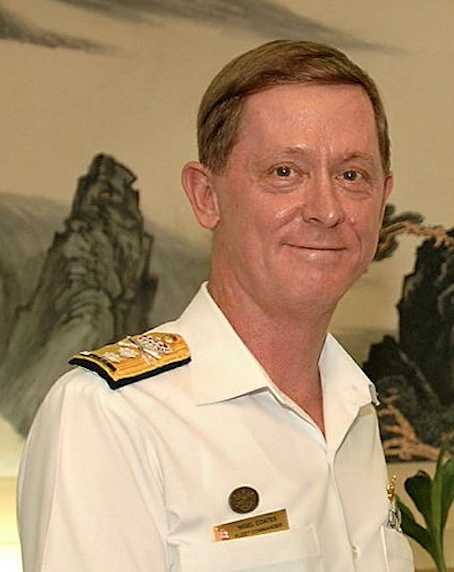
Rear Admiral Nigel Coates was one of the most admired and capable officers of his generation. Many people hoped Nigel would one day lead the Navy and then the Australian Defence Force. Tragically, Nigel was diagnosed with an aggressive brain cancer in late 2009, shortly after relinquishing command of the Australian Fleet. He died on 2 June. This insightful tribute was published in Headmark 137 in 2010 and was written by Rear Admiral James Goldrick.
This for Rememberance
In the aftermath of the First World War, John Buchan, author of The Thirty Nine Steps, wrote a memorial entitled ‘These for Remembrance’ to six friends who had been killed in action. Intended for his children, it was tribute to the memory of men whom he had known and admired for many years and whose departure he deeply mourned. They were not the 19 year old subalterns who have passed into legend as the flower of a lost generation, for none died in his first youth. The youngest of the six was 38 and all had made a mark in the world. The poignancy of Buchan’s narrative comes not simply in the mourning for what might have been, as it would for teenagers of unspanned potential, but in recognition of the loss of so much achievement and wisdom, of the untimely passing of good men who had already proven that they had so much more to off er and to do.
This is my tribute to Nigel Coates and my remembrance of someone whom I admired immensely, whom I always thought would go to the top and for whom I grieve. Nigel did not die in war, but his passing only a few months after his 51st birthday, following a battle with cancer bravely fought, represents a deep loss for both his family and the navy in which he served. He had so much more to off er and to do, both personally and professionally, and we are all the less for his departure.
Nigel Coates had a remarkable career in the RAN. He came to the Service already steeped in the sea. His father was a master mariner and Nigel had a skill in and love of sailing that would be with him for his entire life. From the time he joined the Naval College in January 1975, he was the outstanding member of his cohort and his gifts of leadership and character were quickly recognised. From the first, Nigel displayed a combination of practical skills, intelligence and good sense and a self confidence that never tipped over into arrogance. Even more importantly, he maintained an unshakeable integrity and concern to do what was right that marked out all that he did in the years that followed. He combined this with a natural kindness and consideration for others. Where Nigel led others would follow, but he would never lead them where they should not go. And, wherever he took his people, Nigel would always bring them back.
Nigel was the last and perhaps the finest product of the old Naval College which had operated since 1913. Joining at 15, the Junior Entry continued for only a few years more, as did the construct of protracted education and training within the confines of Jervis Bay. It was when Nigel was Chief Cadet Captain in his fourth year at the College that its organisation changed utterly with the bringing to RANC of the other streams of officer entry and training and female officers. From this time on, the move of the College away from the era of a small, long serving group of boys brought up within what was effectively a boarding school would accelerate. Nigel helped make that change work and integrate the new streams with those of the General List on which RANC had hitherto focused.
Nigel was devoted to the RAN and always wanted to be with it, particularly the seagoing fleet. In part this might have been because, to an extent he did not fully realise, he represented change of another sort. He was in the first generation of Australian naval officers who received no training as junior officers in the Royal Navy; he did not undertake his warfare course with the British, nor did he serve on exchange with them or with another Service. Apart from a couple of months as a midshipman with the United States Navy, he did not have an overseas posting until he attended the US Naval War College at Newport, after selection for promotion to Captain.
Nigel was thus home grown in every sense of the word and the Australian Navy was both his professional vocation and his belonging place. His postings outside the RAN and away from the sea, extraordinarily fruitful as they all were, were essentially imposed on him rather than sought. I remember pacing up and down with him outside Government House in Canberra in an effort, eventually successful, to persuade him to maintain his volunteer status for selection as ADC to the Governor General. It had to be, there was simply no one else of like quality and I knew that the Governor General had already chosen Nigel from the panel. He made a wonderful impression at Yarralumla during the year he served there. Nigel had also to be persuaded to go to Newport – in what proved to be a marvellous 18 months for himself and his family but also in which he was an outstanding representative, still remembered, of his nation and his navy.
To be Chief of Staff to the Chief of Defence Force on his return from sea command and the Persian Gulf was very much not his idea, but it was another post in which he did great things. Although he went on to do fine work as Chief of Staff in the Australian Theatre and as Director General Naval Personnel and Training, it was Nigel’s return to the fleet as its commander on his promotion to Rear Admiral that really counted for him.
Nigel demonstrated again and again, particularly in operational situations, a facility for innovation, particularly in the context of pragmatically solving concrete and immediate problems. Yet Nigel was not one to initiate radical change lightly and he was comfortable to operate within whatever system he was placed. In that sense he was conservative by nature. Indeed, he was a system man in the very best sense because his qualities and talents were such that he made the best possible use of that system and led other people to do so as well. If change was necessary, then he would achieve that change, but his natural inclination was always to work with what was at hand and make it as perfect as possible.
This showed itself best in sea command. Nigel’s performance as a junior officer at sea went from strength to strength and he made his mark in all that he did. But Nigel excelled above all as a ship captain and it was no coincidence that it was under his command that the frigates Canberra and Anzac each won the Gloucester Cup as the best ship in the Navy. His ships were both extremely efficient and very happy and the veterans of those commissions cherish the memory of their service and their captain. It was not only a matter of peacetime efficiency, either. Anzac’s performance in the Persian Gulf in 2001 changed the nature of operations in that theatre. By implementing an aggressive campaign of interception and boarding of the oil smugglers seeking to evade the United Nations’ embargo, Nigel and his crew played the key role in reducing the outflow of illegal oil from Iraq by more than 50%. They laid the groundwork for the Australian forces that followed, not only in completing the shut down of oil smuggling but in establishing the conditions which ensured that the coalition achieved command of the sea in the Persian Gulf during the 2003 war. While captain of the Anzac, Nigel also managed the very difficult demands of Operation Relex and the effort to contain illegal immigration, keeping his people focused on their task and alert to the ethical issues which they faced.
It was Nigel’s completeness as a person and his unshakeable integrity that will remain with me as I remember him. They were matched by his abiding concern for others and an ability to connect at all levels that endeared him to his shipmates. Those qualities gave him a charisma that helped other people to do better and to be better than they otherwise would and this was invariably the case for Nigel’s entire career, from Cadet Midshipman to Rear Admiral. That charisma was so strong that it affected not only his contemporaries and subordinates, but his seniors. It was well known when Nigel was a very junior officer that one of the most difficult and bullying personalities in the RAN of the day not only treated him very differently to the norm but even moderated his own behaviour to others when Nigel was in the vicinity – despite a difference of three ranks and a quarter century in age. It was no coincidence that the tone and culture of the troubled Australian Defence Force Academy improved markedly during the three years that he spent as chief instructor and commanding officer of what was then the Corps of Officer Cadets. For both the military staff and the midshipmen and cadets he was as close to the ideal of what an officer – of what a human being – should be as it is possible to be. As he was for us all.
About the Author
The late Rear Admiral James Goldrick was ANI President from 2005 to 2008.

That’s a truly beautiful reflection on the life of Nigel Coates. It’s also a splendid example of the quality of its author, James Goldrick.
We were very lucky to have the privilege of serving with them.