Naval communications has been an area of dramatic changes through the life of the ANI and articles have frequently appeared on the vital aspect of naval operations. In Headmark 136 published in June 2010 the then Captain Peter Leavy wrote an article recommending a rethink as to how the RAN manages the convergence between traditional naval communications and the rapidly advancing area of information technology (IT). Arguably similar challenge exists today with the current artificial intelligence revolution in full swing.
RAN Communications – Into The Future
In this article I outline my views on how the RAN needs to manage Communications and Information Systems (CIS) into the future if we are to fully capitalise on technological advances. I offer what, for some, will be the radical suggestion that our current CIS sailors need to have their role re-defined so they become solely devoted to the provision of IT services, with the visual signalling component of their current branch transferred elsewhere. I also believe that the time has come for CIS management to become a Weapons Engineering responsibility: that is, the CIS branch needs to come under the WEEO.
While this is a major break with tradition, the realities of modern technology are such that “communications” today really means long haul, Internet Protocol based systems, usually over satellite bearers. Flags and flashing light certainly remain valuable skills, but in my view they are now seamanship tools – not communications in the wider sense of the modern term. Technology advance in the commercial world of IT are driving such rapid changes that our branch structures are no longer well aligned with the tasks we expect our sailors to perform.
The starting point must be an understanding of our future requirements. Maritime warfare is becoming increasingly complex with an ever-increasing array of high tech weapons and sensors entering the market. We can no longer rely on the “technological advantage” in weaponry that the ADF has traditionally cited, and we’ll be even less able to do so in the future. Most countries can now buy high tech weapons from a variety of other countries and/or global companies – they do not have to spend years developing their own or be a “technologically advanced” nation. Hence we are seeing a levelling of weapon capabilities with the victor in future combat likely to be the one who employs his weapons the best, not just whoever has the best weapon. That said, Australia can still expect to retain a certain technological edge in some areas; it just won’t be as great, or as widespread, as it has been.
We must position ourselves to use our combat systems and weapons to best effect – and this does not just mean being more proficient at running through the mechanics of an engagement sequence. It means understanding a wide range of ever evolving circumstances at the tactical, operational and – given capabilities of the modern media – strategic levels, and reacting in the right manner at the right time. This requires a strong focus on intelligence (better understanding what the adversary might do) and an absolute reliance on situational awareness (having a Common Operating Picture (COP)). The key warfare skill will be in deciding if/when to engage a contact and not the actual mechanics of undertaking the engagement. Consequently the ability to move information quickly around networks, both within a ship and too/from external units and agencies – national and international, military and civil – will increasingly become the battleground of the future. Our key activity will be the fight for information upon which to make the correct decision at the right time – the physical employment of weapons will simply be the mechanical act at the end of the decision making process (although clearly one we will still have to work very hard to practice and maintain proficiency in – it just won’t be the ‘main game’.)
The future ADF is envisaged to be a joint, networked series of nodes amongst all three services fighting seamlessly together under a unified, joint (and where necessary, combined) command.1 This requires all nodes (in Navy case ships, submarines, and aircraft) to be “connected” electronically so that a wide range of information and data can be moved around the various sensor, weapons and command and control (C2) networks. Of course, moving electronic data around and between ships is nothing new for Navy; we have had electronic combat systems and Link 11 in service for many years. However, we are seeing that concept significantly increase both in complexity and importance, and this trend will continue over the coming decades.
C2 systems are now fundamental to a warship’s core fighting ability: so much so that the ability to communicate (that is, move the right data and information at the right time) will be the key component of a combat system. Indeed, even the term ‘combat system’ as we currently understand it is undergoing a fundamental change. With the envisaged “Networked ADF” of the future a ship will be increasingly viewed as a series of nodes, albeit co-located, in the wider networked (operational level) ‘combat system’. For example all sensors in the force will be linked electronically in a single sensor network to provide the COP upon which everyone draws, while the ship’s weapons will be part of the wider selection of options the commander (who may or may not be in the ship) has at his disposal. There won’t be any need for a contact detected by a ship to be engaged by her own weapons – there will be a transfer of sensor and C2 information between all nodes in the network and the most appropriate weapons system will be tasked with the engagement. Admittedly, this is still some way off, and there are a number of legal implications to be considered before this concept becomes practical, however, it is the concept to which the ADF, and many other military around the world, are working towards.
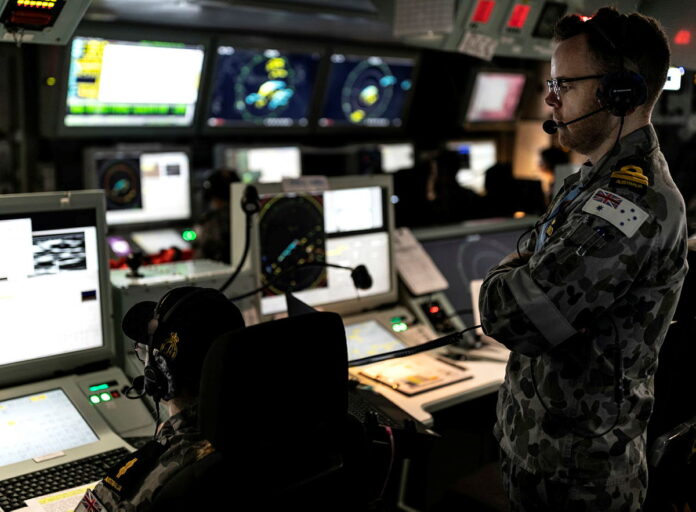
C2 systems are already web-based and require constant access to high bandwidth satellite bearers. Email, chat and other commercially based applications have become indispensable in the planning and execution of many C2 functions and if you are not in the appropriate network, then you are simply not part of the order-of-battle. The speed, stealth and lethality of modern weapons mean the flow of information needs to be fast, accurate and robust and there must be redundancy in key systems. In short, digital data flows, both within and external to our ships of the future, will be increasingly complex and absolutely vital to the success of maritime warfare.
While we must provide a range of communications routes for redundancy, moving data external to a ship is usually done via satellite bearers. Capabilities such as INMARSAT2 and MASTIS3 facilitate this, however most of our current ships were not designed with those capabilities in mind – they have been “add ons”. This is not a criticism; these systems were not around when the ships were designed and our sailors do an outstanding job in making them work. The point is such capabilities will be integral to our next generation of ships and we must plan for both their optimal instillation as a core part of the ship’s weapon system, and have the right people trained to operate and maintain them. We will be getting the hardware component of these systems, but do we have the skills and organisation within Navy to manage these increasingly complex electronic networks? I think we do have the skills in our sailors (and the ability to develop skills of the future) but we don’t have the organisation quite right.
I would argue that the current branches that provide communications services are not well organised or structured to meet our future needs. Our current CIS and ET(C) categories (and their predecessor Signalman, Radio Operator and Electrical Technical Communication categories) were all appropriate for their time. While the current arrangement does work, it is not as efficient as it could be and relies too much on the good-will of our sailors. Importantly, however, I don’t think the current arrangement will work into the future as software and IP based systems become more prolific and embedded in almost every facet of operations.
The advent of the Fleet Network Centre – Sydney in September 2009 is a very positive sign of progress in the right direction, and reflects recognition of the Navy’s growing need for IT systems and professionally satisfying careers for our sailors. However, I believe that the current CIS category has retained too many of the “Radio Operator” and “Signalman” traits that characterised the two branches that amalgamated. It needs to re-position itself as the RAN’s IT and software specialists (both internal and external), focusing on data communications, satellite communications and information management.
The skillsets required to operate a traditional COMCEN, together with an increasing array of satellite and IP based systems, are now far removed from the visual signalling (V/S) skills required for the Bridge. I accept that there is a need for flashing light, flags and tactical skills (ie the former ‘Signalman’) but believe they are more logically ‘seamanship’ tasks than ‘communications’. One key problem we currently face is very few CIS sailors like working both with computers and V/S systems on the Bridge, yet they are forced to train in both areas to progress. The time has come to differentiate between the V/S skills (as important as they are) and the high-tech world of computers, satellite comms and data links. I cannot see how training in V/S can be of any assistance to maintaining IP based C2 systems, ship LANs, satellite bearers etc (or vice versa) and from experience I know that very few sailors are happy switching from one to the other. Indeed, I have had first hand experience of CIS sailors discharging for exactly that reason.
My sense is that most CIS sailors joining the Navy are now attracted by the computer based, high-tech side of the job, and not by the V/S and Bridge tasks that currently remain the category’s responsibility. This reality is reflected in the significant drop that I have seen in the general standard of V/S services provided to Bridge staff over the last 5-10 years. While not acceptable, it is entirely understandable – many CIS sailors are simply not interested in Fleet Work and there is no real link (other than branch legacy) between it and what many see as their “core” job. While beyond the scope of this paper those CIS sailors who prefer the fleet work and visual signalling aspects of the job could perhaps form the core of a new seamanship branch designed around supporting the Bridge. Their tasks could include the traditional V/S roles, Navigator’s Yeoman and, in conjunction with the Bosun’s Mates, watch-on-deck and seamanship tasks. At the more senior levels they could also become qualified as OOW in MWVs which would provide a significant “seaman” career progression. In short, we could establish two broad seamanship branches – both proficient in seamanship with one sub-specialised in small arms and gunnery (Bosuns’ Mates) and one sub-specialised in Bridge/mariner services (Nav Yeoman and Visual Signalling).
Furthermore, there is significant overlap in the work currently undertaken by CIS and ET(C) sailors and a consequent need to rationalise these two streams. I have seen situations where work undertaken by one group is done in isolation from the other, with the result that the best people were not necessarily applied to the problem. While such issues are usually avoided through consultation with the sailors involved, our current branch structure – with CIS and ET(C) sailors both belonging to different departments and consequently regulated and managed separately – does not help. Our sailors make it work despite the way they are organised, not because of it.
I think that we are only just starting to accept that web based systems like CENTRIX4 and CMFP5 are now fundamental to our war fighting ability. Indeed, on a number of occasions when I have needed specific IP based systems (CMFP for RIMPAC 06 and CNFC6 for Northern Trident 09) the systems have been installed immediately prior to the exercise/operation and then removed immediately on completion. The equipment fit has been ad-hoc, on a temporary station in the Operations Room and without extra manning to operate it. Again this is not a criticism, as our current ships were not designed with these capabilities in mind. However, this does not allow any expertise to be developed through experience and undermines the fact that these systems are the future (or in many cases, the present). This issue is a systemic one and is not directed at CIS or ET sailors – they do an outstanding job trying to provide a service from the resources they have, but Navy as a whole must continue to recognise these IP based systems as fundamental to our business. We need to position ourselves organisationally to recognise that fact, and to get the very best out of the systems.
Proper IT support is not just a war fighting necessity either. The administrative information flow within a ship now occurs via various LANs and it is fair to say that these days if the LAN is not operating, a large part of any ship’s administration ceases. Also, the provision of Internet based services for the Ship’s Company is becoming increasingly important not only from a quality of life perspective, but also from a personnel management standpoint. We have already seen activities such as pay, allowances, leave, personnel management and housing services move online, however, the facilities provided on many ships are inadequate to allow all sailors suitable access to a computer to manage their lives and careers. In short, we have forced sailors to conduct a lot of their own management and administration online, yet have not provided the full services to allow them to do so. Whilst this is being rectified, it does highlight the need to have an adequate pool of people on board to manage the infrastructure behind these services.
What all this means is ships will increasingly need the skills onboard to maintain and operate very high data rate communications both within the ship and externally to other units. Access to satellite bearers will be absolutely vital, as will the skills to keep the communications paths open. Unfortunately the current situation appears to have our CIS sailors well trained but unable to do much of the work onboard the ship as many problems are configuration issues that they are not permitted to touch. This is not helped by technical support services often being provided by contractors and consequently some systems are unable to be configured by sailors on board. This is detrimental to the fighting efficiency of the ship and has a negative impact on the sailors’ professional job satisfaction. This is then compounded when they have to simultaneously do Bridge watches.
Given that data flow and communications are becoming the central components of combat systems, it is also timely to review how these capabilities are provided to the command. Currently the CIS branch comes under the Executive Officer based on its heritage as one of the seamanship trades. However modern “communications” has already become electronic and IP based, and will increasingly become the central component of combat systems. Hence, I believe it is more appropriate that the WEEO assume responsibility for providing this service to the command, as he/she currently does for all other components of the combat system. The Gunnery Officer would not proceed to the gun to fix a problem, so why would the SCO be actively involved in the mechanics of establishing satellite connectivity (as often happens)??
Ultimately what we need is a pool of experts that maintain the equipment, manage the configuration and monitor the performance of our increasing array of IT based systems. The operators (PWO and CSOs) need to be free to operate the systems as they see fit, but the provision and maintenance of the services should logically reside with the WEE Department.
I do not believe this is such a huge step for the Navy to take. We already have a pool of skilled and enthusiastic sailors (both CIS and ET(C)) who, generally, like working with these systems. We need to free them from mandated activities that detract from their (proposed new) core business – such as flashing light and flag hoists – and broaden their scope of responsibility to take on all LAN management, satellite communications and IT services and, increasingly, data transfers around and to/from the ship’s combat system. It may even be that in the future the new “IT specialists” will become the core WE sailor, as high speed data communications becomes increasingly prevalent throughout systems everywhere. But, one step at a time…
I propose an amalgamation of the current CIS and ET(C) streams into one new branch who manage the flow of electronic information within and external to the ship, and who fall functionally under the Weapons Electrical Engineering Officer. They would have responsibility for:
- traditional ship-shore communications, which will increasingly be satellite based;
- the internal transmission of information through various ship’s LANs;
- the provision of command and control systems, such as CENTRIX and other IP based systems, together with the monitoring of system performance and maintenance of the appropriate communications path;
- quality of life services such as the provision of Internet and e-mail services for the ship’s company, satellite TV etc; and
- ncreasingly, the maintenance and monitoring of data communications systems within the ship’s combat system.
In order to adequately undertake these new responsibilities, these sailors would need to be heavily trained in high rate data and satellite communications and would be responsible for all LAN, data and voice services throughout the ship, both internal and external. They must also be freed from any commercial or training constraints that restrict their ability to manipulate the onboard systems and manage configuration.
We need the ability to use all our onboard systems to their fullest potential using sailors onboard. I believe that a re-think about how our communications services are provided is quite timely given the huge, ongoing technological advances that are happening in the commercial world and the obvious benefits to the RAN and ADF if we capitalise on these developments.
About the Author
Commodore Peter Leavy AM CSM RAN (retired) served in the RAN for 40 years as a warfare officer. He has been the ANI President since 2023. His seagoing career included command of the frigates Stuart and Sydney, as well as Chief of Staff to the Maritime Interception Force Commander during the 2003 Iraq War. His shore appointments included Commandant of the Australian Defence Force Academy, Naval Attache in Washington and Director of the Seapower Centre Australia. He is an Adjunct Fellow at the Naval Studies Group at the University of New South Wales. He recently received his PhD for his examination of the role of medium power navies, using the RAN as a case study in the contemporary security environment with a return to great power competition.