By Jesse Fahnestock*
Last October, the United States upended global negotiations on shipping decarbonisation. Disruptive and threatening tactics forced a one-year delay of the vote to adopt the International Maritime Organisation (IMO)’s Net-Zero Framework (NZF), a provisionally agreed set of regulations that had been set to lead global shipping towards a zero-emission future. (From: The Interpreter. The Lowy Institute.)
The IMO’s next vote is set for the first week in December. Over the last year, a measure of normalcy has returned, and the international community has negotiated in good faith. Industry support for a meaningful, IMO-led solution wobbled but the constituency that backed it has rediscovered its voice(Opens in new window).
Much could still go wrong. Opposition from the US and Saudi Arabia persists, and the chaotic disruptions of last year may be reintroduced. Wavering on ambition risks a frustrating outcome for industry: a weak IMO framework that will need future revisions to achieve its own climate goals, buffeted by persistent regulatory pressure from Europe to fill the abatement gap.
Such deep uncertainty tends to back countries and companies into their familiar corners, protecting core interests and waiting for others to move.
What’s needed, of course, is the opposite. Dynamic leadership can pursue multiple goals at once: ambitious climate action and expanded trade; energy security and energy transition; multilateralism and regional integration.
And so to the question almost no one is asking: What about Australia?
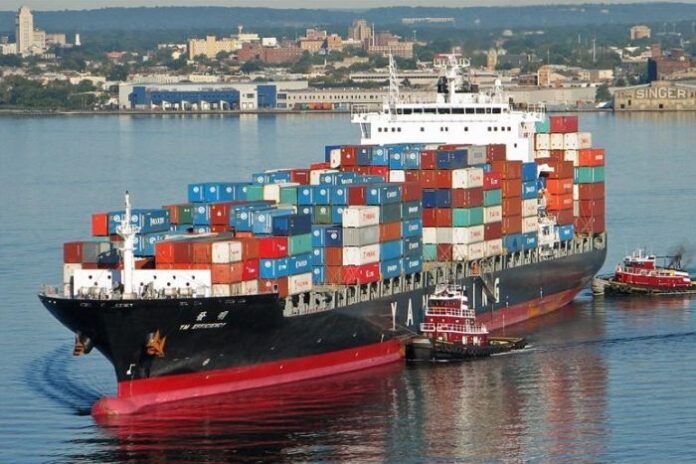
Australia is not a global shipping power. It does not have a major ship owning or shipbuilding industry and its flag flies on less than .01% of the global fleet by tonnage(Opens in new window). However, Australia loads more cargo by weight onto vessels than any other country in the world, the majority of which is attributed to a single trade. Every year, around 900 million tonnes of iron ore from Western Australia is exported to China and East Asia(Opens in new window). This single, massive export lane sits at the centre of Australia’s potential leadership.
Think of it this way: while shipping’s greenhouse gas emissions are about 3% of total global emissions, it is not an end unto itself, but an enabler of other industries. The supply chain for steel starts in the mines of Western Australia, moves onto 300-metre-long Newcastlemax bulk carriers, and ends up embedded in everything from microwave ovens to building frames and automobiles. There is no way to decarbonise the global economy without also decarbonising the trade in iron ore.
From this perspective, Australia’s climate ambitions are aligned with its trade goals, since the country’s dominant role as an exporter gives it a head start on climate-proofing the supply chain.
The fact that this climate-proofing will require fuels based on green hydrogen has not escaped the attention of industry in Western Australia, where mining, shipping, and future fuel production are developing simultaneously in the hopes of securing market leadership. This is a two-pronged opportunity for Australia to secure today’s largest export earner and develop a new one in hydrogen-based fuels. Whether the government follows industry’s lead in developing these opportunities will be a major indicator of Australia’s industrial ambitions as they relate to the energy transition.
The development of those hydrogen-based shipping fuels – arguably the only option for decarbonising shipping at scale – is not just a solution for the climate, and not just an opportunity for Australia. The ASEAN region was hit hard by this year’s disruptions to energy and fertiliser markets(Opens in new window). Green hydrogen offers a pathway to energy and fertiliser security, and the decarbonisation of shipping can help kickstart the market. Australia may have the best fundamentals in the region for producing these molecules, but it can also work with its neighbours to make sure that regional trade in these future alternatives is resilient(Opens in new window)– and that dependence on the Middle East is not swapped entirely for dependence on China, where production of green ammonia and methanol is already taking off.
If the role of a leader is to ensure that others are not left behind, then Australia’s relationship to the small island developing states of Oceania is surely one of its biggest leadership challenges. Shipping is the lifeblood of these economies, and climate change is an existential threat. As their wealthiest and largest neighbour, and president of the negotiations of COP31, Australia’s commitment to global climate action is a moral and diplomatic obligation to the Pacific. More specifically, the country has the means and motivation to support a transition to zero-emission shipping that includes them.
Back to the IMO, where the Pacific island states have been the engine of climate ambition. As Australia’s climate diplomats turn their focus to COP31, its shipping diplomats face the urgent task of preparing for the delayed vote on the Net-Zero Framework. To its credit, Australia has been a prominent defender of the NZF, including its plan to generate funds that backstop zero-emission investments and support the transition in the Pacific island states and other SIDS(Opens in new window).
Given the convergence of its interests in climate, trade, and regional diplomacy above, Australia will have a reason to lead on shipping decarbonisation whether or not the IMO can steer an agreement into harbour. But no single decision would do more to underwrite those interests than the adoption of an ambitious global framework in December.
*Jesse Fahnestock is the director of decarbonisation at the Global Maritime Forum, overseeing the organisation’s work with the Getting to Zero Coalition, Poseidon Principles, Sea Cargo Charter, and green shipping corridors. the director of decarbonisation at the Global Maritime Forum, overseeing the organisation’s work with the Getting to Zero Coalition, Poseidon Principles, Sea Cargo Charter, and green shipping corridors.