China’s security footprint was once confined to its immediate neighbourhood. That time is now past. Under the leadership of Xi Jinping since 2013, China has steadily extended its presence across the Indian and Pacific oceans, building relationships and gaining access far from home waters. )From The Strategist. The Australian strategic Policy Institute.)
The third instalment of ASPI’s Pressure Points series, released today, examines this transformation. It explores how China is expanding its security engagement across the Southwest Pacific, the Indian Ocean and Australia’s maritime approaches; the tools it is using to do so; and what those developments mean for regional security.
The result is an interactive examination of one of the most important strategic trends shaping the Indo-Pacific: the emergence of a China that is increasingly capable of projecting influence and power beyond the First Island Chain.
This didn’t happen overnight. What the region sees today is the product of a decades-long evolution in Beijing’s approach to defence diplomacy and security engagement. During the Mao era, China’s military had little meaningful interaction with foreign counterparts. Under Deng Xiaoping and Jiang Zemin, defence engagement supported economic development and integration into the international system. Under Hu Jintao, China’s military began conducting more overseas activities, including peacekeeping and counter-piracy missions.
Under Xi, security engagement has become a central tool of statecraft. China’s defence diplomacy now supports broader objectives: protecting overseas interests, expanding strategic influence, shaping regional security norms and creating conditions favourable to Beijing’s long-term ambitions. China’s growing blue-water navy, expanding overseas logistics network and deepening security relationships all reflect this shift.
Part three of Pressure Points traces how these ambitions are being pursued across different regions.
In the Southwest Pacific, China’s engagement has evolved from a focus on diplomacy and development assistance into a much broader security posture. While the Pacific remains economically peripheral to China, it occupies an important strategic position. Beijing has sought to build influence through policing cooperation, security agreements, infrastructure projects, military assistance and defence diplomacy.
China’s 2022 security agreement with the Solomon Islands demonstrates how rapidly China’s security role can expand when opportunities arise. Across the region, Chinese police training, equipment donations and institutional partnerships are gradually normalising a Chinese security presence in a region long regarded as strategically important to Australia, New Zealand and the United States.
The Indian Ocean presents a different but equally significant story. China’s dependence on trade routes and energy imports transiting the Indian Ocean initially drove its interest in the region. Over time, however, economic interests have merged with strategic ambitions. Counter-piracy deployments in the Gulf of Aden provided China’s navy with valuable operational experience and created justification for sustained deployments far from China’s shores.
Today, China maintains its first overseas military base in Djibouti, conducts regular naval deployments across the Indian Ocean and continues to develop access arrangements and dual-use infrastructure throughout the region, gradually building a network capable of supporting long-duration naval operations. While not all facilities constitute military bases in the traditional sense, they provide access, logistics, intelligence opportunities and strategic influence.
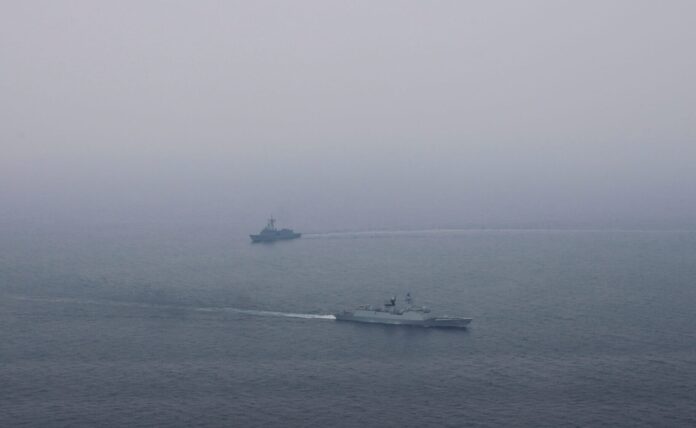
The project also explores the tools that underpin China’s expanding reach. Much attention focuses on warships and aircraft carriers. Yet China’s influence increasingly depends on a broader ecosystem that includes coast-guard vessels, research ships, intelligence collection platforms, overseas police cooperation, private security companies and dual-use infrastructure. Individually, such actors and activities may appear benign. Collectively, they help China build familiarity with operating environments, strengthen relationships with partner governments and normalise a sustained Chinese presence across the Indo-Pacific.
The central question examined throughout part three is not whether China will be present across the Pacific and Indian oceans. That question has already been answered. The challenge for regional states is determining how they respond to a China whose security footprint is becoming larger, more sophisticated and more permanent.
Importantly, the project does not frame every Chinese activity as inherently threatening. Many countries welcome Chinese investment, training opportunities and security assistance. Nor does it suggest that China is alone in seeking influence and access across the Indo-Pacific. But understanding the cumulative effect of these activities is essential. The region’s future security environment will not be defined solely by dramatic crises in the Taiwan Strait or the South China Sea; it will be shaped by the gradual accumulation of access, influence and presence.
Part three of Pressure Points seeks to make that process visible for policymakers, defence planners and the broader public. Drawing on open-source data, official reporting, military imagery and regional analysis, the project maps China’s expanding security engagement across the Pacific and Indian oceans, assesses regional responses and explores how current trends could evolve over the coming decade.