The collapse of the Soviet Union and with it the end of the Cold War led President George H.W. Bush to revive President Woodrow Wilson’s term – the New World Order. But what did this mean for the RAN, particularly after its experience the Gulf War? Lieutenant Commander James Goldrick explored this topic, first at the ANI’s “Maritime Power and its Place in the New World Order” seminar and then in the November 1991 edition of the Journal of the Australian Naval Institute.
Maritime Power in the New World Order: The Young Turk’s View
Introduction
My theme concerns not so much the Gulf but the consequences of the Gulf and the other geo-strategic changes which have been taking place since 1988. My concern is with the consequences for the RAN and its future as an instrument of national policy. Everything we have heard (in this seminar) demonstrates two points. The first is the ease with which RAN units operated with American and NATO units, largely the result of equipment, procedures and communications interoperability which were themselves the result of long and close links at operational, technical and planning levels.
The second is the underlying theme of the ‘New World Order’ – the fact that the ht-polarity of the Cold War is being replaced by a multi-polar world in which the conflicts of interest will stem from many other reasons of self-interest than ideology. And, despite the overwhelming success of United States power and technology, there is an increasing consciousness, foreshadowed by the historian Raul Kennedy in The Rise and Fall of the Great Powers, that the present pre-eminent role of the US as the world policeman is a short-term manifestation. The position of the US must decline, if not absolutely, then relatively. This is a hard economic fact.
We can see it happening now in Asia. The rapidly developing economic strength of the region is bringing with it the dividend of increased stability and a greater recognition of both individual and collective security interests. Where 25 years ago the naval strength of the Association of South East Asian Nations’ (ASEAN) members could be summed up as 20 small Malaysian patrol boats, a partly stripped Russian built cruiser in Surabaya and an elderly Japanese built sloop aground in the Bangkok River, ASEAN naval strength now takes up a good many pages in Jane’s Fighting Ships.
Small Navies in the Modern World
So what does this mean for Australia and the RAN? Nothing much alarming in the short term but a great deal in the long. It means that we will, increasingly, be one smallish navy amongst many others.
Most of all it means much change in our justification for what we do. What do I mean by this? My thesis is this: the change to a multi-polar world with a host of sophisticated nation states means parallel changes in the nature of naval power. The few powerful major fleets and the limited number of client navies with which they co-operated are now being challenged by the creation of capable maritime forces by nation states which have not before possessed either the means or the inclination to operate navies on any scale.
The RAN in the Modern World
The RAN has hitherto been one of the privileged client navies. In 1991 it faces the prospect of profound changes in its relationships with the major naval powers at the same time as it faces the challenge of no longer being a pre-eminent influence in the regional maritime environment. How the RAN – and thus in many ways our national security interests – will fare must depend upon how we deal with these two problems.
The RAN & ‘Big Brother’
Let me start with our relationship with our ‘Big Brother’. To do this it is necessary to go back in history to the foundation of the Australian Navy. First, the RAN was established at a time when, despite much emergent national consciousness and a diverging strategic interest from Britain, Australia was not an independent power and had no legal facility to develop independent foreign policy. In reality, any military forces possessed by a Dominion were elements of the British Crown forces. Both sentiment and law ensured that they would be employed as such come a war – and so they were in 1914.
But there was a second fact. The founders of the RAN wanted an efficient navy. They knew that the RAN could not be a really effective force in the short term without extensive support from Britain. And this could not operate properly unless the RAN was created in form as a miniature of the Royal Navy (RN). I do not say that there was not some element of the fact that the “British way was the only way”. There was. But more importantly, it is and has always been true to say that small navies are fundamentally less efficient than large ones. There are very few exceptions to this rule in the present day. The efficient smaller navies in the modern world are those which have sustained close links with the largest navies.
The difficulty is that this policy, which was sustained consciously right up until the late 1930s (you could not be promoted in the RAN, for example, unless you had served with the RN in the previous rank and been recommended for promotion according to RN standards in that time), clashed with the emerging elements of national sentiment and national interest. I separate these two deliberately because confusion as to their conflict with the navy’s relationships with other navies has done much damage.
The Image Problem
Let me give examples of the two. The Navy often seemed un-Australian in the past because its officers served so long with the RN that they metamorphosed to a greater or lesser extent into what were viewed by other Australians as RN ‘clones’. The fact that they were instantly recognisable to the British as Australians with very much their own identity was beside the point. The problem lay in their style as perceived by other Australians. An instance of the effect of this misapprehension on the determination of national interest came in the debate over the Singapore question. The Navy supported the British “main fleet to Singapore” policy and developed its forces in order to integrate with the RN. The Army and RAAF viewed the whole approach with disquiet and argued for additional expenditure on local defence.
In hindsight the argument has been made that the RAN officers were sacrificing the Australian interest to the British. They were not, of course, they simply had a different approach. The fact that both groups before the Second World War may have been right is rarely mentioned. In this case, the British style of the RAN was presumed by its critics and opponents to imply an uncritical British hue when this was not the case.
An Adolescent Navy
This was one problem for the Navy that continued to dog defence decision making for the next thirty years. T.B. Millar’s work on Australian defence policy written in the 1960s makes specific mention of this syndrome. The real difficulty, however, was that RAN officers began to forget the motivations for their client relationship with the RN and fell into what was very much an adolescent way of thinking – we sought independence without responsibility and the right to criticise without ourselves having full knowledge of what we were criticising. We all know the sort of thing that I mean – the cheerful acceptance of a prescriptive right to criticise British methods while using their training, their equipment and their Books of Reference. We did not start from first principles in determining what it was that we were doing at sea and why we were doing it. The tendency was to take the operational procedures and concepts of the larger navy and force them into whatever shape was demanded by the forces we possessed.
The entry of the Americans into the picture meant little improvement upon this syndrome. We adopted the DDGs and their associated systems with enthusiasm and took our pick of the US training courses while sustaining a cheerful contempt for many of the American procedures. Any Australian DDG was better than any USN DDG. The fact that the Americans had other concerns and saw fit to devote the cream of their talent to other purposes such as nuclear power and aircraft carriers passed us by. What also passed by many was the realisation that without the free admission to the USN systems and procedures, the quantum leap which the DDGs implied in operational capabilities would never have been achieved as early as it was.
I think that the higher administration of the Navy has always been clearly conscious of the anomalies of such a client relationship in relation to the major navies. But I do not think that the appreciation of our position always existed at subordinate levels.
To give you an instance. In 1950 and 1951 we commissioned the Australian built destroyers Tobruk and Anzac. These had been constructed to a modified design based on the 1945 British Battle class. The most important difference was that Tobruk and Anzac carried the brand new 4.5 inch Mk. VI turret – which was not due to go to sea operationally in the RN until the first of the much delayed British Daring class commissioned in 1952. Now it seems to me that it is a glimpse of the blindingly obvious that, if there is a new system available and a big navy is buying it and you can afford it – you’ll fit it. And so we did. Tobruk was the first operational unit in the world with the Mk. VI. Being a brand new design, it had lots of teething troubles – as all novel gunnery systems do. But did we accept this as something natural – ‘No’. I have heard it seriously suggested that the British set us up so that all the problems would be out of the way by the time the Darings entered service. Yet what would have been said if the British had fobbed us off with the obsolete Mk. IV turret of the older Battle class? This is what I mean by an adolescent attitude.
Consequences
As a result of this immaturity, we found great difficulties in thinking about what Australia’s strategic situation required of its navy. We suffered, to use a term beloved of the present naval attache in Washington, from ‘delusions of adequacy’. Anything the big navies could do we could do better, anything that the big navies needed we needed as well. We had little idea of the real infrastructure requirements of multi-purpose naval services because so many of those infrastructure requirements represented such a long term investment of funding which had permutated into standing expertise that no amount of budgeting could provide for them without the lapse of decades. We were, until only the last fifteen years, effectively operating squadrons of the RN and the USN, modified for local conditions but in almost every respect indistinguishable from their own ships. The British Flag Officer Second in Command Far East monitored the operational standards of RAN frigates and destroyers in the Strategic Reserve in the 1960s. No one thought this odd. And where did we look to revive our MCM capability and create a submarine force in 1960 – where else but the RN?
It was a comfortable enough system. It actually served Australia’s strategic needs pretty well. But it did allow us to avoid uncomfortable decisions. And it did not prepare us mentally for the vast changes in our situation which became inevitable with the withdrawal of Britain from east of Suez and with the American debacle in Vietnam. Much has been said about the difficulties of changing the shape of Australian strategy to meet the new requirements. I do not propose here to attempt to deal with the strategy itself. What I am more interested in is the Navy’s reaction to those changes and its response as an entity.
Delusion of Adequacy
In most ways that reaction reflected another stage in our adolescence. Although I understand Rear Admiral Richard Hill’s doctrine of the medium maritime power, find his analysis lucid and relevant and agree with most of his conclusions. I cannot help but think that the term ‘medium maritime power’ did a certain amount of harm in Australia because it was applied in a sweeping and over confident manner and, in conjunction with the term ‘self reliance’ came to mean something which it never could, particularly in a country which has no intention of ever spending very much on defence if it can avoid it.
What happened was that we entered a period when we thought that the Australian answer had to be the best answer. We tried to do too much and failed to recognise that what self reliance is all about is a recognition of where this country’s best interests lie, not necessarily doing everything ourselves or attempting to create a core of expertise in all subjects. Some of the problems of recent years, have I think, been directly attributable to this syndrome. We were not ready and I would suggest that we could not be ready – to meet the demands of all the novelties with which we were dealing, I am unsure that we are ready now because our tendency is to oscillate between “If we are doing it by ourselves, it must be wonderful” to “Don’t look now but everything has turned to shit.”
I hope that anyone here who is involved in the submarine project will forgive me making a cynical prophecy. Up until now the new submarine project has been all ‘hearts and flowers’ but, as work progresses, we will stand to hear the doom laden buzzes from the after stokers’ heads concerning engineering difficulties, stability problems, cost over-runs and, worst horror of all, software problems. By the time she commissions, the first Collins class will probably have a white cross chalked on her conning tower with “Lord have mercy on our souls” underneath. It won’t be until she has been running for a couple of years that people will stand to admit that the design is quite a good one. The truth is that any new warship of any sophistication will suffer significant teething troubles— look at the Americans with the Aegis cruisers and the British with their new submarine, the Upholder.
Life with the Big Navies
And we have not thought through the future of our relationship with the big navies. That it is presently in reasonable repair is seen by the results of the Gulf but we have yet to take a hard line on what it is that we have to do for ourselves and what it is that we will buy, beg, borrow or steal – and I use that term deliberately – from our Big Brothers. I’ll leave this part of my argument with one example. Before I came south last weekend, I did a rapid head count of British Books of Reference and other Allied publications carried in my – presently high and dry ship. In a lone Fremantle class -admittedly British designed – we carried 20 British BRs and 26 Allied publications. Not bad in a 42 metre ship!
If our relationship with the great navies does stand to atrophy, what do we have to put in its place? And what resources will be able to do the substitution?
South East Asia
So we have problems in dealing with the realities of one side of the ‘New World Order’ – but there are others. As far as South East Asia is concerned the RAN is in decline. I do not mean absolute decline – I mean relative decline, which, in realpolilik, comes to the same thing.
Make no mistake. Naval strength is no longer the preserve of the Great Powers and their client allies. It now represents a function of national activity amongst the great majority of nations of any size and sophistication which have access to the sea. The truth is that the technological edge which the RAN has enjoyed within the South East Asian region has nearly disappeared. Its passing is represented by the commissioning of the sophisticated Singaporean Victory class corvettes, by the acquisition by Malaysia and Indonesia of capable mine counter measure vessels (MCMVs), by the Malaysian project to create a submarine force, by the Indonesian/American project to configure the CN-235 maritime patrol aircraft with the air launched harpoon missile. I could go on. But as an observer for the last decade I can tell you that these developments are consistent and they are working. Every major Asian power, with the possible exception of China, is – for whatever reason developing its naval forces and espousing strategic policies which have an increasingly maritime orientation.
I am not arguing that any of these advances in regional capability represent a threat to Australia. They do not of themselves. But what is more important from the aspect of the navy as an instrument of policy is that the relative importance of an RAN presence in South East Asia must inevitably decline. Nations which are capable of operating naval forces of some sophistication are much less likely to be impressed by the national capability implicit in the deployment of major combatants. What these developments represent is a challenge.
Arms Sales
And we had better get it out of our heads that we are going to be the beneficiaries of any decisive technological advantages from the major powers unless there is something in it for them. If there is one lesson from the Gulf War it is that arms sales are not going to stop. And, the less the importance of ideology and standing alliances, the more part will be played by the almighty dollar, particularly when a country with large scale defence industries is cutting down on its own budget. We may see some interesting rationalisations to justify arms sales but we are definitely going to sec arms sales, from the great power point of view, Australia is no more a ‘worthy’ beneficiary of arms than any other regional power. Our credentials as a maintainer of stability are no better than anyone else’s.
And remember, too, that the more sophisticated a navy, the more discriminating it will be in its purchases. Beads to the natives and Old Ming are a thing of the past unless there is some pressing financial advantage to accompany them. Buyer nations will insist on the ‘top of the range’ missile homing head and will not be content with the export model. They will also be more prone to check that what they are getting matches the specifications and they will be more capable of doing the check themselves. We already have examples of discrimination – the Thais were happy to have frigates built in China but, as soon as possible, they have opted for bare hulls with a fit of Western systems.
Keeping Ahead
So what will make the difference? In a word, doctrine the ability to exploit the technology available to the seagoing fleet. And it is here that we return to my earlier point that small navies are inherently less efficient than large ones. I make a rider to this – they are less efficient in a time of technological change (such as the present) because they lack both the human and the financial resources to derive sufficient operational experience from the equipment they have, analyse that experience and determine what lessons should he applied. This lack is something which we see time and time again in passage exercises with navies which have not enjoyed the same cosy relationship with the leading navies which has been our lot. And it is something of which our regional neighbours are acutely aware. Should it be any surprise that they send so many students overseas to the US and to the UK, sometimes at exorbitant cost, to learn what they can from the major navies. Should it be any surprise that there is much interest in seeking assistance from the RAN?
So the difference in capability in a world in which there are so many navies will lie in doctrine, not technology itself – or, to express it somewhat differently, in the possession of information and the ability to exploit it. And what does that mean for the RAN?
In short we have to decide just how we can access the best sources. The race, ladies and gentlemen, will go not to the swiftest but to the best informer. And here lies the problem for the RAN. On the one hand, we stand a good chance of losing our access to the big western navies – or, more critically, our ‘privileged’ access to them – while we have yet to develop really strong links with the South East Asian navies and possess ourselves only a very limited data base and an equally limited capacity to originate or develop doctrine for ourselves. I hope that you get my line of argument – the future of the navy depends absolutely upon its ability to manage information.
Managing Information
How do we go about that management? The first solution is to recognise our relationships with other navies for what they are. Within the context of mutual strategic interests, we must realise that we are in with the big navies for what we can get. Sentiment be blowed. Every exchange officer, everyone involved in a multi-national exercise must be out there to learn and to bring back knowledge about procedures, about equipment and about promising developments. We have to make the learning process formal and we have to develop means by which the invaluable experience of our exchange personnel can be turned immediately into solid information and not retained within the brain of the officer concerned. We have started to move in this direction but I would suggest that a permanent ‘debriefing and translation’ team would be worth consideration, with an accompanying brief to analyse the lessons of major multinational exercises.
Specialising to Survive
We have to specialise in our attempts to develop unique capacities and this specialisation should be determined not only in relation to Australia’s strategic requirements – there is and should be no way round that requirement – but in relation to what will be of benefit to the navies which have something to offer us. And that does not only apply to the USN and to the RN but to the South East Asian navies. The Singaporeans are in the process of acquiring at least four MCMVs and have a host of other activities in that field. It is difficult to believe that there are no opportunities there. The efforts in anti-submarine warfare under the Five Power Defence Agreement represent a beginning, we have to capitalise on this.
I’ll make two observations on this subject. The first is that the time is coming when the bigger navies may welcome links with us because reductions in their own force strength will mean that they themselves will have to pick and choose. We are already seeing this in the RN. Britain is unlikely to be in a position to afford a new generation area defence missile for the AAW units. Collaboration with the French (of all people) is almost inevitable. So there may be a willingness to take advantage of other nations’ expertise on a quid pro quo arrangement.
As a corollary. I laving chosen our fields of expertise, we must bury forever the ‘not invented here’ and ‘we can do better than that’ syndromes. We must decide what we want, write the staff requirement with care, select the right system and write the contract with even more care. If it is not in our designated areas of development then we must avoid at all costs the labels ‘High Technical Risk’ and ‘Still to Go to Sea’. All this done, we must get on with the job of learning how to use it properly – ‘Best is the Enemy of Good Enough’. We must content ourselves with the Volkswagen of reality rather than the Mercedes of our dreams.
Talking to each other
And, above all, we have to achieve a revolution in our internal thinking and in the way that we transmit information around our own system. I suppose that the most important thing here is a change in attitudes. For a small navy, we have a remarkable ability to break ourselves down into small tribal groups between which minor wars often break out. These disputes can be a healthy sign, but tribalism is no good thing when it results in the senior members of each tribe concealing their specialist knowledge from the uninitiated. I remember the look of horror on a submariner’s face when I told him that we were planning to distribute the submariners’ tactical guides to the Principal Warfare Officers course. You just don’t do that with people from the skimmers – they might read them! And, even though I pick on the submariners, the fad is that we are all guilty of such tribalism. But we cannot afford it.
Conclusion
Rather than stupefying you all with a repetition of my points and recommendations, let me conclude with a quotation which encapsulates my thesis. It is Benjamin Franklin’s cheerful comment made on the occasion of the signing of the American Declaration of Independence: “Yes, we must, indeed, all hang together or, most assuredly, we shall all hang separately.”
About the Author
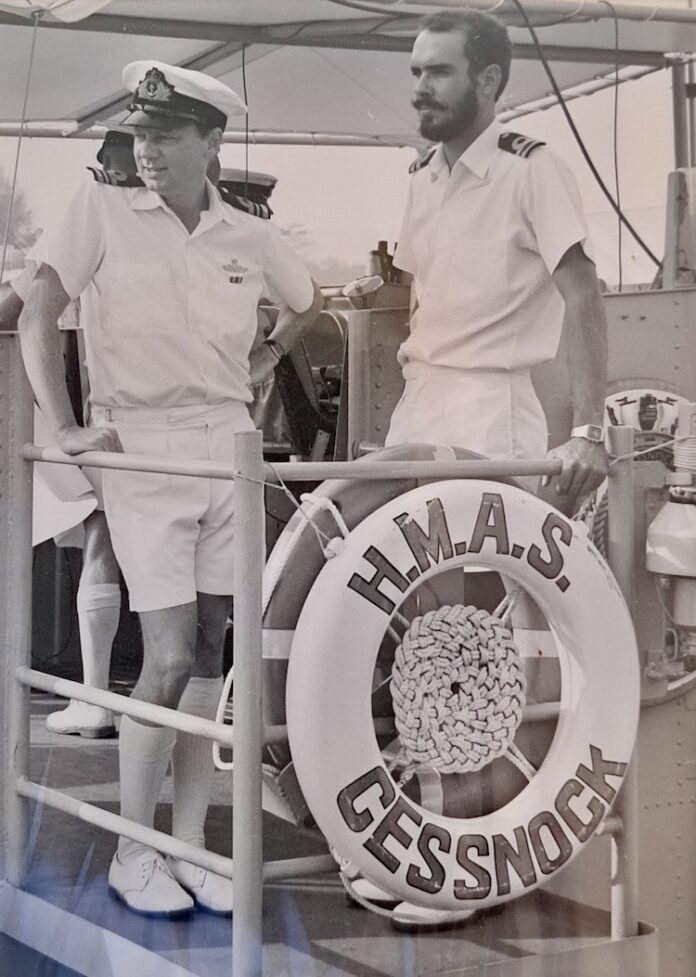
Rear Admiral James Goldrick AO CSC RAN joined the RAN as a 15-year-old cadet midshipman in 1974. He was the commanding officer of the patrol boat HMAS Cessnock when he presented this paper. A member of the ANI from its earliest days, he would go on at different times to be a counsellor, journal editor, President and was finally made an honorary life member. James Goldrick passed away in 2023. His ANI obituary is at https://navalinstitute.com.au/obituary-rear-admiral-james-goldrick-ao-csc-ran-retired/