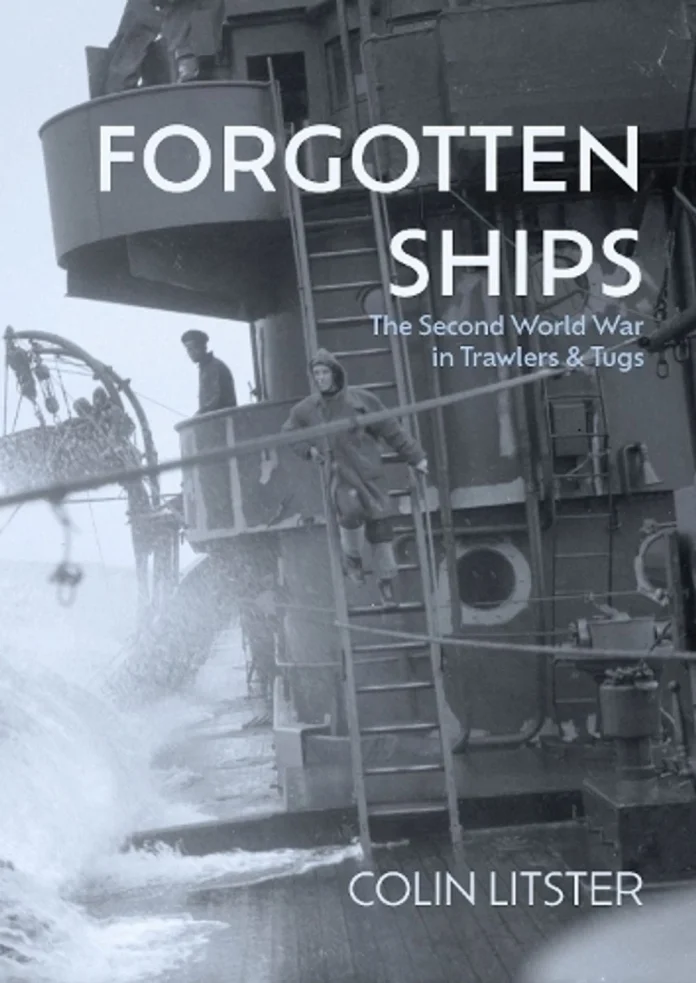
Forgotten Ships – The Second World War in Trawlers and Tugs. By Colin Litster. Whittles Publishing, an imprint of Porto Press Ltd, St Albans, UK, 2026. ISBN: 978-1-84995-729-8 (Paperback)
Reviewed by David Hobbs
Colin Litster is a former bookseller who lives in the southwest of England where he works with adults suffering from learning difficulties. His father was a naval architect and his grandfather was a peacetime yacht skipper who served in the Royal Naval Reserve during the Second World War, commanding several armed trawlers and rescue tugs.
The author recalls growing up listening to his grandfather’s stories of an adventurous life spent at sea and this book combines some of those stories with a wider description of the important roles played by these minor war vessels. As he observes, few books have been written about the tasks undertaken by these vessels and even fewer have attempted to describe the conditions suffered by their ships’ companies, most of them merchant seamen absorbed into the RNR, as they operated in every kind of weather from the arctic seas to the Indian Ocean. Litster’s book makes an interesting contribution, therefore, to the overall historiography of the war, combining anecdotal descriptions of his grandfather’s time at sea in command with descriptions of the part played by other, similar, vessels in the overall conduct of the war.
The book is divided logically into two sections with the first, comprising slightly more than half the text, describing the work of Admiralty trawlers in roles that included anti-submarine searches, convoy escort, the movement of troops in the short but unsuccessful Norwegian campaign and mine clearance. On page 100 the author summarises the contribution made by these minor war vessels to the Royal Navy’s global operations with some interesting statistics. In 1939 the Admiralty had only 94 trawlers and drifters on its charge but by August 1945 their number had grown to 6,000. They were mainly manned by civilian crews absorbed into the Navy under T142X regulations with RNR officers given only the minimum of tactical training. Roughly 10% of these vessels were lost at a cost of 14,500 lives; a number Litster believes to be the highest proportion of fatalities within any branch of the service. Of those 2,385 have no known grave but the sea. Lieutenant Litster RNR commanded His Majesty’s Trawler Angle and it is measure of how hard the crews of these vessels were worked that he was not ashore for long enough to receive the DSC he was awarded for service during the Norwegian Campaign in 1940 until four years later in October 1944. Family legend has it that when Lieutenant Litster stepped forward to receive his medal from King George VI, the King asked ‘why have you kept me waiting? Apparently he was touched by the King’s concern and explained how his duties had kept him far from home for all that time.
The second part of the book begins with a description of Litster’s time in command of the rescue tug Bold, a new vessel built for the Royal Navy by the Defoe Shipbuilding Company of Bay City, Michigan, under Lend/Lease arrangements. He stood by her while she was completed and subsequently operated from Newfoundland and in the Caribbean before moving to the Eastern Fleet in the Indian Ocean. A number of different tasks are described including the rescue of torpedoed merchant ships that could be repaired, towing battle practice targets for other ships to shoot at and towing Admiralty floating docks. For sheer scale the task of towing the constituent parts of the artificial Mulberry harbour to Arromanches as part of Operation Neptune after the D-Day landings, described briefly, must constitute one of the tug force’s most notable achievements. Lister and his vessel were not there but this is one of the details that the author has added onto his grandfather’s story to give readers a wider appreciation of the minor war vessels’ operations. Litster’s final command, by then as a Lieutenant Commander RNR, was the powerful tug Mediator built at Leith, just outside Edinburgh in Scotland. By 1945 her most notable achievement was towing Admiralty Floating Dock 32 from New York to Mers-el-Kebir via Puerto Rico. This important work provided the operational fleets with the support they needed but seldom made the headlines.
Inevitably in such a book there are a few errors. Typical of these is the statement on page 45 that the German Admiral Hipper was a battlecruiser. She was a heavy cruiser. However, the error that I found most irritating was the author’s description, on page 60, of Captain E S F Fegen VC RN of HMS Jervis Bay as ‘a member of the Merchant Navy’. Perhaps his understanding of what an armed merchant cruiser was and how it was manned lacked sufficient clarity.
Small errors apart, this book does shed light on an aspect of naval warfare that has received too little attention. Whilst it only tells part of the story, it does give the reader an awareness of this wide ranging subject and stimulate many to look more deeply into the part played by minor wat vessels throughout the Commonwealth Navies in two global wars and from that perspective I recommend it.