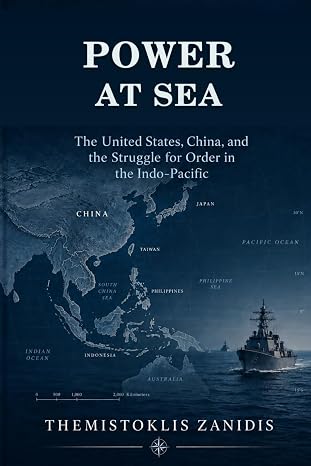
Power at Sea; The United States, and the Struggle for Order in the Indo-Pacific. By Themistoklis Zanidis. Independently published ISBN: 979-8-1760-0032-0. www.themiszanidis.com
Reviewed by Tim Coyle
Themistoklis (Themis) Zanidis is an independent geopolitical analyst and writer based in New York, specialising in Indo-Pacific maritime analysis. He is a 15-year veteran of the Hellenic Navy in which he held roles in radar, weapons systems and electronic warfare.
Power at Sea is a 100-page monograph arguing that ‘the rivalry between the two greatest powers of our era cannot be understood adequately without reference to the sea’.
Zanidis begins his argument by stating ‘Why the Sea Still Rules the World’… ‘States move and shift in directions resulting from their histories, cultural ideologies and generational national and supra-national influences…’
China emerged from the 1937-45 Civil War when the Chinese Nationalist Kuomintang (KMT) government of Chiang kai-chek fled to Taiwan and the Communist leader Mao Zedung declared that the ‘Chinese people have stood up’. The sea played little part in the Communist victory until the Chinese People’s Liberation Army-Navy (PLAN) was largely cobbled together from junks and fishing vessels to expel KMT troops from the near Chinese islands. The PLAN was incrementally expanded and professionalised through former Nationalist naval personnel and a 15-year period of Soviet tutelage. It remained a coastal force until the late 1990s when it began its unprecedented expansion, supercharged by Xi Jinping’s assumption of presidential power in 2012. Laying claim to the South and East China Seas, it uses a network of fortified islets and a formidable military establishment of PLAN surface, subsurface and air forces, the world’s largest coast guard and the People’s Armed Police Maritime Militia, comprising numbers of ostensible fishing craft, to conduct ‘grey zone’ maritime confrontations against the Philippines, Japan and other regional powers to assert its unilateral claims to maritime regional hegemony. This reality is part of Zandidis’ argument.
Zanidis contrasts the 80-year plus US maritime presence in the Indo-Pacific region post the Pacific War. The US Pacific Fleet remained in East Asia, after having pacified Japan, to oversight the postwar security of South Korea, the Philippines and exert a powerful buttress against the PLA. The Korean War is still technically unresolved while the Vietnam war ended in effective defeat for the US. Now the People’s Republic of China, and its armed and paramilitary forces, combine with its industrial capacity, exemplifies in an enormous shipbuilding capability, threatens US and European industries and their economies.
Zanidis posits that the PRC has changed the strategic balance in that its maritime ascendency has not historically arisen as that of Britain and the US. Its dominant emergence is driven by the understanding that ‘no durable great power status is possible without maritime security and maritime leverage’ and ‘Beijing sees greater freedom in the near seas and a significant presence in the far seas’. Its aim is to diminish American regional presence.
Any contemporary seapower observer must have a grudging respect for how the PRC – historically a land power – has used non-military maritime assets – such as the para-military China Coast Guard and the Maritime Militia – to enforce its maritime claims and conduct operations below the threshold of war. Zanidis points to this strategy as 21st century maritime power with cannot be confined to naval fleets alone.
For its part the US seeks to preserve an existing maritime order, based on its 80-year regional presence. It does this by maintaining its alliances, protecting trade routes and, above all, to uphold American interests. In this fraught relationship between the US and the PRC, Taiwan is the linchpin. Zanidis discusses the relative strengths and weaknesses of both sides through the maritime balance and backgrounds the contrasting economic, demographical, technological and industrial profiles.
Taiwan and defence of the First Island Chain receive due analysis as simmering volcanoes. Maritime policies and force profiles – engaged in or peripheral to – the regional standoff are examined, as are the strategies and operational challenges vis-à-vis the two great powers. These include India, Japan, the Philippines, the ‘Indo-Pacific geometry’ and go further afield to consider Russia and Europe. The US alliance system is its primary strength and has been for over 80 years. The current US Administration’s demeaning of these valuable assets have led to a questioning of US reliability, particularly with respect to the seemingly ambiguous relationship with Russia (not to mention North Korea), and indeed China itself.
Australia is included in the regional collection with due reference to its status as a formal US ally and its purported role as such in supporting the US bloc. Zanidis enumerates Australia’s value to the alliance, quoting AUKUS, US rotational forces’ presence in Australia, and historically close military links. So far, the Administration’s scorn has not included Australia.
In Power at Sea, Themis Zanidis has presented a thoughtful, timely and succinct outline of the Struggle for Order in the Indo-Pacific.
That he accomplishes this in 100 pages makes Power at Sea a worthy addition to the maritime strategist’s analytical resources.