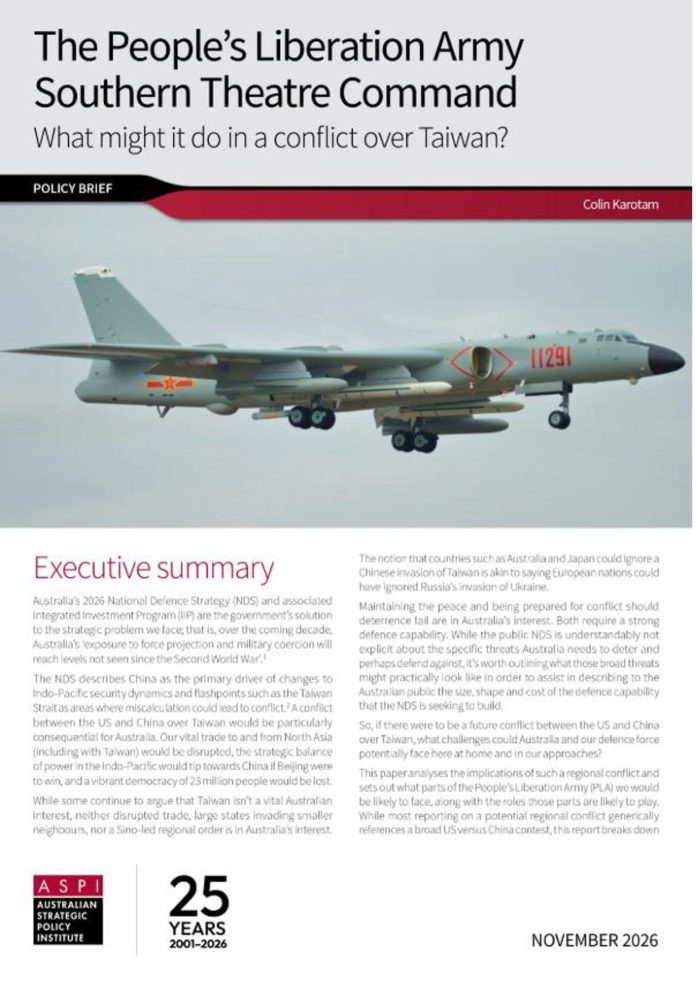
A new report from the Australian Strategic Policy Institute (ASPI) examines how China’s People’s Liberation Army (PLA) Southern Theatre Command could be deployed in a conflict over Taiwan to disrupt Australian military operations, threaten vital maritime supply routes and complicate allied efforts to defend the island.
The report, ‘The People’s Liberation Army Southern Theatre Command: What might it do in a conflict over Taiwan?’, by ASPI Senior Resident Fellow Colin Karotam, explores the challenges a potential conflict over Taiwan could pose for Australia and identifies the parts of the PLA our defence force would likely face.
It breaks down the roles of PLA theatre commands and their likely responsibilities in a conflict over Taiwan, with a particular focus on the Southern Theatre Command, whose area of responsibility extends into the South China Sea and towards Australia’s primary area of military interest.
“A conflict over Taiwan would be likely to be a whole-of-nation effort for the CCP, given that it’s the primary core interest of the party, and the consequences of failure could be catastrophic,” the report states.
“Geographical proximity and the preponderance of air, maritime and missile capabilities in Southern Theatre Command suggest that it would be likely to play a key role in a conflict between the US and China over Taiwan.”
The PLA Southern Theatre Command is the closest theatre command to Australia and the part of the PLA with which the Australian Defence Force interacts the most.
Its area of responsibility stretches deep into the South China Sea towards Australia, while its maritime forces regularly contribute to distant sea deployments to the Gulf of Aden, through the Indian and Pacific oceans, as well as into Australia’s exclusive economic zone as demonstrated by the PLA’s circumnavigation of the country in 2025.
The report notes that, in a major conflict over Taiwan, the Southern Theatre Command would likely contribute significant military assets to the main effort around Taiwan while potentially retaining some capabilities to disrupt allied operations from the south.
It identifies three potential ways China could complicate military operations launched from Australia:
- Long-range disruption: Cyberattacks against critical infrastructure, interference with satellite communications and missile strikes against military facilities or infrastructure supporting operations in northern Australia could seek to deter Australia from involvement or degrade its ability to support allied forces.
- Threats to maritime supply routes: Chinese submarines operating in Australia’s eastern or western approaches could threaten shipping and constrain the movement of troops, military equipment and supplies, potentially disrupting vital maritime links that keep Australia operating.
- Disruption through northern approaches: Submarines, bombers and maritime militia could threaten allied forces transiting the narrow waterways between Australia and the South China Sea, complicating operations from Australia in support of Taiwan.
While the 2026 National Defence Strategy (NDS) and Integrated Investment Program are broadly investing in the right capabilities to deter and counter these potential threats, the report highlights the need for a deeper understanding of the PLA’s theatre commands and the importance of sustaining military capabilities over prolonged periods.
It recommends that the Australian Government communicate more openly with the public about the specific military threats Australia could face, including through an annual public report detailing those threats or through regular updates to the NDS.
The report also calls on strategic planners to better understand the capabilities of individual PLA commands and units, particularly Southern Theatre Command in a Taiwan contingency, and on capability developers to strengthen Australia’s ability to protect its power-projection routes north and safeguard its eastern and western sea lines of communication.
“The aim isn’t to cause panic or fear but to reassure the public that the government has a clear-eyed view of potential threats and a strategy for managing them.”