By Tom Sharpe*
Gulf crude exports are close to pre-war levels. Some reporting even has it above, yet Iran is hitting more ships than at any point in the war. How can both these things be true?
Let’s start with the flows. Data house Kpler, which counts ships by satellite and is as close to an authority on this subject as is possible, puts Middle East crude exports at 18.5 million barrels a day in the week to October 1, against a pre-war figure of 18 mbpd. US official sources quote anything from 13 million to 22 million. The spread tells you how strongly the counting method affects the result here which, in turn, makes this an area ripe for misinformation.
Meanwhile, Iran has been busier than ever trying to cut all this flow off. War-numbers outfit ACLED counted 18 ships struck in September, 16 of them tankers: a worse month for tankers than any since Feb 28 when this all started. Last week added at least six more, including the Kuwaiti super tanker Kazimah III, hit off Oman on Oct 1.
The weapons are mostly one-way drones and “unknown projectiles” probably fired into a kill box to look for a target rather than at a specific ship. At least 11 of September’s victims were linked to the UAE, Kuwait or Saudi Arabia. The targeting is political if not always accurate. Damage is usually engine-room fires and lost propulsion, nasty and occasionally fatal, but rarely ship-killing.
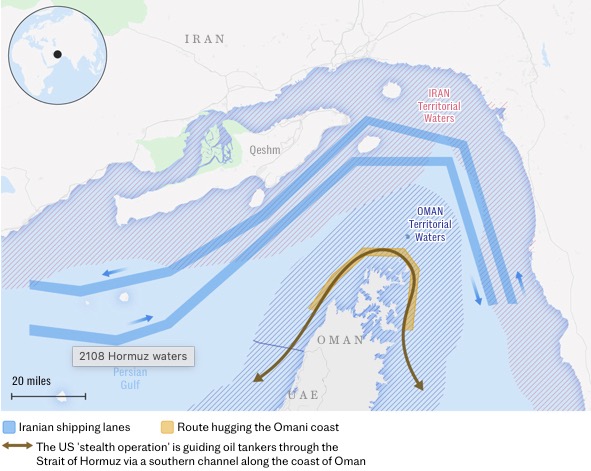
It’s partly because the target has changed. Before the war about 138 ships a day passed through. Now it is nearer 28, and most of the oil moves in very large crude carriers (VLCC) running a shuttle. They load at Basrah or Das Island, then do the dash with their AIS tracking transponder and navigation lights off and tight mobile phone discipline, hugging the Omani side as close as they can making good use of the deep water there.
Iran gets perhaps five loaded crossings a day to fire at instead of a hundred, and the US navy’s southern corridor provides the cover. A key unknown, as it has been throughout, is how good Iran’s surface picture compilation in the southern Strait can be right now. Every time they metaphorically pop their head up, it could be the last thing they do. They’re still hitting ships, so the kill chain is sort of working, but not always the right ones. Having US navy F/A-18 strike fighters, Hawkeye radar birds and all kinds of other things overhead will do that.
How are the shuttle tankers insured, when in March nobody would sail?
Insurance never vanished; it was just repriced, and crews still refused to go. What has changed is ownership. The shuttle fleet is led by the crude producers’ own fleets, for whom one cargo is worth more than the ship. They pay premiums of 6 to 9 per cent of hull value per crossing, or carry the risk themselves. The bill lands through discounts to Asian buyers and on us at the pump.
Sal Mercogliano, a former merchant mariner and maritime historian at Campbell University in North Carolina, points out that “the high flows out of the Strait of Hormuz coincide with the highest charter rates ever seen for Very Large Crude Carriers – $1.3m/day for a voyage from the Persian Gulf to China”. Add war risk insurance in the double digits and low volumes of crude on shore and afloat, he says, and you have the current situation in global oil.
Iran’s own exports are quite another story: zero crude loaded in September, the first time since 1979. The US navy has turned back 125 blockade runners and, after Iranian attacks on 5 September, destroyed five Iranian tankers. The 90 million barrels Tehran had afloat at sea on the way to customers run out this month. The rial is 2.5m to the dollar, inflation is near 90 per cent. It’s taken longer than many expected but the pain of the US blockade is now very high.
To the south at the Bab-el-Mandeb – the entrance to the Red Sea – the Houthis still matter because they own the back door. They overran the rest of Yemen’s Red Sea coast last month and the Saudi East-West pipeline was struck on Sept 10, shutting Yanbu for a fortnight and pushing Saudi crude back through Hormuz. The Houthis also claimed attacks on Riyadh and Khurais last weekend. Red Sea flows of Gulf oil have halved following these, and the legitimate (Saudi-backed) Yemeni government announced a renewed offensive this month. It’s not clear what this will look like. What is clear is that all routes out for Gulf oil – the Bab el-Mandeb, Yanbu, the pipeline, the Omani hubs – are under Iranian attack to some degree.
The Roosevelt is still heading in. Her estimated time of arrival (ETA) might give some indication as to whether strikes are planned by Donald Trump’s administration before or after the US midterms. The USS Ford’s arrival in the eastern Mediterranean in February was a good indicator that strikes were about to start. None of this is an exact science and it’s easy to read into routine rotations as if they are strategic indicators.
This has certainly happened after the US air force’s forward-deployed B-1 bombers left RAF Fairford over the weekend. This means there are none of them there now, which has been the case for 70 per cent of the last five years. This could be rotating a rare and precious asset back home knowing they can return at a moment’s notice if strikes recommence, or it could be the strategic embarrassment for Britain that most commentary suggests.
Based on my knowledge of how these rotations happen, the fact that RAF Mildenhall and RAF Lakenheath still have their US aircraft there – not to mention the USAF’s own statement on the rotation – then add in the Bush and other assets leaving the Middle East, and I suggest there’s not a lot to see here, but let’s see.
Back in the Strait of Hormuz where sailors’ lives are on the line, it remains the case that both “friendly” flow rates and Iranian strike rates are simultaneously as high as we have seen since March. Meanwhile, Iran’s own flow rates are at a historic low and this month their floating pipeline empties.
Has this latest shift in tactics on the water swung things in favour of the US? Arguably yes. Has it reduced the price of oil prior to the midterms? Definitely no.
Can this uneasy status quo survive contact with the enemy for the remainder of October, or is there another shift in tactics with a strategic outcome to follow?
A week is a long time in politics, let alone a month, and it can be an eternity in war. Right now: it’s advantage US.
*Tom Sharpe OBE served for 27 years as a Royal Navy officer, commanding four different warships.
This article was first published in The Telegraph and is republished with the permission of the author.