
By Jahara Matisek*
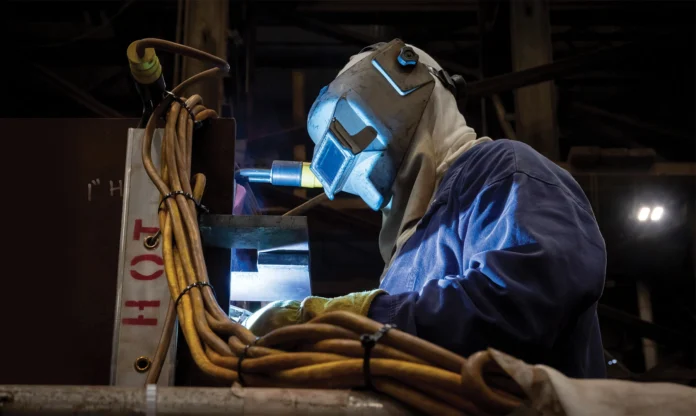
Submarine production falters when a fragile industrial base cannot deliver the specialized castings, forgings, ceramics, magnetics, steels, and acoustic coatings that nuclear safety and acoustic stealth demand. (From: US Naval Institute.)
As a 2019 Proceedings article warned, the U.S. naval industrial base has been in “worse shape than you think” for years.1 This slow-motion train wreck is marked by a shrinking pool of suppliers, aging equipment, and overreliance on brittle subtier vendors. Despite repeated warnings, the submarine-construction enterprise still relies on a handful of sole-source suppliers for critical materials and components, with little margin for error when demand spikes.2
Since 2018, the Navy has directed more than $2.6 billion in supplier development funding to expand capacity, qualify alternates, modernize equipment, and train workers across the submarine industrial base.3 Yet, a 2025 Government Accountability Office (GAO) report noted the Navy has not defined clear metrics to show whether that spending has actually increased throughput, reduced costs, or shortened schedules.4 The result is a concentrated supplier base that remains brittle.
The Navy must commission the Columbia-class ballistic-missile submarines while also restoring a steady production rhythm for Virginia-class fast-attack submarines. At the same time, the Australia–United Kingdom–United States (AUKUS) security partnership envisions U.S. sales of Virginia-class submarines to Australia later this decade, stressing the same yards and suppliers.5
If left unaddressed, supply chain and industrial base weaknesses will undermine one of the most important U.S. geopolitical tools. Submarines are not just another weapon system; they are a leg of the nuclear triad and pillar of U.S. deterrence, power projection, and maritime dominance. Fragile supply chains hurt the Navy’s ability to compete strategically, sustain readiness, and prevail in high-end conflict.
There are four material families in which failures could cascade quickly: (1) propulsor castings and forgings, (2) hull steels, (3) sonar ceramics and rare-earth magnets, and (4) anechoic coatings. In addition, seven systemic pressures are straining the submarine industrial base. Fortunately, practical steps can shore up supply chain choke points to prevent future breakdowns.
Castings and Forgings for Propulsors and Major Machinery
Submarines are stealthy and survivable because of their propulsors and major machinery. Propulsor hubs, vanes, and large pump or valve bodies must meet extraordinary standards of metallurgy, hydrodynamics, and vibration resistance, while also passing exacting nondestructive testing and nondestructive examination. A single defect results in months of rework.
Unfortunately, the United States relies on a dangerously thin bench of suppliers. The Naval Foundry and Propeller Center (NFPC) remains the Navy’s organic foundry and design reference for submarine propellers.6 But the NFPC alone cannot carry the load, nor was it designed to. Each propulsor involves long-lead steps—patterns, molds, pours, and machining—that stretch timelines even in the best cases. When quality issues arise, such as pour defects, heat-treatment variability, or radiographic anomalies, delays ripple into construction schedules.
The GAO flagged supplier quality and planning issues as contributing to early delays in Columbia-class construction. The problem is more than a lack of money; there is an absence of consistent outcome metrics linking supplier development funding to actual gains in capacity, yield, and cost.7 In a supply chain dominated by single-source nodes, that absence of feedback is a red flag.
The risks multiply because Columbia– and Virginia-class production are now overlapping. Two classes of boats, each with demanding propulsor requirements, compete for the same scarce furnaces, molds, and machining slots. Add the prospect of future AUKUS demand, and the submarine production system becomes more fragile.
Mitigation is possible, but it requires discipline. Dual-qualification of subcomponents (i.e., hubs and major pump casings) reduces sole-source risk and ensures that NFPC’s expertise does not become a bottleneck. Early material and tooling buys (such as patterns, molds, and alloy stock) could help smooth furnace and machining queues. Finally, rigorous quality governance using Naval Sea Systems Command (NavSea) technical publications, such as those for nondestructive testing and welding/fabrication, reinforced by on-site oversight from the Supervisor of Shipbuilding (SupShip) and the Defense Contract Management Agency is essential.8 Metrics should track first-pass yield, nondestructive examination reject rates, and the number of waivers per lot, revealing where bottlenecks occur. Without such measures, castings and forgings could become the first choke point that derails submarine delivery schedules.
Hull Steels and Plate for Pressure-Boundary Sections
Every U.S. submarine depends on hull steels to withstand deep-ocean pressures while retaining weldability, toughness, and predictable performance over decades of service. The materials used are not exotic alloys; they are specialized high-yield and high-strength, low-alloy steels. However, their uniqueness lies in the demanding combination of thickness, toughness, flatness, and weld quality needed for a nuclear submarine.
The supply chain for these steels is narrow. A handful of mills provide the plate, and only a few furnaces can accommodate the sizes and specifications needed for submarine hull sections.9 When multiple Columbia– and Virginia-class boats compete for limited mill and furnace slots, the system operates with almost no slack. A single ultrasonic testing rejection or a weld-procedure requalification can result in weeks or months of delay.
Welding itself is a choke point. The process requires exact adherence to approved NavSea procedures, with consistent welder training and qualification.10 Variability can result in rejected sections, costly rework, and schedule slips. Oversight from NavSea, SupShip, and shipyard inspectors helps, but without broader alignment on standards, differences in interpretation between yards and subtier suppliers drive rework.
Risks are magnified by overlapping demand. Columbia-class pressure hulls consume significant quantities of thick plate at the same time Virginia-class submarines are in full production. Future AUKUS requirements will further increase demand.11 As with castings and forgings, this is not a theoretical concern; delays in pressure-hull fabrication have already contributed to schedule challenges.12
Mitigation requires early and steady action. Smoothing plate orders across Columbia– and Virginia-class production could prevent spikes that overwhelm mills and inspection lines. Long-lead contracting could secure furnace and rolling capacity before schedules tighten. Most important, standardizing weld and inspection governance across shipyards could reduce variability and rework. Metrics should track ultrasonic rejection rates, first-pass weld quality, and time-to-repair for nonconformances. Without such steps, even small disruptions in steel supply or welding capacity could generate large delays in delivery.
Sonar Front-Ends: Ceramics and Rare-Earth Magnetics
U.S. submarines have a combat advantage because of their silence and ability to detect quiet adversaries. Modern sonar arrays are built on thousands of piezoelectric lead-zirconate-titanate (PZT) ceramic transducers, each one converting mechanical vibrations into electrical signals with exquisite sensitivity.13These ceramics are unforgiving: Small deviations in chemistry or processing can affect performance. Acceptance testing catches defects, but when batches fail, replacements take months to produce and qualify.
However, the global industrial base is incredibly shallow. Only a handful of producers worldwide can consistently make PZT ceramics at the volumes and tolerances naval sonar requires. Qualification barriers are high, since NavSea specifications demand long, costly testing. These standards make it difficult to bring in alternatives quickly, even when failures or capacity shortfalls occur.14
Risk extends beyond ceramics. Many submarine motors, actuators, and sensors rely on high-performance magnets (i.e., neodymium-iron-boron or samarium-cobalt alloys). Today, most rare-earth magnet supply chains run through China at some stage, from oxide powders to finished magnets, which Beijing can weaponize against the U.S. economy and defense industrial base.15 Beginning in 2027, new defense acquisition rules will bar the use of Chinese-origin magnets anywhere in the supply chain.16 That requirement is strategically necessary but will narrow near-term options even further, putting pressure on an already fragile segment of the industrial base.17
Mitigation requires both foresight and flexibility. Alternate qualification must move beyond part numbers to broader “Navy type” specifications, allowing for standardized substitutions when ceramic batches or magnet lots fail. Traceability requirements for magnet powders and alloys should be embedded now, not deferred until the 2027 deadline forces a scramble. At the same time, safety stocks of ceramics and magnets should buffer against failures.18 Metrics should track qualification lead times, compliance rates, and the number of substitutions approved per program year.
Sonar is the submarine’s first line of defense. If PZT ceramics or rare-earth magnets falter, there is an elevated risk to submarine construction and that could lead to degraded acoustic performance.
Anechoic Coatings: External Tiles and Adhesives
Beyond hull form and quiet machinery, submarine stealth also depends on a specialized exterior covering. The outer hull is covered with thousands of rubber-like anechoic tiles designed to absorb and scatter sound, making submarines harder to detect.
The challenge is that tile performance hinges on adhesives and surface preparation as much as on the tile material itself. Bond-line chemistry, cure control, and application discipline all determine whether tiles stay fixed through decades of pressure cycles and ocean conditions. Even small changes in adhesive formulation require lengthy requalification under NavSea standards. If an adhesive supplier modifies a resin blend, changes a curing agent, or even relocates production, the entire process may need to be repeated. This becomes a costly, time-consuming step that stalls throughput.19 Past tile-debonding problems have forced time-consuming repairs, reduced availability, and complicated deployments. In today’s environment, when the Navy struggles to meet delivery schedules for current and future submarines, any adhesive delay becomes a fleet concern.20
Mitigation should focus on process discipline and redundancy. Surface preparation, primer application, and cure windows must be locked down under rigorous oversight, not left to variable yard practices. Second-source adhesives should be funded and prequalified before shortages strike. Suppliers should be required to maintain configuration control over formulations, with NavSea and SupShip inspectors ensuring compliance. Metrics should track bond strength, installation time, and tile-loss rates per 1,000 operating hours.
Anechoic coatings are the final layer of stealth. If adhesives fail, submarines lose more than tiles—they lose their stealth. No amount of advanced sonar or weaponry can compensate for a hull that is easier to find.

Seven Cross-cutting Pressures
The four material families show how fragile the submarine supply chain has become. And these vulnerabilities are compounded by seven cross-cutting pressures.
Workforce fragility. The Navy and industry partners estimate that building and sustaining the Columbia and Virginia classes (and future submarine classes), alongside AUKUS commitments, will require roughly 100,000 additional skilled workers in the next decade.21 Welders, machinists, inspectors, and coating specialists are in short supply, and each takes years to train and qualify under NavSea standards.22 A casting defect or weld rejection is more than just a material problem; it is a reminder of a workforce stretched thin and struggling to pass on specialized knowledge to the next generation.
Oversight and accountability. Congress appropriated $3.3 billion in April 2024 for the U.S. submarine industrial base via a national security supplemental.23Unfortunately, the Navy has not consistently tied this investment to measurable outcomes such as reduced rework, higher first-pass yields, or shortened cycle times. Dollars without metrics risk being absorbed by overhead instead of expanding capacity.
Policy shocks. As previously mentioned, beginning in 2027, new acquisition rules will bar the use of Chinese-origin magnets across the entire supply chain. This is a strategically essential decision because China has weaponized magnet, material, and mineral supply chains.24 But it also narrows options in the near term, just as Navy shipbuilding demand peaks. Without allied or domestic capacity online and scaled up, well-intentioned policy could tighten the vise on already brittle suppliers.
Supplier fragility. Across castings, steels, ceramics, and adhesives, the Navy relies on single sources. A foundry defect, an adhesive reformulation, or a failed ceramic batch can cause multiple hull delays.25 Without dual qualification, no margin exists.
Competing shipbuilding priorities. The submarine industrial base does not exist in isolation. The same foundries, mills, skilled trades, suppliers, and engineering talent are foundational for U.S. naval shipbuilding. The Congressional Budget Office’s August 2026 analysis warns that proposed expansion of large surface combatants, including a new guided-missile battleship, would further strain shipyards already struggling to deliver submarines and destroyers on schedule. Until the underlying industrial base is strengthened, adding ambitious new shipbuilding programs risks increasing competition for the same scarce materials, facilities, and workforce.26
Cybersecurity for intellectual property. The Department of Defense finalized the Cybersecurity Maturity Model Certification (CMMC) program rule in October 2024, with a phased implementation through follow-on defense acquisition rules.27Unfortunately many subtier suppliers are small firms with limited cybersecurity budgets. Compliance will be costly, and these firms are attractive targets for intellectual property theft. Unless prime contractors enforce cybersecurity requirements on their subcontractors, vulnerabilities will persist. Tracking supplier CMMC readiness levels and incident response times must be standardized to protect U.S. submarine-building technologies.
Traceability to reduce counterfeit risks. The GAO 2025 Defense Industrial Base report urges the Pentagon to integrate and share supply-chain data, adopt leading commercial practices, and use contract clauses to obtain country-of-origin information from suppliers; the sort of illumination needed for magnets, ceramics, and coatings.28 Moreover, the GAO highlights counterfeit risks in electronics and passive components, with Government-Industry Data Exchange Program (GIDEP) reporting essential to detection and corrective action. Tracking the share of critical items with deep-tier origin data, and the number of GIDEP reports resolved per quarter, would illuminate continued vulnerabilities.
Together, these seven cross-cutting pressures magnify submarine industrial base risks. They explain why the system is slowly cracking even when no single supplier has failed. Without tackling systemic issues and addressing bottlenecks, it will be impossible to foster and maintain resilient U.S. shipbuilding.
From Foundry to Fleet
U.S. submarines have been a major component of U.S. seapower dominance for decades. But that edge increasingly rests on the fragile foundations of foundries that cannot miss a pour, mills that cannot slip a plate, ceramic shops that cannot fail a batch, and adhesives that cannot change a formula. Cross-cutting pressures, workforce shortfalls, absent metrics, policy shocks, sole-source fragility, cybersecurity gaps, and weak traceability magnify these risks.
Submarines are the foundational pillars of deterrence, reassurance, and maritime warfighting. The path forward will not be easy, but the Navy must stabilize demand, dual-qualify suppliers, enforce cyber and traceability standards, and measure dollars against outcomes. Without that discipline, billions in investment will not translate into more submarines or greater sea power. U.S. maritime capabilities depend on the supply chains that actually make hulls. The U.S. Navy’s ability to deter, fight, and win depends on strengthening the entire industrial base as soon as possible.
1. William R. Hawkins, “The Naval Industrial Base Is in Worse Shape Than You Think,” U.S. Naval Institute Proceedings 145, no. 8 (August 2019).
2. Chris Panella, “Weak Shipbuilding Could Be the U.S. Navy’s Achilles’ Heel in a War with China,” Business Insider, 17 November 2024.
3. Government Accountability Office, Columbia Class Submarine: Overcoming Persistent Challenges Requires Yet Undemonstrated Performance and Better-Informed Supplier Investments (Washington, DC: GAO, September 2024).
4. Government Accountability Office, Navy Shipbuilding: A Generational Imperative for Systemic Change (Washington, DC: GAO, 11 March 2024).
5. “U.S., Partners Mark Third Year of AUKUS Partnership,” DOD News, 17 September 2024; and Ronald O’Rourke, Navy Virginia-Class Submarine Program and AUKUS Submarine (Pillar 1) Project: Background and Issues for Congress (Washington, DC: Congressional Research Service, 11 February 2025).
6. U.S. Naval Sea Systems Command, “Naval Foundry and Propeller Center Delivers Final Propulsor Component for First Columbia-class Submarine,” Naval Foundry Propeller Center public affairs, 11 April 2025.
7. U.S. Government Accountability Office, Columbia Class Submarine: Overcoming Persistent Challenges.
8. U.S. Naval Sea Systems Command, NavSea Technical Publication T9074-AS-GIB-010-271: Requirements for Nondestructive Testing Methods (Washington, DC: Department of the Navy, 30 April 1997); and U.S. Naval Sea Systems Command, NavSea Technical Publication T9074-BD-GIB-010_0300_REV-2_51917: Base Materials for Critical Applications: Requirements for Low Alloy Steel Plate, Forgings, Castings, Shapes, Bars, and Heads (Washington, DC: Department of the Navy, 18 December 2012).
9. David Hutchins, “Ripple Effects: Steel Tariffs and U.S. Naval Shipbuilding,” Defense and Security Monitor, 15 April 2025.
10. Peter Suciu, “Navy’s Great Achilles Heel: Bad Welding on Submarines and Warships,” 19FortyFive, 10 December 2024.
11. “Alloy Grade UNS: HY-80—NavSea Technical Publication T9074,” Metaltek, 2025.
12. Sam LaGrone, “GD CEO: Electric Boat to Scale Back Submarine Work Due to ‘Major Component’ Delays,” USNI News, 23 October 2024.
13. Stephen C. Butler, “Properties of Transducers: Underwater Sound Sources and Receivers,” Naval Undersea Warfare Center Division, 19 December 2018.
14. “High Sensitivity Piezo-Ceramic Materials for Hydrophone Devices,” Navy SBIR, 2 April 2025.
15. Hon. Rob Wittman, “China Is Opening a New Front in Its Supply Chain War,” The Washington Post, 20 May 2025.
16. Defense Acquisition Regulations System, “225.7018-2 Restriction,” Acquisition.gov, 17 January 2025.
17. Government Accountability Office, Defense Industrial Base: Actions Needed to Address Risks Posed by Dependence on Foreign Suppliers (Washington, DC: GAO, 24 July 2025).
18. “Supply Chain Illumination in the Department of Defense,” Defense Business Board, 7 January 2025.
19. David Axe, “What’s Causing U.S. Submarines to Lose their Stealth Coatings?” The National Interest, 11 December 2021.
20. Zita Ballinger Fletcher, “Delays in Navy’s Next-Gen Submarine Threaten U.S. Seapower, Report Says,” Defense News, 11 July 2025.
21. “Navy’s Submarine Industrial Base and BlueForge Alliance Partner with Nuts, Bolts & Thingamajigs,” BlueForge Alliance, 8 April 2024.
22. Sam LaGrone, “Navy Awards BlueForge Alliance $951M Contract for ‘Uplifting’ U.S. Submarine Industrial Base,” USNI News, 10 September 2024.
23. Sen. Jack Reed, “U.S. Senate Passes National Security Supplemental Appropriations Bill,” press release, 23 April 2024.
24. Macdonald Amoah, Morgan Bazilian, and Jahara Matisek, “Minerals, Magnets, and Military Capability: China’s Rare Earth Weaponization Should Be a Wake-Up Call,” Modern War Institute, 10 July 2025.
25. Sens. Jack Reed and Jim Inhofe, “To Provide and Maintain a Navy: Understanding the Business of Navy Shipbuilding,” U.S. Naval Institute Proceedings 147, no. 7 (July 2021).
26. Congressional Budget Office, The Navy’s New Battleship Program: Costs and Implications for the Shipbuilding Industrial Base (Washington, DC: CBO, August 2026).
27. Department of War, “Final CMMC Acquisition Rule Published: CMMC Phase 1 Implementation of Self-Assessments to Begin Nov 10th,” press release, 2025; “Cybersecurity Maturity Model Certification (CMMC) Program,” Federal Register: The Daily Journal of the United States Government, 15 October 2024; and “Cybersecurity Maturity Model Certification (CMMC),” Defense Counterintelligence and Security Agency, 2025.
28. Government Accountability Office, Report to Congressional Committees: Defense Industrial Base.
*Lieutenant Colonel Jahara Matisek, PhD, is a command pilot and senior fellow at the Payne Institute for Public Policy and a visiting scholar at Northwestern University. He was previously a professor at the U.S. Naval War College and the U.S. Air Force Academy. He has published two books and more than 250 articles on the defense industrial base, strategy, and warfare.