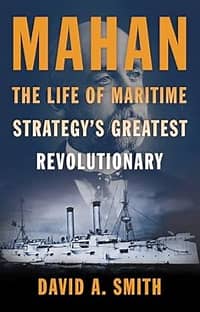
Mahan. The Life of Maritime Strategy’s Greatest Revolutionary. By David A Smith. Naval Institute Press, Annapolis, Maryland, 2026
Reviewed by Tim Coyle
Visionaries gestate slowly. Certainly, brilliance may burst upon a field of human endeavour issuing in life-changing breakthroughs in science, medicine and indeed, military strategies and tactics. Our times are currently seeing such revolutionary movements spawned by singularly controversial protagonists.
Anyone who has had any exposure to the concept of Sea Power has a passing acquaintance with Alfred Thayer Mahan. Generations of naval officers, maritime strategists – those in elevated positions of power and others who keenly self-educate – have sat metaphorically at his feet. These include, no less, the ‘All-Highest’ Kaiser Wilhelm II of Imperial Germany who ‘devoured’ Mahan’s seminal work, The Influence of Sea Power on History 1660 to 1783. Wilhem saw Mahan’s concepts of concentrated battle fleets raised to engage in ‘decisive battle’ as a harbinger to develop a rival fleet to the peerless Royal Navy which would establish Imperial Germany, together with its vast armies, as a power of the utmost strength. His theories of ‘sea control’ and the global significance of maritime mercantile trade were revolutionary insofar as his articulation of these centuries-old realities existed in plain sight, from which Mahan raised the blinkers.
Navies throughout the 20th century seized on the concept of decisive battle and prepared for it. These battles, when they came, mainly validated Mahanian theory, albeit adapted through the emergence of subsurface and aerial capabilities. The US Navy and Imperial Japan looked to a decisive battle in the Pacific through the 1920s and -30s; in the USN it was ‘War Plan Orange’. It was fought at Midway.
Mahan’s influence extends to the present day; the People’s Liberation Army-Navy (PLAN) continues to point to Mahan’s gospel as they assemble the ‘pacing challenge’ to the USN. The extent of the PLAN study of Mahan is illustrated in Red Star Over the Pacific Third Edition; China’s Rise and the Challenge to US Maritime Strategy (Yoshihara and Homes, Naval Institute Press, 2026) recently reviewed in these columns.
So, if Mahan is so well known for his body of work, do we really need another biography? In 1977 the Naval Institute Press published Alfred Thayer Mahan; the Man and His Letters (Robert Seager II ).
Every generation needs to be reminded anew of the man or woman who influenced human endeavour – for good or evil – and the effects these people’s lives and works have had on history and contemporary events. To refresh the life of Alfred Thayer Mahan, as David A Smith has done in this book, is to reacquaint students of maritime strategy in devolvement of theories applicable to the present day. Any serious maritime commentator should understand the initiator, Mahan in this instance, through his personal life experiences to understand how his theories germinated and subsequently flourished in spectacular fashion. Living through stultifying boredom as captain of the geriatric and dangerously deteriorating USS Wachusett, he fretted over his inactivity as his ship swung around a buoy in sickly ports such as Guayaquil, Ecuador as a unit of the anaemic US Pacific Squadron. He was embarrassed by the US Navy’s ships of spectacular decrepitude in comparison to foreign men-of-war, especially those of the peerless Royal Navy. The worldwide extent of the British influence through its empire caused Mahan, an inveterate anglophile, to seek insular solace in British clubs and libraries as a respite from the depressing environment of his command.
Mahan; The Life of Maritime Strategy’s Greatest Revolutionary traces the career of an ‘also run’ officer in a the decidedly second-rate post-Civil War United States Navy. Mahan’s evinced a certain enthusiasm in his junior officer appointments to the fleet; however, as his burgeoning fertile mind learnt lessons from his operational deployments, there arose an increasing desire to develop and contribute to the hitherto unknown academic field of formulating a theory of Sea Power. This required a studious environment to crystallise his thinking which was not necessarily served by running a down-at-heel warship, banished to foreign climes for years on end.
Stephen B Luce, an acquaintance of Mahan from Civil War days, was an unusually forward-thinking officer who became a mentor to Mahan. Luce had been influenced by British initiatives in naval officer education, which the then USN lacked. The theme of this educative direction was the use of history on the development of naval tactics and doctrine.
Luce convinced Navy Secretary William Chandler to approve the establishment of a Naval War College, which was inaugurated in February 1844. Mahan was included in Luce’s selection of suitable instructors, and he accepted the offer to join the College enthusiastically. However, months passed as the inert Wachusett festered in the unhealthy Guayaquil while its captain seethed at the Navy’s inaction in relieving him for academic duties.
Finally released from this purgatory he was able to research and write his War College lectures. Frustration continued through the years – the War College was amalgamated with the Torpedo School – an inappropriate manacling of a purely technical establishment with a philosophically-inclined education campus.
The vicissitudes of the Mahan’s subsequent career saw him desperately fending off Navy attempts to send him back to sea; the navy’s view that, as a line officer, his seniority as a captain required his rotation from shore to a sea command – a not unreasonable expectation. His appointment was to the USS Chicago, flagship of the USN’s one-ship European Squadron. Under the time-worn truism that the Service is always right, the unexpected result of the Chicago’s European deployment was overwhelming enthusiasm for the modest captain from the European elite who, having absorbed Mahan’s revolutionary ‘The Influence of Sea Power on History’ afforded him fame beyond measure. The foreign adulation of a mere captain rankled Admiral Erben, the squadron flag officer, to the extent of writing a less than flattering fitness report on Mahan, attributing a lacklustre execution of command qualities in favour of self-aggrandisement as a sea power prophet.
The cruise of the Chicago might be assessed – in today’s terminology – as ‘soft power/force enhancement’. Returning in triumph, his reputation at its apogee, Mahan ascended even further into the sea power firmament, while the navy of which he had been ashamed burst into a magnificent 16 battleship Great White Fleet which stunned the world on its December 1907 to February 1909 world circumnavigation.
Author Smith provides an intimate biography of Alfred Thayer Mahan set in the far-off days of the late 19th century. It is a window on the exigencies of service and civilian life in that period and how far removed our generation is from Mahan’s world. Mahan’s professional highs and lows – expressed in his seething frustrations – to his eventual elevation as the apostle of the canon of sea power – are presented sympathetically to the reader. But there is much more: his personal life expressed in his paternal family and early formation, his struggles with alcohol and his religious faith, his ‘eye for the ladies’ (quite prim, though heartfelt), his marriage and children and the effect of long separations on him and them.
This biography reveals the definitive Mahan to a new generation. One ventures to say no one can properly teach Mahan without knowing him. That is why we need this biography.