The head of the Royal Navy called for Britain to expand its maritime capabilities and strengthen the U.K.-led Joint Expeditionary Force coalition in preparation for a potential conflict with Russia in the North Atlantic during a speech last week, US Naval Institute News reports.
“The reason why we need this is simple: the greatest threat to our security today is Russia. That threat is felt most acutely in the maritime domain – in the North Atlantic, in the High North,” First Sea Lord Gen. Sir Gwyn Jenkins said at Admiralty House, Department of Naval Research in London.
Control of the Atlantic, Jenkins said, has always been closely linked to control of its northern approaches. Norway’s defeat in World War II gave the Nazis control of the coastline and deep-water fjords from which they were able to threaten allied shipping lanes in the Atlantic, Jenkins said. Today, the importance of Norway and the Greenland-Iceland-U.K. Gap remains undiminished.
“The Norwegian Sea, the Arctic and the northern approaches are not distant theaters. They are the gateway to our backyard; they form our open sea border with Russia. They are where British security, NATO and European stability come together. And it is also where the JEF makes an increasingly important contribution,” he said.
In July, the coalition force committed to maintaining a maritime presence in the High North, North Atlantic and Baltic to counter Russia’s increasing activities in the region, USNI News reported.
The U.K.-led Joint Expeditionary Force coalition is an outgrowth of the Critical Undersea Infrastructure Coordination Cell at NATO Headquarters in Brussels and complements NATO. The force is a coalition of 10 Northern European nations to provide security in land, air and maritime domains. Members include Denmark, Estonia, Finland, Iceland, Latvia, Lithuania, the Netherlands, Norway, Sweden and the U.K.
Additionally, the Atlantic continues to be crucial to the U.K. with almost all its energy, food, raw materials and exports flowing through maritime routes.
“We have reached a dangerous paradox. The sea, the Atlantic, has arguably never mattered more to Britain. We are certainly much more reliant on it than we were in the 1930s. And yet it has become increasingly invisible in the public’s mind,” Jenkins said. “We are a maritime nation, an Island Nation – and it’s time we remembered it.”
Russia has advanced submarines that are increasingly difficult to track, long-range precision weapons and specialist systems designed to operate deep underwater, Jenkins said. In line with that, Russia is active in the U.K.’s maritime domain, and the Royal Navy is spending more time and resources monitoring Russian vessels and the shadow fleet. An average of two Royal Navy warships deploy each week to conduct such tasks, Jenkins said.
Russia is probing, testing and mapping critical undersea infrastructure to gain an advantage in the region.
“We know that Russia is probing us for weakness. And we are facing threats…in a way we have not been since the Cold War,” Jenkins said.
He cautioned that while conflict is avoidable, many of the underlying challenges from the Cold War-era remain.
As such, the Royal Navy continues to invest in anti-submarine warfare, underwater surveillance, maritime aviation and Allied integration and building its Hybrid Navy.
“This is not about seeking confrontation. It is about preventing it through credible capability, strong alliances, presence and the ability to respond immediately when required,” said Jenkins.
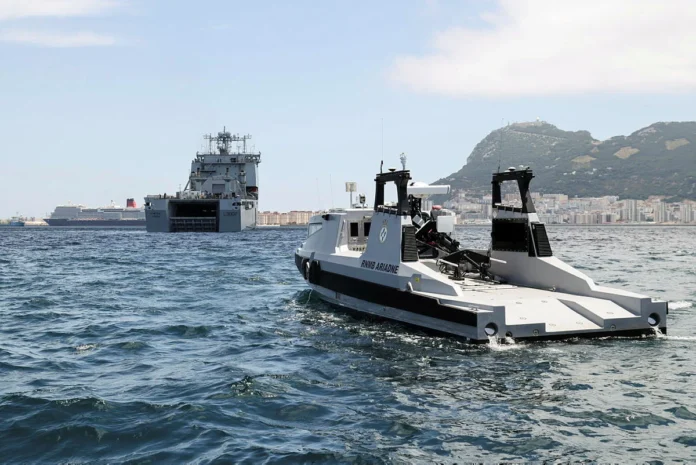
The maritime battlespace is becoming increasingly distributed, connected and data-driven and the Royal Navy’s future advantage will come from integrated networks combining ships, submarines, aircraft, autonomous systems, sensors, data and people under its transformation into a Hybrid Navy, Jenkins said.
According to Jenkins, traditional platforms still matter but it is no longer possible to defend a vast, contested ocean with crewed warships alone. The Royal Navy’s hybrid fleet will blend old with new – a crewed warship commanding a network of large uncrewed escorts, drones and autonomous sensors.
“It will make the fleet bigger, more lethal, harder to target and knock out of the fight, while also allowing us to adapt faster and impose more dilemmas on the enemy. That is the Hybrid Navy in a nutshell,” Jenkins said.
The Hybrid Navy is being shaped through a series of strategic frameworks dubbed the Atlantic Series. The first is Atlantic Bastion, which is creating a defensive net across the North Atlantic comprised of crewed and uncrewed ships, drones, sensors, artificial intelligence and weapons working above, on and below the sea to detect, deter and, if necessary, neutralize hostile activity. The second is Atlantic Shield, which is protecting the U.K. homeland, fleet and allies from drones, hypersonic weapons and ballistic threats through modern air and missile defense. The third in the series is Atlantic Strike, which will give the Royal Navy the ability to conduct long-range strikes against adversaries, if attacked.
Through the Hybrid Navy, the U.K. will also have a chance to lead the global maritime autonomy race, creating military advantages while generating new economic growth. However, leading this autonomous charge must be matched with a serious domestic shipbuilding strategy, Jenkins said.
“The Royal Navy’s task is to ensure that, with our allies, with industry, and with the whole maritime nation behind us, Britain is ready,” Jenkins said.