After a 25-day voyage via the Arctic a Chinese container ship has arrived at Teesport in the UK.
The voyage of the Dubai Tower, operated by Chinese shipping company Sea Legend, shows the potential of Russia’s Northern Sea Route (NSR) as a much faster passage between Asia and Europe, the ABC reports.
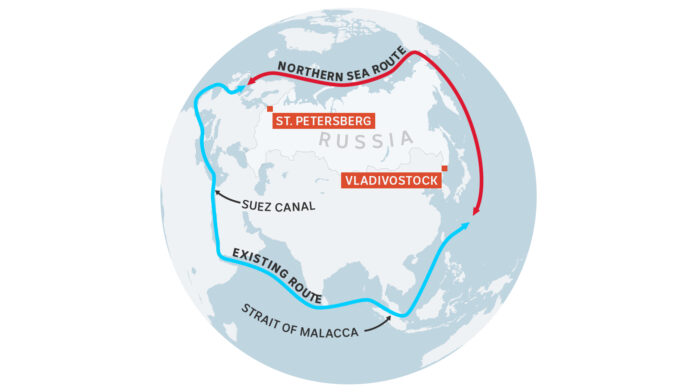
The NSR runs along Russia’s Arctic coast, from the Kara Sea through Siberia to the Bering Strait.
Compared with the traditional route via the Strait of Malacca and the Suez Canal, the NSR cuts the voyage time nearly in half.
The Dubai Tower left Ningbo-Zhoushan Port in eastern China on August 15 carrying about 1,500 containers, including energy-storage equipment, power batteries and photovoltaic components.
The voyage marks the first sailing of a weekly but seasonal China-Europe Arctic container service, with eight voyages planned between August and October.
In China the service has been dubbed the “Polar Silk Road”.
Although the route has proven workable, some experts believe it is unlikely to replace traditional shipping routes because it remains largely seasonal, depends on Russian support, and faces other risks and concerns.
As the World Economic Forum reported last month, a shorter route between Asia and Europe reduces sailing time and fuel consumption.
Analysts note it also offers an alternative to traditional trade corridors that are vulnerable to geopolitical disruption, such as the Strait of Hormuz.
But experts said it would be difficult for the NSR to become a viable alternative to the Suez Canal.
“The route is only navigable for a relatively narrow window in the height of the Northern Hemisphere summer,” Edward Rhys Jones, a researcher at Oxford University, told the ABC.
Nord University’s Centre for High North Logistics recorded 103 complete voyages on the NSR in 2025 involving about 3.2 million tonnes of cargo, with the vast majority of voyages between China and Russia.
The Suez Canal, by comparison, recorded 12,758 vessel transits and 522.1 million net tonnes in 2025.
Mr Jones added that the route remained heavily dependent on Russian support, with most vessels requiring Russian icebreaker escorts — a process that requires strict permits and adds significant operational costs.
Without an Arctic coastline, China describes itself as a “near-Arctic state” and incorporated the Polar Silk Road concept into its 2018 Arctic policy.
Mr Jones said China had spent more than a decade establishing itself as a legitimate stakeholder in Arctic affairs. “China recognises an Achilles’ heel in relying upon the US-dominated Indo-Pacific trunk routes for trade between Asia and Europe,” he said.
“China has less to lose than other countries from engaging with Russia in achieving these goals.”
But sanctions remain a major concern for Chinese companies, according to a 2025 report by the Danish Institute for International Studies titled China and Russia Challenge the Arctic Order.
Cooperation has increased since Russia’s invasion of Ukraine as Western sanctions push Moscow and Beijing closer together.
The full article is here.