By Tom Sharpe*
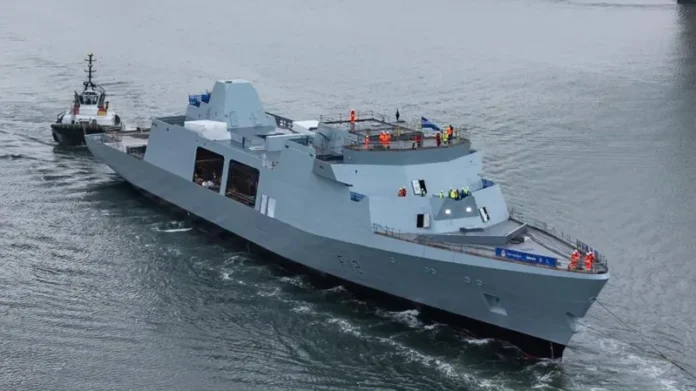
New Zealand doesn’t look for new warships too often. Its two Anzac-class frigates, Te Kaha and Te Mana, are being extended into the early 2030s and not much beyond. The shortlist to replace them looks like just two types: Japan’s upgraded Mogami-class frigate, which Australia has just ordered eleven of, and Britain’s Type 31.
The temptation in Wellington will be to see the Mogami as the better, quicker, more politically compatible fix. I actually thought that was correct, on balance, until I started writing this.
New Zealand Defence Minister Chris Penk confirmed in May that both designs are being examined as “mature combat capable vessel programmes”, with advice to Cabinet promised by the end of 2027. Luke Pollard, the UK Defence Readiness and Industry Minister, was in Auckland last week at Devonport Naval Base – which Babcock already runs – with an offer London puts at 1,000 jobs and some $300m of investment. “The era of crewed ships continues, but they no longer sail alone,” he said. More on that later.
Politically the Mogami case is strong. The programme is a marker of how US allies are converging on kit they can operate – increasingly, interchange – together: Japan, Australia and, if the pitch lands, New Zealand. Strategically, the Indo-Pacific is a maritime theatre where stability is shaped by everyday presence, and the ship was designed for that – with small crews and cutting edge tech – and just about able to take part in a fleet-on-fleet fight. Above all, it is not a ship on paper or taking shape in a shipyard: hulls are operating in the Pacific now, and new Mogamis have been delivered on time and on budget for years. I know full well from defence projects I have worked on how compelling this is. Political decision makers are, rightly, very keen on proven designs with a high degree of confidence on costs and timing.
So the Mogami is a strong pitch. But its underlying assumptions – that the Mogami will arrive sooner, comes with a ready-made partner next door, and is a better ship – each deserve a look.
On paper, the Mogami is strong: 30 knots against 28, though that comes from having an expensive, thirsty, maintenance-heavy turbine as opposed to the T31’s all-diesel propulsion. Then the Mogami has a ship’s company of 90 against well over 100 in all likelihood (important these days although less so if you want to survive-to-fight and not simply abandon ship); 32 heavy missile cells fitted from day one as against foundations awaiting cells; a 5 inch gun against a 57mm. The Mogami also has a more sophisticated sonar suite and various other advantages. It is smaller though, at least the Japanese variant is: 3,900 tonnes against the Type 31’s c 6,500. When it comes to seakeeping – being able to operate in the big waves of the open ocean – there are many variables but tonnage dominates. The larger Australian variant of the Mogami is better, and that matters because the small Japanese Mogamis struggle in this regard. Overall, however, in a game of Top Trumps, the Mogami card would win in many categories.
However, every one of those numbers describes the Japanese Mogami – the hulls afloat today. The Australian version, some variation on which the Kiwis would presumably go for, is taking shape now and so there is little clarity on what systems either variant will actually have. What happens when western weapons need to plugged into a Japanese combat system? The Mogami combat system is good but weapons integrations which are not already proven are always a roll of the dice.
Then there is the sea itself. New Zealand needs oceanic reach, from the sometimes terrifying Southern Ocean to the relative calm of the South China Sea – where, incidentally, Indonesia will be operating Type 31s. The Arrowhead 140 design behind the Type 31 descends from Danish frigates built for the High North and the Atlantic and are proven sea keepers. The Mogami’s fine, stealthy hull was shaped for Japanese littoral waters, and the noises from Canberra suggest that their variant will focus on Australia’s northern approaches as well. This is not the capability New Zealand needs (or Australia, come to that).
Seakeeping is a mysterious thing and we love telling stories, so it’s no surprise that there is a story doing the rounds on the naval grapevine of a Mogami sent to NZ as a demo having to hunker down for many days (supposedly turning its AIS transponder off as it did so, so that nobody would notice) to avoid bad weather. This might not be true, but, as I said before, size matters when it comes to seakeeping and the Mogami is small. Of course, all ships have an upper limit, but if you can’t maintain any desired course in a sea state seven then you will spend most of your time down there not even going where you want to, let alone being able to do harm to an enemy. For a two-frigate navy the importance of this is hard to overstate.
Then there’s the ability to take it, as opposed to dishing it out: damage control. The Type 31 has hard earned damage control and survivability baked in. Even Mogami fans agree that the Japanese ship does not. And lean crews are sound financial sense until you’ve taken a couple of hits and the fires and floods need dealing with – at which point you’re looking at a total loss if the crew can’t cope.
As for overall cost the numbers here are slippery, but Canberra’s Mogami programme works out at roughly double per hull what the Type 31 is costing us here: though it must be admitted that our current plan doesn’t include weapons for our T31s and it is weapons and kit that cost money, not hulls.
Pace and drumbeat are also key. On the current drumbeat Rosyth finishes the Royal Navy’s five Type 31s around the end of the decade (as ever this is slipping slowly right). New Zealand’s pair could follow as hulls six and eight, arriving as the ancient Anzacs expire.
The Mogami queue looks different: hulls one to three for Australia will be built in Japan from 2029, four to eleven from a Henderson yard that has yet to build one. New Zealand’s two would be… well that’s not clear. Japan has a remarkable track record of producing ships on time and to budget, the envy of every western navy, but New Zealand will need assurance on the plan. And I suspect the Anzac experience will have caused some damage when it comes to trusting Australia on the business of upgrades.
This works both ways though. If the Arrowhead/T31 design becomes the basis of the Royal Navy’s now planned Common Combat Vessels (which nearly every sensible commentator thinks it both should and will), then Rosyth’s order books will fill up too and Wellington will need a clear idea of where their hulls sit in the overall timeline.
I wonder if adaptability over time is the T31 trump card. The age of the multi-billion-pound exquisite warship is closing. What follows is cheap, flexible, numerous and drone-controlling, and the Type 31’s volume and growth margins are built for exactly that. If NZ joins this programme, it will benefit from the proposed global supply chain for that ship and have a say in how we develop our own hybrid navy for follow on export to them. Does this outdo the perceived importance of collaborating with an ally that is geographically close, as Australia is?
The Kiwis’ 2025 Defence Capability Plan is clear on this: New Zealand “will seek to procure the same assets and equipment as Australia where it makes sense to do so”, and every business case must now begin with the question “what is the Australian approach?”. That is about as clear as government prose gets.
In summary the Type 31 wins on price (probably), adaptability, seakeeping and survivability and the promise of belonging to a geographically distant partnership that is running hard at autonomy (that you will later want). But the Mogami is already operational, tied in with local partners and the builder country has shown undeniable excellence in shipbuilding.
When I started writing this, I assumed the Mogami was the better buy now and that in ten years New Zealand would wish it had bought the Type 31. Now I’m not even sure that first part is correct, although it is close. The fact is, much of what I’ve described is “navy stuff” and beyond the imagination of most desk-bound decision makers. In defence procurement, political convenience and proximity routinely win over requirement and capability. So the Kiwi deal is Japan’s to lose, but stranger things have happened at sea.
*Tom Sharpe OBE served for 27 years as a Royal Navy officer, commanding four different warships