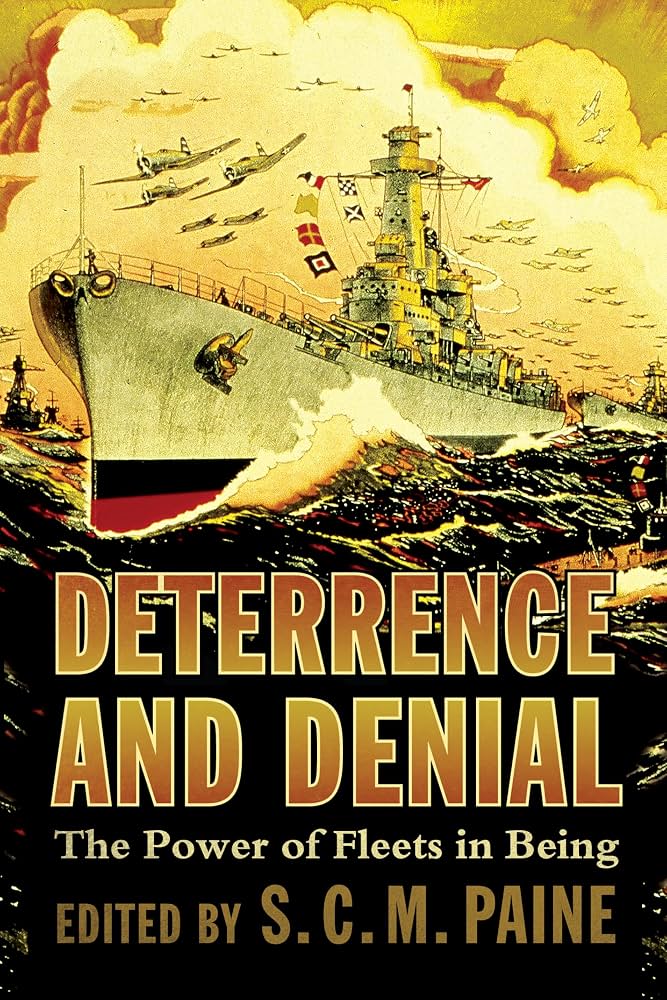
Deterrence and Denial: The Power of Fleets in Being. Edited by S.C.M. Paine. Naval Institute Press, Annapolis, Maryland, 2025.
Reviewed by Darren Puttock
Deterrence, denial and maritime strategy are all concepts that feature in Australia’s defence policy and strategic discourse, making S.C.M. Paine’s edited volume Deterrence and Denial: The Power of Fleets in Being a timely book for Australian readers.
This study of a ‘fleet in being’ is an edited volume consisting of multiple case studies on the concept which, in very broad terms, is a naval strategy where a typically weaker force seeks to maintain a credible level of threat and strategic influence while simultaneously avoiding direct engagement in a decisive battle. That said, ‘fleet in being’ as a concept is not a settled one, and there is no singular definition. This is noted by the editor herself as well as John Hattendorf in his US Naval War College article The Idea of a ‘Fleet in Being’ in Historical Perspective. Hattendorf notes that it was first developed into a strategic concept by Philip Colomb, the eminent Royal Navy officer and historian who is somewhat overshadowed by his better-known contemporaries Alfred Thayer Mahan and Julian Corbett. All three debated the concept’s utility in contemporary writings, and the term’s popularity has waxed and waned over the decades.
The inconsistency of its definition emerges from the chapters, though not systematically. Kevin McCranie provides an exceptional chapter on the theoretical debates between Colomb, Mahan, Corbett and other contemporary scholars. Noting the multitude of circumstances that appeared to apply to the concept, George Aston quipped “if ‘in being’ means ‘in existence’ the words seem to be redundant and unnecessary.” McCranie notes that a ‘fleet in being’ is a fleet that is generally weaker than an adversary yet powerful enough to influence its planning and decision calculus. Paine provides evidence they can sometimes be subcategorised as active, where the main force remains in port and auxiliary forces conduct an ‘active’ defence, or passive where the fleet remains in port or at sea but close enough to port not to be cut off. Of note, a ‘fleet in being’ is not to be confused with ‘force in being,’ a contemporary term for military forces available for deliberate (planned) or responsive (unplanned) operational activities.
Indeed, several of the contributing authors reveal just how tenuous ‘fleet in being’ can be as a concept. Iván Valdez-Bubnov notes the concept of ‘active defence’ was much more applicable to Spanish naval strategy, and Michael Epkenhans explains how the German High Seas Fleet became a ‘fleet in being’ contrary to its intentions. Alessio Patalano provides a very clear qualification, noting “the idea that Japan’s behaviour in the late 1930s unfolded from a rejection of a fleet-in-being strategy needs reexamination because of one unproven assumption arising from insufficient clarity about the fleet in being as a conceptual framework.” He goes on to say that “the assumption that Japan designed its fleet for deterrence reflects the naval literature’s inadequate distinction between a fleet in being as an organizing principle for a peacetime posture design from a fleet in being as a wartime operational preference.” This is also relevant to Epkenhans’ observation of the High Seas Fleet, for the distinction between a deliberately chosen strategy and a posture that produces certain strategic effects irrespective of original intent remains relatively unclear, and whether ‘fleet in being’ can be equally applied to both circumstances is unfortunately left unresolved.
Also relevant is Andrew Monaghan’s observation of the Russian fleet, where he notes that ‘fleet in being’ can be translated into Russian and is acknowledged as a Western naval concept or strategy; however, he points out “it is not a Russian naval concept or strategy.” For the Russians, he reveals, this does not accurately describe their navy’s tasks or reflect its priorities. These distinctions raise important questions about the universality of the concept, which leaves the reader wondering if ‘fleet in being’ is an enduring strategic concept or an attempt to group distinctly national responses to superior naval forces under one common phrase. Paine acknowledges some of these issues in her conclusion, which is aptly titled “Possibilities and Problems,” though she largely assimilates cases that challenge the concept rather than discussing what they mean in terms of its limitations and boundaries.
In addition to the unsettled nature of ‘fleet in being’ as a concept, it is also worth mentioning that ‘deterrence’ and ‘denial’ are themselves contested and lack a singular definition or framework. Given the conceptual ambiguity with the core concepts of the volume, the introduction would have benefited from a more explicit treatment that addressed the tensions between competing versions of the concept. Instead, the reader is provided the definition of ‘fleet in being’ from the glossary of Robert Herrick’s monograph on the Soviet Navy. Though his active/passive distinction noted earlier is useful, it does not adequately situate the reader to assess the case studies that follow. McCranie’s treatment does not arrive until Chapter 5, though in Chapter 1 Andrew Lambert provides a very thorough explanation of Lord Torrington’s coining of the term and its theoretical origins. That said, the reader is not provided with the theoretical tools at the outset to determine whether the case studies reflect a common theory or are merely national operational responses to the common problem of facing superior naval forces.
The case studies provided, it must be said, are exceptional. Paine has adeptly assembled a large sweep through naval history using examples of ‘fleets in being’ that span the age of sail, the twentieth century before the world wars, the twentieth century global wars, and the Cold War. Equally refreshing is that the volume is not limited to Anglo-American navies as it includes studies of French, Spanish, Japanese, German, Soviet and Chinese navies. Paine also provides an exceptional synthesis of the observable patterns from the case studies. She compares usefulness in narrow seas versus open seas, peacetime deterrence and wartime denial, and concludes that distant ‘fleets in being’ are vulnerable to pre-emptive attack, citing Force Z in Singapore and the US Pacific Fleet in Pearl Harbor as examples. These are interesting comparative conclusions, though they do not fully engage with the tensions over the conceptual boundaries discussed in several of the case studies. Norman Friedman has also provided an inspired historical précis of the case studies in his review article, and this reviewer will therefore not attempt to replicate his exceptionally informed comments as the results will inevitably be far less comprehensive. Friedman reframes this volume around the question of “what is a weaker navy to do?” This observation is one that deserves further attention.
S.C.M. Paine has provided a very important scholarly work, as naval theory and detailed studies of weaker navies are considerably less prominent in the naval, defence and strategic studies scholarship. As ANI readers will well know, much of the naval strategy literature has been written by, for, or about great power navies. There are notable exceptions, including J.R. Hill’s Maritime Strategy for Medium Powers and a recent resurgence in works on the Jeune École, but overall the study of relatively weaker navies remains far less prominent. The historical case studies demonstrate repeatedly how weaker naval forces can successfully protect national interests, though perhaps are better understood in their specific context as opposed to confirming or dispelling ‘fleet in being’ as a theoretical concept.
Friedman’s framing and Paine’s volume offer value for Australia’s maritime discourse. For the past several decades, much Anglo-American naval thinking, including Australian, has generally been developed for strategic circumstances where allied naval superiority could be largely assumed. That assumption is becoming less certain. The value of Paine’s study is not that ‘fleet in being’ as a concept can be directly transposed onto the RAN; rather, these case studies offer insights into how past navies sought to protect national interests and generate strategic effects from circumstances of relative weakness when compared to adversarial naval forces. These are salient lessons.
One such salient lesson is the challenge of deterrence as a strategy. Paine rightly points out the issues with strategic clarity when seeking the prevention of something happening, though she is on epistemologically dangerous ground with her assertion that “successful deterrence is unknowable.” Dr Paine is correct that deterrence is difficult to demonstrate from non-occurrence alone, but archival and empirical evidence can reveal adversarial intentions, explain decision-making processes, and identify reasons for changes in behaviour. These factors enable deterrence to be assessed with varying degrees of confidence. For example, Argentina’s own official account of the loss of the General Belgrano and how it impacted decision-making during the Falklands War informs us of the result: a significant change in operational employment. This singular example demonstrates perceptions of risk within adversarial decision-making can be interpreted, which in turn challenges the assertion that successful deterrence is fundamentally unknowable.
Deterrence and Denial is an excellent collection of historical case studies, an important comparative exploration of how weaker fleets can constrain stronger ones, although somewhat less successful in its treatment of fleet in being, deterrence, and denial as strategic concepts. To be fair, as an edited historical volume it cannot be expected to fully resolve the theoretical disputes surrounding a concept that Dr Paine herself acknowledges is long contested. Ultimately, the reader is left wanting to understand more about ‘fleet in being’ as a concept, which is a testament to the effectiveness of Dr Paine’s work. Despite its minor conceptual shortcomings, I absolutely commend this volume as a very important and highly relevant study for readers interested in how navies have approached the challenging position of relative naval weakness.