By Tom Sharpe*
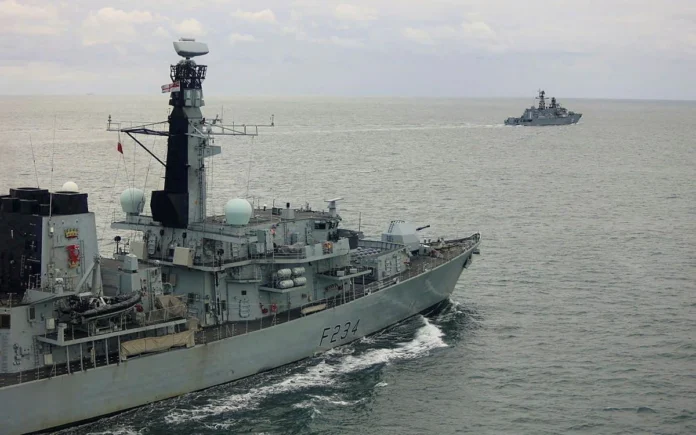
Britain does not have enough warships. This is old news, but we are reminded of it at frequent intervals by the Russians. In particular, we are reminded because they have taken to keeping a warship of theirs permanently on station off our southern and eastern coasts.
The frigate Neustrashimy is Moscow’s current Channel guardship. She relieved the Admiral Grigorovich in mid-July and has settled into her predecessor’s routine, loitering and waiting for the next sanctioned shadow-fleet tanker which she will escort past our shores.
I have written about the Neustrashimy before, on the occasion of her unannounced 100mm gunnery exercise 40 miles south of Plymouth – in the busiest shipping lane in the world, firing shells capable of ricocheting ten miles beyond the target. The Defence Secretary called it “performative and irresponsible”, but it was also a signal.
For weapons, Neustrashimy – in addition to her 100mm main gun – has capable anti-air missiles and guns plus various anti-submarine weapons. Most Russian frigates can also carry capable cruise missiles such as the land-attack Kalibr, which could strike anywhere in Britain if fired from the Channel.
As it happens the Neutrashimy is a rare exception and has no tubes capable of launching Kalibrs, but when she is replaced in due course by a Grigorovich-class, Gepard-class or Gorshkov-class vessel the whole of Britain will be under Russia’s guns again, as we were up until mid-July and have been for quite some time.
People who think a Russian attack on Nato would be “over there” – in the Baltics or Poland, perhaps – well, they should think again. Putin might start with a sheaf of Kalibrs fired at London: a city with no air defences.
Meanwhile the Neustrashimy is being sustained in place. Her predecessor repeatedly rafted up alongside a repair ship to refuel mid-Channel and the Neustrashimy has now been snapped taking on stores alongside an intelligence ship 15 miles off the Suffolk coast. The Russians have to wait for calm weather to do this: for whatever reason, they have never learnt to replenish stores and fuel while underway using hoses and lines slung between two ships on parallel courses.
This week we have also seen a Ka-27 “Helix” helicopter on her flight deck. This helicopter will multiply her surveillance reach by hundreds of miles, increasing her radar horizon by enough of a margin to be able to track dark fleet vessels approaching from both directions.
The counter-rotating nature of a Helix’s blades is part genius, part madness. The advantages provided by good power-to-weight figures and the lack of a tail rotor are generally considered to be offset by the hideous mechanical complexity of the opposing rotor heads. Either way, it’s a notable boost to their capability, given what they have been tasked to do.
So what are we doing about it? The Fleet Ready Escort (FRE) – the on-duty frigate or destroyer we’d expect to use for shadowing Russian warships – can only be in one place at once. HMS Somerset recently logged 25 days of shadowing in May alone, escorting various kinds of Russian vessels. Of the handful of frigates we have left, around four (at a push) are useable and you need three ships to keep one on task. So we can just about sustain the FRE task if we have nothing else to do.
Unfortunately there are also Russian submarines to think about: they are also a perennial threat, prowling about over our undersea infrastructure and trying to find our nuclear deterrent submarine. So we also need frigates to act as the Towed Array Patrol Ship (TAPS), hunting subs. Apart from frigates, we have just two destroyers fit for sea and one is in the Gulf of Oman doing destroyer stuff (area air defence).
To use the modern vernacular, the maths aren’t mathing. Just by way of a cherry on top, only three of our warships currently have any anti-ship missiles. The rest are comprehensively outgunned by their Russian equivalents.
And indeed it gets worse. Due to our lack of frigates and destroyers, the mission of shadowing and monitoring Russian ships off our coasts often falls to the Batch 1 River-class patrol ships (retiring in 2028), minehunters, or Royal Fleet Auxiliaries (of which we have four that we can operate). All of these are armed with nothing more than light guns and would be blown out of the water unanswerably if it came to fighting.
In terms of messaging, deterrence and intelligence gathering, this doesn’t cut it. We could just leave the Russians alone to do what they like, and some people think we should. We would certainly have to if the Royal Navy were ever tasked to intercept migrants, as Reform recently suggested. You can see why the RN winces a little whenever politicians lob the small boats grenade at them.
Back to escorting the Russian Channel guardship. In due course, the answer will be to use the forthcoming Type 31 for this – a general-purpose frigate that will be ideal, assuming we arm them properly. At the moment we are only building five which isn’t enough (see above). At roughly a quarter of the price of the submarine-hunting specialist Type 26 frigate, there’s really no excuse for the lack of numbers or the ongoing delays to the programme.
Early aspirations to have one ready by 2023 have clearly been and gone and the latest official statement suggested “handover to the RN by the end of the decade”. However, “handover” is not the same as “operational”. In other words, it will be at least five years before they are ready to deploy to the Channel by which time the dear old Type 23s will have become the Swiss Cheese class and Russia will have more warships off our coast than we do.
Meanwhile we must continue to explore other methods to monitor and deter this constant offshore presence by a known adversary as instances of this and other activities rapidly increase. Persistent uncrewed aviation could help. We need to get radical: the frigate problem will get worse before a single new hull arrives. As @TBrit90 has mused online,we are one breakdown away from “core/only frigate task failure”.
In sum, a new permanent warship patrol has materialised off our coast and it’s not one of ours. We must decide our posture for it, find new ways to meet it and accelerate all technological solutions to do so within the confines of a meagre budget.
You can analyse this to death: whiteboard it, write learned papers, even do a Command Estimate to look at balancing the Ends, Ways and Means if you are really bored. At the end, you’d have done just as well to write “We don’t have enough warships” on a Post-It note.
*Tom Sharpe OBE served for 27 years as a Royal Navy officer, commanding four different warshipsharpOBE served for 27 years as a Royal Navy officer, commanding four different warships
This article first appeared in The Telegraph and is republished with permission of the author.