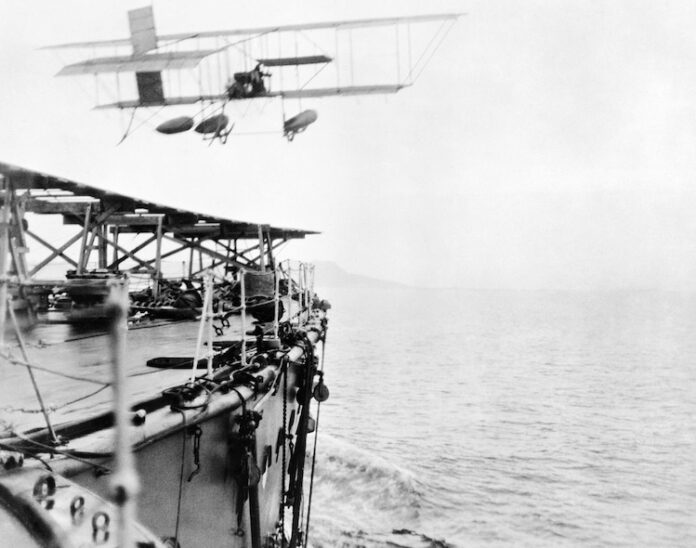
As witnessed in the war in Ukraine the adoption of novel technologies can have a profound impact on the conduct of war and adoption into doctrine. In Headmark 132, published in June 2009, the then Lieutenant Colonel John Abbatiello of the US Air Force explored a naval aviation example of this phenomenon.
Doctrinal Innovation in the Royal Naval Air Service: Samson, Longmore, and Williamson
During its brief existence, Britain’s Royal Naval Air Service (RNAS) teemed with pioneer aviators who sought out the best roles for aviation in support of naval operations. In an age when minimal historical experience was available for air organisations to develop doctrine, three men in particular improvised naval air employment concepts while under actual combat conditions of World War I. At a time when many who served worked to improve the capabilities of Britain’s new naval air arm, Charles Samson (1883-1931), Arthur Longmore (1885-1970), and Hugh Williamson (1885-1979) employed innovative methods for aircraft, providing leadership during the Great War that transformed Britain’s naval air arm out of its early experimental stage into a combat arm of significant value.
In many ways Samson, Longmore, and Williamson shared a common background. All three men were born in the mid-1880s and attended HMS Britannia (Britain’s pre-commissioning training establishment) as teenagers. Each served on capital ships in the Royal Navy at some point in their careers, and they all learned how to fly in 1911. All three participated in combat operations during the Great War and each one chose to transfer to the Royal Air Force when the world’s first independent air force stood up in April 1918. After retiring from military service, all three wrote memoirs. But most importantly, they tenaciously sought to improve the effectiveness and efficiency of naval air power at every opportunity during their time in both the RNAS and RAF.
The differences among the three men are perhaps more striking. Samson, the senior of the three, joined Britannia in 1897 and received his commission as a RN sub-lieutenant in 1902. After serving in a number of ships at home and abroad, including the command of a torpedo boat based at Devonport, he volunteered to be one of the first four naval officers to be trained in flying airplanes. In April 1911, after qualifying for his Royal Aeronautical Club Certificate (certificate no.71), he became Britain’s first fixed-wing naval aviator. He subsequently directed Britain’s earliest naval flying school at Eastchurch and led a squadron to Flanders when the Great War began. In spring of 1915, he commanded the RNAS contingent sent to the Dardanelles to support the Gallipoli landings. Throughout his career, he was known to be “impatient of discipline.” His service record shows that Samson’s commanders lauded his zeal and ability but also lamented his lack of tact.
Longmore attended Britannia three years after Samson, but following a number of assignments afloat, also including the command of a torpedo boat, he likewise volunteered to learn how to fly along with Samson, Lieutenant R. Gregory, RN, and Captain E. L. Gerrard of the Royal Marines. Longmore passed his Royal Aero Club check-ride only a few minutes after Samson did and became Britain’s 72nd fixed-wing pilot and the RN’s second. A year later Longmore moved on to be a flight instructor at the joint Central Flying School, where the British Army, the RN, and the Royal Marines worked together to train their first generation of pilots. He commanded two naval air stations in the years immediately preceding World War I and took over command of RNAS units around Dunkirk after Samson departed for the Dardanelles in late February 1915. In January 1916 the Admiralty transferred Longmore back to the fleet, where he served as a senior watchkeeper and turret commander aboard the battle cruiser HMS Tiger. He saw action at Jutland and later returned to the RNAS to serve as station commander at Eastchurch and then as a staff officer with the Air Board. He finished the war serving as the commander of all RAF units in the Adriatic.
Williamson’s early career was unique for a naval officer. Like Longmore, he entered Britannia in 1900, but Williamson soon volunteered for the RN’s new submarine service in 1906 and subsequently captained two submarines. In 1911 he learned how to fly at his own expense – while on leave and on weekends – and finally earned his Aero Club Certificate in November, becoming the 160th British pilot. In 1912 he was posted to the new battle cruiser HMS Lion, and in September 1913 he attended the Central Flying School (CFS) in order to qualify as a naval pilot for the RNAS. Thus, Williamson possessed the unique experience and perspective of being both a submarine commander and a naval pilot during his career.
During the opening months of the Great War, Williamson flew patrols along the southeast coast of Britain and in late 1914 was appointed second-in-command and senior flying officer of the HMS Ark Royal, a new seaplane carrier converted from a merchant steamer. In March 1915, while spotting HMS Queen Elizabeth’s gunfire against Turkish batteries in the Dardanelles, Williamson was severely injured in a seaplane crash. After convalescing, he was deemed unfit for sea service and transferred to the Admiralty in London, where he first served as the personal assistant to the Director of Air Services and then as the RNAS representative with the Admiralty’s Operations Division. In May 1918, he was appointed to command No.18 Group, RAF, with responsibility to defend merchant convoys sailing along England’s east coast.
Samson, Longmore, and Williamson were only three men among a lengthy list of Great War innovators, but they stood out because they helped to establish roles and missions that naval aviators still carry out today. Their experiences also remind us that military organisations often rely on mid-level commanders with operational savvy to employ new technology effectively.
Samson
Charles Samson was an aviation pioneer in every sense of the word. As the senior officer among the first four of the RN’s aviators, he served as the leading advocate at the tactical level for answering a brief yet rather complicated question: in what ways could fixed-wing aircraft support naval operations? The first step was to convince the Admiralty to actually purchase airplanes for the RN; Samson and his three colleagues had learned to fly on airplanes borrowed from a civilian flying enthusiast and under instruction from a civilian volunteer.
In October 1911, the Admiralty agreed to purchase two airplanes as well as provide naval ratings to serve as mechanics and approve the formation of a naval flying school at Eastchurch. Samson and his men immediately went to work in order to develop and prove concepts for employment of naval aircraft. In January 1912, Samson flew a Short pusher biplane off a bow platform from the pre-dreadnought battleship HMS Africa, using a track system he had designed himself. A few months later he flew the same aircraft off HMS Hibernia, another pre-dreadnought, while she was underway. Other pre-war experiments included dropping dummy 100-lb. bombs from aircraft and transmitting with wireless radio in 1912, flying at night and designing and testing folding wings for shipborne seaplanes in 1913, and practicing formation flying during the summer of 1914.
Samson’s most significant pre-war experiment was a series of ‘proof of concept’ exercises involving airplanes attempting to locate submerged submarines and then directing destroyers to their position. In reaction to a January 1912 paper submitted by Williamson, where the submarine skipper (mentioned above) not only suggested using airplanes to spot enemy submarines but also proposed that the Admiralty should investigate building decks on ships for both launching and landing airplanes – the Admiralty approved a series of experiments for the summer and fall of 1912. Samson played the leading role in these trials, which took place October 1912 in the Firth of Forth. In these exercises, Samson demonstrated that aircraft could spot periscopes and submarine – produced oil slicks easily from altitudes between 1,200 and 3,000 feet, depending on visibility and sea conditions. Once located, he marked the position of the submarine with Holmes Lights – an early floating flare that produced smoke – which served as the pre-briefed signal for destroyers to close on the position. Finally, visual and aural communications between airplane and destroyer proved feasible through the use of airborne Klaxon horns and shipborne semaphore flags and steam sirens.
Although such laudatory pre-war accomplishments set the stage for later developments, the test of armed conflict prompted Samson’s most important innovations in naval aircraft employment. While operating in France and Belgium in the opening months of the war, Samson’s squadron observed German efforts to improve Belgian ports to later serve as U-boat bases and to construct zeppelin bases. His men also attempted to bomb these facilities as well as German infantry and artillery positions. In November 1914, Samson conducted what was probably the first night bombing mission in aviation history, when he attacked German batteries near the port of Ostend with eighteen 16-lb. bombs. A complicated series of raids under Samson’s leadership in February 1915 against German port facilities in Belgium demonstrated the ability of RNAS airmen to coordinate attacks from different directions, by different units, against varied target sets. Samson’s leadership of the naval squadron supporting the landings on the Gallipoli Peninsula in 1915, however, established forever the following roles for naval aviation: photo-reconnaissance, naval and army gunnery spotting, close air support, interdiction, strategic attack, anti-ship strike, air superiority, and, finally, antisubmarine patrol.
After the RN failed to force the Narrows at the Dardanelles using battleships alone in February and March of 1915, the British Cabinet decided to land troops on the Gallipoli peninsula. RNAS aircraft from Ark Royalhad been spotting the fall of shot and conducting reconnaissance during the bombardment of the forts, where pilots and observers developed their own techniques of abbreviating wireless messages to gunnery officers on the battleships. In preparation for the landings, they continued their air reconnaissance and in late March Samson’s No.3 Squadron, RNAS, arrived to set up an airfield on the island of Tenedos, strategically located near the entrance to the Dardanelles. The squadron brought 11 pilots, three observers and over 100 support personnel to employ 18 aircraft of six types. Subsequently, only a half dozen aircraft proved useful in operations, since many of the aircraft suffered from underpowered engines or inadequate structural robustness. This tiny force would be for many months the only air support available to British, Dominion, and French troops fighting the Turks at Gallipoli, as the Royal Flying Corps could spare no units from the Western Front.
Between 28 March and the 25 April 1915, the day of the first Gallipoli landings, Samson and his squadron flew many observation sorties that provided detailed intelligence concerning Turkish positions near the landing beaches. Between April and June of 1915, one of Samson’s pilots, Flt Lt C.H. Butler, took over 700 photographs and used them to piece together a photographic map of the landing areas, passing this intelligence to Sir Ian Hamilton’s army headquarters on a regular basis.
Aerial photography later played an important role in the Suvla Bay landing, an operation designed to outflank Turkish positions containing the initial landings. In late July, Hamilton’s headquarters asked Samson to reconnoiter the heights above Suvla, efforts yielding intelligence that Turkish forces were inactive in that sector. On 6 August, Hamilton noted in his diary that photographs from Samson showed no Turks “on the move” and only 100-150 yards of trench and a half dozen gun emplacements. This information doubtless contributed to Hamilton’s decision to land two divisions at Suvla on 8 August. Unfortunately, a lack of initiative to expand the beachhead as well as a rapid Turkish reaction to man the hills above the landings made Suvla another failed operation. Although the Gallipoli expedition resulted in massive casualties on both sides and ended with a brilliant evacuation in January of 1916, Samson’s aerial reconnaissance and photographic intelligence proved to be, as historian Alan Moorehead states, the “most important part” of his air support of the troops ashore.
In addition to reconnaissance and photography, Samson and his No. 3 Squadron provided many other services to Allied units fighting the Turks. From the start of No.3 Squadron’s flight operations on 28 March until early November, Samson’s pilots and observers flew 349 sorties in support of naval gunfire or army artillery batteries. Most of these flights were of 2½ hours duration. On one occasion in May, one of Samson’s pilots spotted for the battleship HMS Agamemnon, which was firing on a Turkish artillery battery menacing British and Dominion troops ashore. Three of four howitzers were destroyed. Another case demonstrates the capabilities of early spotting efforts of naval gunfire. A few days after the initial 25 April landings, one of Samson’s airplanes spotted for the pre-dreadnought HMS Prince George, whose 6-inch guns were firing on a Turkish battery on the shore of Asia Minor. After losing their guns to the battleship’s fire, the Turkish artillery crews ran from their positions. The aircrew was able to immediately signal to the gunnery officer aboard the battleship to shift fire “up 200 yards” and use shrapnel; according to the aircrew, only half of the Turkish gunners survived the ensuing barrage. Spotting for the army’s artillery was less effective since their supply of shells was severely limited, allowing only for barrages of short duration where spotting was not as useful. Nevertheless, Samson assigned an Army officer serving as an RNAS observer, Australian Captain A.H.K. Jopp, to work with Anzac gunners in order to devise a system of air corrections to counter battery fire, which met with some success. Samson later claimed that aircraft airborne over Turkish batteries in Asia Minor “always” caused their fire to diminish for fear of incoming British gunfire directed by the airplanes.
During the Gallipoli operation, Samson and his men also developed now-familiar bomb dropping roles for aircraft. In 1915 there was no distinction between close air support, interdiction, and strategic attack, but Samson realised the merits of bombing tactical, operational, and strategic targets. In May, he reported to the Air Department that he normally sent up an early morning bombing attack against Turkish positions each day. He asked for “a steady supply of 100 100-lb. bombs a month” and promised that he would be able to “get rid of them as quickly as they are supplied.” On a number of occasions Samson’s pilots bombed Turkish troops in the front lines as well as their supporting bivouacs, ammunition dumps, and artillery positions. During a massive Turkish counterattack on 19 May, Samson dropped bombs directly onto assaulting troops, a feat lauded in Hamilton’s diary as contributing the successful defence of the Allied trench line. During the summer of 1915 the squadron began bombing Turkish positions at night, using the light of campfires to serve as aiming points.
Interdiction efforts became more prominent as the stalemate developed ashore. Samson targeted Turkish supply depots along the coast as well as ordering four attacks against a key railroad bridge and dozens against a major railway junction. In his memoirs, Samson wrote that a German staff officer serving at Gallipoli said that the bomb dropping attacks had a “terrible effect…on the transport columns and disembarkation points.” Ak Bashi Liman and Kilia Liman, ports at the neck of the Gallipoli peninsula that the Turks used to bring in supplies by sea, became favourite targets for the airmen.
Samson even planned a strategic air attack against Constantinople, but his aircraft were not capable of carrying both bombs and fuel for the long-range flight. Instead, he sought to damage Turkey’s overall war effort by attacking the main railway connecting Europe to Constantinople. He chose the Maritza railway bridge, near Adrianople in European Turkey, as his target and sent four bombing missions against it, flying the first one himself. Although these endeavours achieved limited damage – Samson’s first attack closed the railway bridge for four days – they did succeed in forcing the Turks to withdraw antiaircraft guns from other theatres to defend the bridge.
Finally, Samson’s men bombed Turkish shipping whenever the opportunity arose. Although attacks against warships were common, the relatively light 100, 60 and 20-lb. bombs available caused little damage to steel-plated naval vessels. In May, however, one of Samson’s pilots bombed an elderly Turkish battleship, putting a turret out of action and killing 10 sailors. Another No.3 Squadron aircrew sank a Turkish transport with bombs. An interesting series of anti-ship strikes also deserve mention. Although not under Samson’s direct command, a seaplane piloted by Flt Cdr Charles H. K. Edmonds was the first aircraft to attack a ship with a torpedo on 12 August 1915. Although the Turkish steamer had already been damaged and beached by a British submarine, Edmonds attack with a 14-inch torpedo from 300 yards proved the torpedo-strike concept. Five days later, Edmonds damaged another steamer, this one underway, from a launch range of 800 yards. Edmonds’ wingman, Flt Lt G. B. Dacre, sank a third Turkish ship on the same day while water-taxiing his own seaplane. Thus, three seaplane-launched torpedoes actually struck their targets in that month.
While employing his aircraft as bombers, Samson’s men dropped 179 100-lb. bombs and 507 20-lb. bombs through mid-November. Samson himself claimed to have dropped over 4 tons of bombs while in the Dardanelles. Nevertheless, the RNAS established and developed the close air support, interdiction, strategic attack, and anti-ship strike roles for naval aircraft relatively early in the Great War, using underpowered airplanes and employing a pilot force that averaged 6 to 7 available each day.
The final two roles for naval aircraft, which were less regular but no less important from a developmental standpoint, were air superiority and anti-submarine patrol. The RNAS’s first air-to-air engagement of the Gallipoli campaign took place on 2 May, when Flt Lt Reggie Marix downed an enemy seaplane near the Turkish coast. Turkish pilots and their German allies avoided flying over Allied lines until the closing months of the campaign, when they occasionally raided Tenedos and the new airfields on the island of Imbros with German built Taube aircraft. Samson taught his pilots to be aggressive; standing orders called for attacking enemy aircraft as soon as they were sighted, even when on spotting missions. Samson wanted his pilots to open fire at close range in order to guarantee hits as well as ensuring the target was an enemy aircraft. Largely due to the relatively poor performance of airplanes on both sides – that is, rarely achieving speeds over 100 miles per hour – air-to-air engagements seldom ended with a kill. Samson was pleased to report, however, that no RNAS airplane was ever shot down while operating under his command in the Dardanelles, while his men brought down two enemy aircraft during eight months of operations. During the Allied evacuation from the Gallipoli peninsula in December and January, British air superiority prevented German and Turkish reconnaissance aircraft from discovering the withdrawal.
Lastly, Samson made use of his prewar submarine spotting exercises when the Germans sent Otto Hersing’s U-21 to operate near the Gallipoli peninsula beginning in late May 1915. Hersing torpedoed and sank two British pre-dreadnoughts – HMS Triumph on 25 May and HMS Majestic on 27 May – and caused great concern to the Allies who relied completely on the sea to supply their expeditionary force on the Gallipoli peninsula. Samson subsequently added submarine patrols to his list of missions for No.3 Squadron. On two occasions he attacked U-21 himself, each time achieving near misses with bombs but causing no damage. It would not be until the closing years of the war, however, that RNAS and later RAF aircraft would become effective at helping to neutralise the danger of the German U-boats.
Samson thus established forever most of the roles and missions carried out by naval aircraft ever since the Great War. During the Gallipoli campaign, he accomplished this with only a handful of planes and pilots, not being reinforced until late August 1915, when a second RNAS unit arrived with 16 additional pilots and 22 airplanes. In his final, technical contribution to Great War naval aviation, he introduced the use of a towed 60 foot barge – known as a lighter – to serve as a runway for a single Camel fighter. Towed by a 30-knot destroyer, this mini-aircraft carrier’s fighter accompanied patrols in the North Sea in order to intercept German naval zeppelins that might be flying nearby. On 11 August 1918, Flt Lt S.D. Culley, one of Samson’s pilots, shot down zeppelin L-53 with his lighter-borne Camel.
Longmore
Arthur Longmore worked closely with Samson during their first year of aviation service at Eastchurch, where Britain’s first four naval aviators honed their flying skills and experimented with new employment concepts for airplanes. Longmore worked with aircraft designer Oswald Short to fabricate and test airbags that enabled airplanes to land on the water. After a tour as an instructor at the CFS, Longmore commanded the Cromarty Air Station in the Scottish Highlands, where his three seaplanes worked with naval vessels based at Invergordon at “every opportunity.”
In January 1914, he took command of the Calshot Air Station, which was in close proximity to the extensive complex of naval facilities around Portsmouth. In the early days of the RNAS, the Air Department considered Calshot an experimental station and Longmore thrived in the test environment. He continued submarine-hunting exercises that Samson had pioneered in 1912, and he conducted seaplane experiments with airborne wireless, landing at night, launching torpedoes, and testing new aircraft and engine designs.
Longmore’s greatest contribution to naval aviation, however, took place after the Great War began by putting into practice the Admiralty’s strategy of attacking enemy zeppelins and submarines while in their bases. Also known as an ‘attack at source’ strategy, the idea was grounded upon the fact that these German weapon systems were easier to locate and destroy at their bases than while operational above or under the surface of the seas – a traditional English method of dealing with pirates and invasion threats since the Age of Sail and a concept not unlike NATO’s Cold War plans to attack Soviet naval and air bases with carrier airstrikes. On two occasions, Longmore commanded air units tasked with executing this strategy: first, while leading RNAS air units around Dunkirk in 1915 and, later, when in charge of RAF units in the Adriatic in 1918.
When the war began, Longmore and his pilots supplemented Samson’s force in Flanders and flew coastal patrols in Britain until taking complete responsibility for RNAS operations on the continent once Samson departed for the Dardanelles in late February 1915. Longmore’s 14 pilots and 130 men, initially named No.1 Squadron and based at Dunkirk, carried on parallel efforts to mature the roles and missions that Samson so ardently developed in the eastern Mediterranean.
The Air Department charged Longmore’s naval airmen with a variety of missions that were eventually codified in June 1915 to include:
- To attack the enemy’s airships and aeroplanes in the air, or in their sheds.
- Coastal work comprising patrols to Ostend and Zeebrugge [the main German U-boat bases on the Belgian coast], attacking enemy submarines, observing for fire of ships’ guns, and searching for mines.
- Attacks on Submarine Building Yards, Power Stations, and other objects of military importance.
- Development of wireless spotting and photo-reconnaissance techniques.
These priorities reflected the increased threat to merchant shipping after Germany’s first U-boat campaign in early 1915 as well as the growing menace of zeppelin bombing raids over southern England. It is interesting to note that in his memoir Longmore revises slightly his priorities in Dunkirk by listing efforts “to prevent zeppelins and aeroplanes operating from bases in Belgium for raids on England” as his first task, attacking “enemy submarines using Ostend and Zeebrugge and to obtain information as to their movements” as his second task, with the other roles lower in priority.
Nevertheless, Longmore’s aviators conducted these operations under terrible weather conditions using relatively “primitive equipment,” including prewar British and French aircraft designs. No.1 Squadron was soon reinforced and Longmore assumed command of a larger No.1 Wing of six small flying squadrons, expanding the effort to bomb the German U-boat and zeppelin bases in Belgium to include submarine construction sites in Antwerp and zeppelin sheds in Brussels. No.1 Wing records indicate a strong emphasis on ‘attack at source’ missions which after ten months under Longmore’s command resulted in numerous attacks on German facilities yielding ten U-boats bombed (but none sunk), two of the massive zeppelins destroyed, and a zeppelin severely damaged.
One ‘attack at source’ example highlights the challenges that Longmore and his men faced when using “primitive” technology to carry out such varied missions. On the night of 6 June 1915, Longmore received word from the Admiralty that three zeppelins would be returning from an unsuccessful bombing raid on England, providing him an opportunity to intercept them. Before dawn the next morning he sent two aircraft as airborne interceptors to patrol above Ghent and two more to bomb zeppelin sheds near Brussels. In short order Flt Sub-Lt R. A. J. Warneford earned notoriety by downing of LZ-37 near Bruges. After out-climbing the airship in his Morane single-seater, he dived on his target and dropped six 20-lb. bombs along the length of the zeppelin’s hull. The resulting explosion completely destroyed LZ-37 and almost brought down Warneford, who had to gain control of his airplane after the shock wave turned him upside down. Warneford was awarded the Victoria Cross for achieving the first air zeppelin kill of the war.53 While Warneford was struggling with his rather large airborne target, Flt Lt J. P. Wilson and Flt Sub-Lt J. S. Mills successfully bombed LZ38 in its shed at Evere, near Brussels. Dropped from an altitude of 2,000 feet in the darkness, Wilson’s three 65-lb. bombs made a direct hit on the shed, causing smoke but no explosion. Ten minutes later, Mills let go his four 20-lb bombs resulting in a massive explosion and the destruction of LZ-38.
Longmore’s “attack at source” efforts resulted in the Germans abandoning their Belgian zeppelin bases, operating henceforth only from their bases along the northern coast of Germany. The U-boat bases, however, continued to serve as a thorn in the RN’s side until the closing months of the war. Longmore’s efforts forced the Germans to begin a considerable investment of resources in defending Ostend, Zeebrugge, and Bruges from air attack – attacks which RNAS and RAF would continue until 1918.
As mentioned above, Longmore left Dunkirk and returned to duty with the fleet where he participated in the Battle of Jutland aboard Tiger. Later service with the Air Board and at home air stations led to his selection as senior RNAS (and then RAF) officer in the Adriatic in early 1918. In this capacity he received approval to expand the small naval air force based in Italy in order to carry out a bombing campaign against Austrian submarine base at Cattaro, which incidentally served as the headquarters for the German Navy’s Mediterranean U-boat Flotilla.
By spring of 1918, Longmore’s RAF Adriatic Group Headquarters oversaw the operations of two attack wings:
- 66 Wing (at Otranto),
- 223 Squadron (12 Short Seaplanes),
- 224 Composite Squadron (12 DH9s plus 6 Camels),
- 225 Composite Squadron (12 DH9s plus 6 Camels),
- 67 Wing (at Taranto),
- 226 Composite Squadron (12 DH9s plus 6 Camels), and
- 271 Squadron (unknown number and type of Seaplanes).
Longmore’s flyers traversed the Adriatic, across 100 miles of open sea, to attack Cattaro, which the Austrians began defending with fighter aircraft as well as antiaircraft artillery. The need for escort fighters explains the integration of De Havilland bombers with Camel fighters in composite squadrons. By late October 1918, the RAF had supplemented Longmore’s Adriatic Group with flying boats for anti-submarine patrols and also planned to employ large, Italian-made Caproni bombers for airstrikes against Cattaro.
Longmore’s air campaign against Cattaro and Durazzo, another Austrian naval facility, got under way in May 1918 and by August had accomplished 19 major raids against the two ports. H. A. Jones’s official air history of the Great War, The War in the Air, notes that in June 1918 Mediterranean shipping loses were reduced by half. While the introduction of Mediterranean convoys around that time caused much of that reduction, Jones argues that RAF bombing efforts at least deserve consideration as a part of that success against the Austro-German U-boat forces in the Adriatic, where enemy submarines and crews suffered “some damage and much anxiety.”
Thus in two air campaigns, Longmore put into practice the concept of attacking German zeppelin and submarine bases “at source.” This concept would witness further development during World War II; as Air Officer Commanding RAF units in the Mediterranean during 1940, Longmore himself used a strong force of medium bombers to neutralise the Italian Air Force by attacking their air bases in Libya. RAF Bomber Command and the US 8th Air Force likewise devoted many sorties to bombing German U-boat bases and construction yards. The doctrine of employing NATO naval aircraft to attack Soviet bases “at source” during the Cold War therefore owes its existence to Longmore and other pioneer RNAS aviators.
Williamson
Hugh Williamson, the submariner who taught himself to fly and later transferred to the RNAS, was a deep-thinking, articulate officer who was outspoken with his views on naval aviation. Although Williamson was credited with the initial concept of the modern aircraft carrier – a 1915 design that featured a superstructure on the starboard side of the flight deck and a wire arrestment system for landing airplanes – his main contributions to naval aviation fell in the area of anti-submarine warfare. As a staff officer in the key developmental years of 1915-17, Williamson occupied position where he could collect data from air units in the field, decide which ideas were the best, and then write memoranda for senior Air Department and Admiralty officers to consider. His elevation to RAF group command in May 1918 allowed him to put these ideas into practice.
Williamson’s importance as an innovator of naval aviation stems from three ideas relating to air antisubmarine warfare: the use of direct telephone lines between stations and higher headquarters to report rapidly submarine sightings; the establishment of monthly anti-submarine reports to share information between air ASW units and serve as a de facto doctrine publication; and finally putting “best practices” he had discovered as a staff officer into use when he took command of No.18 Group, RAF. The most important of these practices was the use of aircraft to provide both a close in and distant air escort for coastal convoys sailing the busy shipping lanes along the east coast of England.
After recovering from his injuries resulting from his March 1915 aircraft accident, Williamson was posted to the Air Department to serve as Personal Assistant to Rear-Admiral Sir Charles Lee, the Director of Air Services. In this role, Williamson researched and wrote reports on various issues for his chief, represented the RNAS at a number of conferences and boards, and in general focused a great deal of intellectual energy on questions of naval aviation doctrine. In September 1916, he joined the Admiralty War Staff as a member of the Operations Division, where he advised both his staff colleagues and admirals commanding fleets and naval districts regarding RNAS operations and capabilities.
During this latter tour of duty, Williamson expanded a telephone communication system between the Admiralty’s London headquarters and the various air and naval stations around the coast of Britain. Known as the Naval Air Exchange System, the communications web allowed the rapid transmission of information, and it was initially used to aid the interception of zeppelin and Gotha bomber attacks by passing radio direction finding information to the nearest intercepting fighter squadrons. To accomplish this, Williamson had a staff of 30 officers and 120 men at the Admiralty to work the lines. When naval air units began coastal anti-submarine patrols in earnest during the spring and summer of 1917, the Admiralty simply adapted Williamson’s Air Exchange System to track the location of U-boats and send aircraft to investigate sightings and radio direction finding (D/F) information. The fusion of human intelligence from sources in Belgium, Holland, and Germany with existing communications infrastructure eventually led to a submarine tracking room at the Admiralty.
As a staff officer, Williamson was also keenly aware of the need to share the latest developments and patrol results with all naval air units. In June 1917, he published the first monthly RNAS Anti-Submarine Report under the auspices of the Admiralty’s AntiSubmarine Division. The ASRs listed all known U-boat sightings and attacks by RNAS aircraft, as well as statistics summarising each units’ number of sorties, hours, and miles flown. All aircraft sorties, including airplanes, seaplanes, flying boats, airships, and kite balloons, were included. Later editions summarised French air ASW efforts.
As part of the ASRs, Williamson often included general remarks indicating new technology and tactics that RNAS units employed with success. For example, one report recommended the use of floating flares to ascertain whether an object in the water was moving relative to the stationary flare. Another edition admonished naval aviators to take time to study pictures and drawings of German submarines and to coordinate with RNAS units in close proximity to their own. Through his close study of unit reports and his compilation of data into monthly ASRs, Williamson in effect established the first air ASW doctrine for the RN in its history.
After almost three years of serving as an Admiralty staff officer, Williamson finally received a field command. In May 1918, he took over No.18 Group, RAF, and assumed the rank of Colonel in the new, independent RAF. In this capacity he commanded all naval cooperation air units in eastern England between the Wash and the Scottish border. More importantly this vital command, with the responsibility of guarding merchant convoys traversing the waters off the east coast of England, gave Williamson the opportunity to employ the ideas he had developed over the preceding three years.
When the RAF absorbed the RNAS in April 1918, the new air service agreed to provide each regional naval district with an air group equipped with naval cooperation aircraft. The group would be under the operational control of the commanding admiral, but under the administrative control of the local RAF Area Command. In essence, the RAF provided the aircraft and crews, while the local commanding admiral – advised by his RAF group commander – determined how to employ his assigned assets. The Admiralty was initially pleased with this arrangement, since it meant little change from the RNAS days. For the most part, the operators themselves did not change; former RNAS commanders and aircrew simply donned new RAF uniforms, assumed RAF rank, served in numbered RAF squadrons and groups, but still carried out the same missions for the same naval commanders.
After four months of commanding 20 air stations and sub-stations, with a complement of 300 officers and 4,000 men and 100 aircraft ready to fly each day, Williamson reported to Admiral Charlton, the Vice Admiral Commanding, East Coast of England, his views on air ASW. Knowing that the memorandum would make its way to the Admiralty and then to the Air Council, Williamson reported his recommendations on both doctrine and equipment. He found that even though pilots feared straying too far from land, airplanes proved more useful than seaplanes and airships simply because they could withstand worse weather conditions than the other weapon systems. Convoy escort by aircraft in conjunction with surface forces proved effective in hampering U-boat operations. He reported that available weapons (65,100, and 230-lb. bombs) were not powerful enough to destroy submarines, and he planned to experiment with 520lb. versions aboard his new Blackburn Kangaroo airplanes, the only purpose-built ASW airplane to see service during the Great War. Finally, he complained that although they were useful in providing an air presence, the DH-6 trainer aircraft that the RAF had pressed into ASW patrol service needed to be replaced by improved aircraft with long range and sufficient carrying capacity for fuel and bombs.
A month later Williamson reported on his overall scheme of operations in using aircraft to escort convoys. His goal, weather conditions and maintenance status permitting, was to have two to four airplanes or seaplanes with each convoy as a distant escort, working in reliefs from his string of bases along the coast. Additionally, he tried to have two airships with each convoy as a close-in escort (within one to two miles of the ships); the extended range of airships meant that they could accompany the convoy during its entire journey through Williamson’s sector. Additionally, effective communications existed between aircraft, convoy commodores, and escort vessels by using Aldis lamps. Finally, Williamson brought aircrew and captains of escorting naval vessels together regularly at naval bases to coordinate escort procedures.
According to standing aircraft orders to No.18 Group, the first priority was for air units to provide air escort of merchant convoys and naval vessels sailing along the east coast. The second priority was to carry out patrols of the war channel and to keep sighted U-boats down by maintaining an air presence over their last known position. The orders clearly delineated assigned patrol areas for each air station. Finally, given sufficient warning, No.18 Group aircraft were ordered to be ready to help in defending against coastal raids by both German surface vessels and zeppelins.
As a result of his air ASW doctrine and the increasing use of coastal convoys, the intensified U-boat activity along the east coast of England in spring and summer of 1918 met with failure. According to Williamson’s memoir, no ships protected by both air and surface escorts succumbed to submarine attack on the east coast during the period of his command of No.18 Group. As a matter of record, during the entire war, only five ships that were accompanied by both air and sea escorts – of thousands of ships escorted in ocean-going and coastal convoys – were lost to German U-boats. Although somewhat neglected during the interwar years, the use of aircraft to counter the submarine threat became a decisive factor in winning the Battle of the Atlantic 25 years later. Williamson’s pioneering work in the development of doctrine and infrastructure for air ASW certainly paid off in the latter conflict, where 324 U-boats (of 821 German submarines destroyed during World War II) owed their destruction to Allied aircraft.
The impact of technology on the outcome of the Great War is a well trodden story. Historians of World War I have already argued the merits of tank and artillery development, submarine warfare, and most recently dreadnought gunnery. Indeed, the Great War witnessed the evolution of two branches of naval warfare that – while not necessarily decisive technologies in the war at sea – proved to be a vital, preliminary stage in weapons development for later 20th Century conflicts. The airplane and the submarine possessed similar characteristics: both had been made operationally viable only a few years before the war’s start in 1914; both began as mere auxiliaries to surface forces, but later achieved important independent roles; and both seemed to be at once fragile and great absorbers of combat damage.
Britain possessing the world’s most powerful fleet in 1914, had a tradition of waiting for new technologies to be proven elsewhere before committing to their use. As John Brooks persuasively argues in Dreadnought Gunnery and the Battle of Jutland, the RN was “a user, not a creator, of technology because it would rely on its suppliers to meet its technological needs.” The British did rely, however, on well-educated operators to hone new technology into useable weapon systems for the fleet and also to think through how new weapons would be employed in combat. Such was the case within Britain’s relatively small naval aviation community, where Samson, Longmore, and Williamson in particular represented an extraordinary spirit of innovation before and during the Great War.
After the Dardanelles operation, Samson took charge of a seaplane carrier squadron in Egypt, served on the Air Department staff, and commanded the naval air station at Yarmouth. In October 1917, he took command of the RNAS air group responsible for defending the southeast coast of England, and he continued in this position as an RAF colonel until the end of the war. He subsequently served in a number of RAF command positions both at home and in the Mediterranean, retiring in 1929. Samson died unexpectedly in 1931 at the age of 47.
Longmore went on to senior RAF command positions later in his career, including his leadership of the RAF College at Cranwell in 1929, RAF Coastal Command in 1936, Training Command in 1939, and finally RAF Middle East Command from May 1940 to May 1941. He finished the war on the Air Ministry staff and retired in May 1944 after achieving the rank of Air Chief Marshal. Interestingly, Longmore spent the final months of the war going back to his roots – as a volunteer motor boat skipper in the Yachtmen’s Emergency Service. He died in late 1970.
After the Great War, Williamson served in Iraq and at the Air Ministry, retiring in 1928 as a Group Captain. Upon the outbreak of hostilities in 1939, Williamson rejoined the RAF where he served as station commander at two Coastal Command airbases and again at the Air Ministry. He retired a second time in 1943 and died in 1979 at the age of 94. Modern navies owe much of their current capabilities and employment doctrines to the operational savvy of these men. They are only the first, however, of a lengthy list of innovators whose willingness to improvise, think, and adapt made the airplane an important, and in later years a decisive weapon system in naval warfare.
A fully referenced version of this article is available at: https://navalinstitute.com.au/wp-content/uploads/2014/04/headmark-132.pdf
About the Author
John Abbatiello is a retired USAF Colonel and was member of the Air Force Academy history faculty when he wrote this article. In 2004 he received his PhD from King’s College London and is the author of Anti-Submarine Warfare in World War I: British Naval Aviation and the Defeat of the U-Boats. He, along with Mark Grotelueschen and John Farquhar, have co-edited a book on American military leadership. It is expected to be released by the University of Oklahoma Press this year.