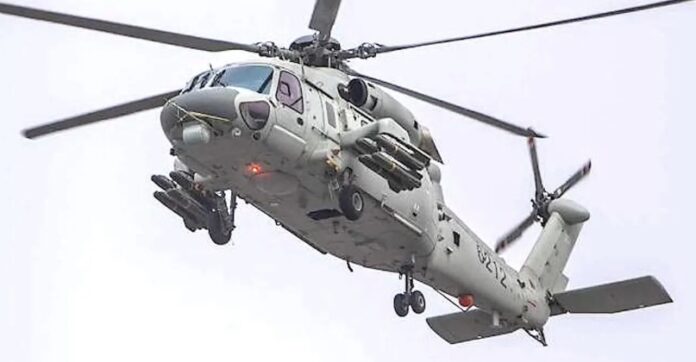
Footage has confirmed the service entry of Z-20F maritime helicopter in the China Coast Guard, which represents a major landmark the modernisation of the service’s anti-submarine warfare capabilities. This represents part of the increasingly close integration between the China Coast Guard and the People’s Liberation Army, as while the Coast Guard is officially a civilian maritime law-enforcement organisation, it has operated under the command of the People’s Armed Police since 2018, giving it a closer institutional relationship with the armed forces. (From: Military Watch magazine.)
The introduction of a helicopter derived directly from a frontline naval military platform further blurs the distinction between civilian maritime enforcement and military operations.
The helicopter observed in flight was equipped with a prominent electro-optical sensor turret beneath the nose and a large surface-search radar housed in a distinctive radome, matching the configuration previously seen on the Z-20F naval helicopter. This combination of sensors allows the aircraft to conduct long-range maritime surveillance, identify surface vessels in all weather conditions, and support law-enforcement or military operations far from shore. The Z-20F is believed to be capable of carrying sonobuoys, lightweight torpedoes and other specialised equipment used to detect and engage hostile submarines.
The aircraft would significantly enhance the China Coast Guard’s ability to monitor maritime activity across the East China Sea, South China Sea and other contested waters. Compared to smaller helicopters previously operated by the service, the Z-20 offers substantially greater endurance, payload capacity and sensor performance, allowing Coast Guard vessels to maintain aerial surveillance over much larger areas while responding more rapidly to incidents at sea. Helicopters equipped with maritime surveillance radars can greatly extend the situational awareness of Coast Guard patrol groups by detecting vessels over the horizon, directing ships toward targets of interest and providing continuous airborne reconnaissance. Such capabilities are particularly valuable during sovereignty patrols, fisheries enforcement missions and operations around disputed islands and reefs.
The full article is here.