By Tom Sharpe*
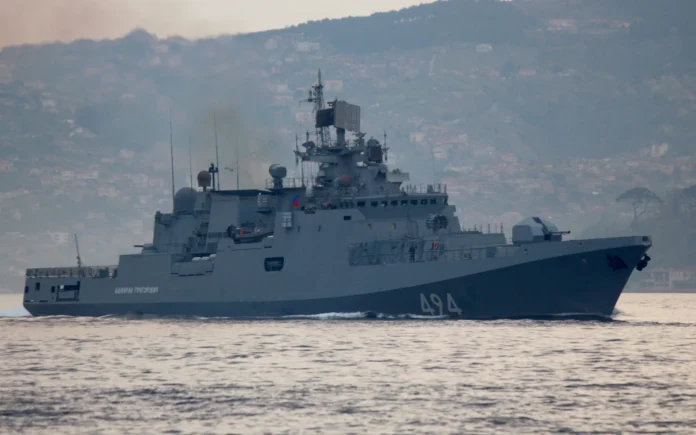
The Russian frigate Admiral Grigorovich firing warning shots across the bow of the British yacht Bright Future on June 16 was not an “isolated maritime misunderstanding” – no matter that our own Ministry of Defence would like you to think so. It illustrates two things: our own naval weakness, and the general incompetence of the Russian surface navy.
The Russian surface fleet remains poorly run and under-trained, as repeatedly demonstrated by the Black Sea Fleet’s performance against the Ukrainians since 2022. Another instance of Russian unprofessionalism was the firing of warning shots at HMS Defender on passage past Crimea in 2021. The sequencing and recording of that interaction was almost comedic. Maybe they think it makes them look tough, but to most, it just looks like they don’t really know what they’re doing.
But let’s get to the specific failures of seamanship and judgment aboard the Grigorovich this last week. The frigate chose to wait for its next job escorting Putin’s shadow tankers in the middle of the westbound shipping lane between the Dover Strait traffic separation scheme (TSS) and the Casquets TSS. This is roughly equivalent to stopping your car in the middle lane of a busy motorway. I was tasked to conduct fishery-protection duties there once and then spent the next 48 hours dodging huge ships. It wasn’t much fun.
The Russians stopped there deliberately: and it gets better. Their next move – in fog, mind you – was to turn their engines and Automatic Identification System (AIS) transponder off.
Having no propulsion makes you what is known as Not Under Command (NUC) which gives you special status within the International Regulations for Preventing Collisions at Sea (COLREGs). Everyone should keep out of your way, and the Russians have claimed that they held this status at the time. But NUC only applies in “exceptional circumstances”. Choosing to turn your engines off doesn’t count. You can turn them on any time you want to: you are still under command and still obliged to obey the rules of the road.
The Grigorovich most probably shut her engines down to save fuel: in the Channel she is far from any friendly harbour in which to refuel.
A Nato warship on station far from a friendly base would carry out what we call Replenishment At Sea (RAS), where the warship will cruise along close to a resupply tanker on a parallel course. A taut cable will be deployed between the two vessels and used to support a hose line so that the warship can be refuelled from the tanker.
The Russians have tankers but they cannot do RAS: another indication of their general competence. Carrying out a RAS isn’t completely simple – in fact it can be quite tense – but any group of professional seamen can learn it: and it can be done out in the open sea in quite bad weather. Accidents during RAS are pretty much unknown.
The Russians have never bothered to learn how: they normally refuel at anchor in sheltered waters if they don’t go into harbour. The Grigorovich is reportedly compelled to refuel in the Channel by coming alongside a tanker, which will quite possibly involve damage to both ships if the sea isn’t glass calm. So this is why the Russians are keen to conserve fuel: because they aren’t very good at their jobs.
Meanwhile the AIS transponder tells nearby ships that you are there and what you are doing. It was originally intended as a collision avoidance system, though it is also used for many other things nowadays. Turning it off is permitted for warships, but doing so while drifting in a busy shipping lane – in fog! – is wildly unprofessional.
This wasn’t the yacht’s fault, but they didn’t help themselves. Bright Future was due to pass at 500 yards and in normal conditions that would be fine. But if the warship calls you on the emergency radio channel to say it isn’t and sounds five short blasts on the siren, this immediately stops being a “who has right of way” discussion. Instead, you should answer the radio immediately whilst making a bold alteration of course to make your intent unambiguously clear.
As far as I can tell, the yachties did none of these things. Instead, they altered course by just two degrees which would not be perceptible either visually or on radar. The rules are clear: “any alteration of course and/or speed to avoid collision shall, if the circumstances of the case admit, be large enough to be readily apparent to another vessel observing visually or by radar; a succession of small alterations of course and/or speed should be avoided.”
But no, there’s nothing to see here, it would seem. In response to all this, the Ministry of Defence stated: “Following attempts to contact a British vessel in the channel, the Grigorovich fired warning shots. These were not aimed at the vessel and were an attempt to prevent a possible collision.”
The MoD then described it as an isolated incident. Defending the Russians this way, and shutting down the narrative of peaceful British yachtsmen who have been shot at by the navy of a brutal enemy dictator, is clearly an attempt to downplay our own embarrassing weakness. It reminds me of similar lines taken when Hezbollah recently managed to strike the British base at Akrotiri on Cyprus with a drone.
“Nothing to see here,” we were told then. “It doesn’t matter that our servicemen and their families were defenceless against the most basic, cheapest form of air attack. Nobody has done their job badly.”
Dan Jarvis, appointed Defence Secretary on June 11 after John Healey’s resignation over inadequate spending plans, now inherits the problem of a maritime country having a navy that is too small. As an ex-Army man, will he even understand it? That sounds patronising but we have seen many examples over the years of ex-service politicians carrying their personal experience/baggage of the Forces into the job. When one considers the training, the love for the cap-badge and so on, it’s understandable: but it’s not helpful and the very fact that Jarvis was willing to take the job without any commitment to increased spending does not bode well.
I for one will be scouring the Defence Investment Plan, if Jarvis ever does produce it, for evidence of a reversal in the Navy’s fortunes. The threat is all around us, literally, and we are not resourced to meet it. I also won’t be holding my breath until that happens.