By William Hazell*
For more than two decades, the extent of Australia’s claim to the Antarctic seabed has remained unresolved. In 2004, Australia lodged a submission concerning 10 extended-continental-shelf marine regions with the United Nations Commission on the Limits of the Continental Shelf (CLCS).
These claims flank Australia on all sides, from the Timor Sea to the Indian, Pacific, and Southern Oceans. Together, they cover 3.37 million square kilometres, an area almost half the size of Australia itself. In 2008, the CLCS backed Australia’s entitlement to nine of these ten regions. Only the shelf adjacent to the Australian Antarctic Territory (AAT) was left in legal limbo, where it remains today.
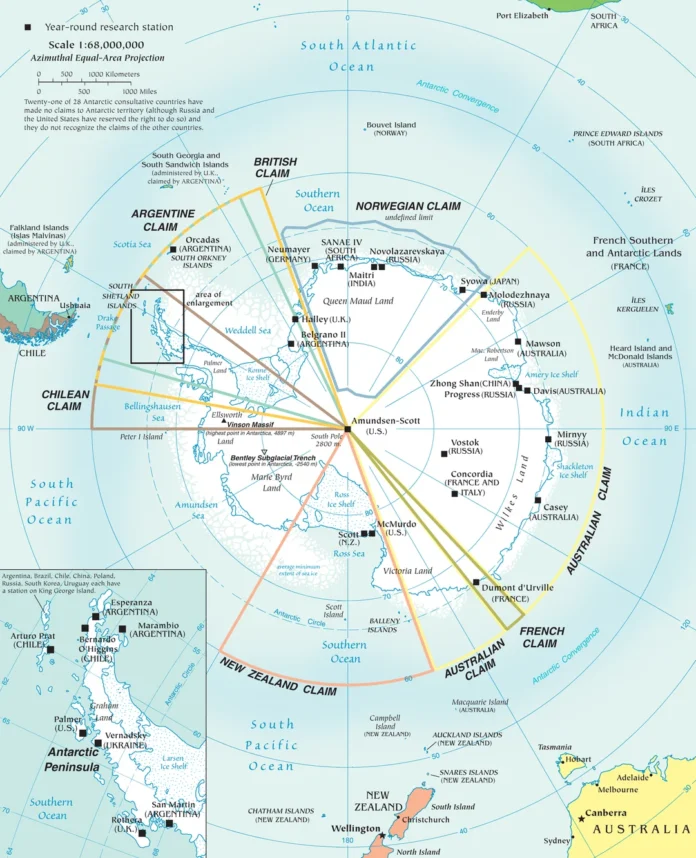
Territorial claims are a delicate matter in Antarctica. The continent is governed through the Antarctic Treaty, which was originally formed during the Cold War to keep unresolved sovereignty disputes from becoming dangerous. Today, there are 58 parties to the Treaty which have all agreed to freeze territorial claims, promote scientific activity, and ban commercial mining below 60 degrees south latitude. However, that compromise has never meant that claimants stopped believing their claims. The seven original claimants continue to view Antarctica as sovereign territory. Australia is no different, and to this day continues to claim 42% of the continent, including sovereign rights over adjacent offshore waters consistent with international maritime law.
In November 2004, Australia faced a diplomatic dilemma. The ten-year deadline to lodge its continental shelf submission was approaching, and it had to decide how to handle the Antarctic Shelf off the coast of the AAT. Including the AAT shelf risked violating the Treaty’s freeze on new claims. However, failing to put the Antarctic shelf on record risked abandoning Australia’s legal claim. Ultimately, Australia chose to proceed with the submission but asked the Commission to ignore the Antarctic shelf region “for the time being”. The CLCS accepted Australia’s request.
Four years later in 2008, the CLCS confirmed Australia’s outer limits across 2.56 million square kilometres of seabed jurisdiction. Even without the AAT shelf, it had important implications for the Antarctic Ocean. One of Australia’s accepted claims included sections of continental shelf below Heard and Macquarie Island. While the islands themselves lie outside of the Antarctic Treaty area, the Macquarie continental ridge extends below 60 degrees south latitude. Australia therefore became the first state to hold confirmed, undisputed sovereign rights over seabed inside the Treaty area.
Since the CLCS adopted recommendations on Australia’s submission in 2008, maritime law has become increasingly competitive worldwide. In 2009, Malaysia and Vietnam made a joint continental shelf submission in the South China Sea. In objection, China wrote to the UN Secretary-General and attached a map depicting the now-infamous nine-dash line. Australia’s own continental shelf submission is part of this wider trend. Since 2019, Malaysia, the Philippines and Vietnam have all made partial continental shelf submissions in the South China Sea. And as of 2026, the CLCS has received close to 100 submissions concerning outer continental shelf limits.
For many states, the appeal of continental shelves is that they can give exclusive access to billions of dollars in offshore oil, gas, and minerals far beyond their ordinary maritime zones. In Norway, petroleum from their continental shelf is the country’s largest industry by government revenue, investment and export value, with an expected net government cash flow of about US$73.6 billion in 2026. The money to be made on the sea floor has encouraged some states to make some bold extra-legal claims. In 2023, the United States unilaterally announced outer limits for almost one million square kilometres of extended continental shelf rights, outside the CLCS process.
Antarctica has largely been sheltered from such disputes. While Australia was politely cautioned by six states (including Russia and the United States) about the Antarctic Territory submission, Australia’s claim on the Macquarie and Heard Island shelf passed without protest. Australia has been careful about what its Antarctic seabed rights mean in practice. Australia’s 2022 Antarctic Strategy stated that economic activity must remain consistent with Antarctic Treaty obligations. Even so, Australia continues to insist on the legality of its Antarctic position. Official maritime maps even mark AAT waters as part of Australia’s Exclusive Economic Zone. In 2022, Australia committed $804.4 million to the Australian Antarctic Program over the next 10 years, in order to strengthen strategic and scientific capability; even while Australia’s 20 Year Action Plan aims to keep Antarctica “free from strategic and/or political confrontation”.
Australia seems to see no contradiction in supporting an international regime while continuing to maintain its own Antarctic claim. Other long-time claimants hold similar positions and use continental shelf law in similar ways. Argentina’s 2020 maritime map included coordinates for an Antarctic continental shelf, Chile has advanced an extended continental shelf position connected to the Chilean Antarctic Territory, and the United States and Russia still preserve a “basis of claim” in Antarctica.
This raises another important question: does Australia genuinely believe in Antarctic ownership? Australia has its own narrative, resting its claim on British imperial title, the discoveries of British, Australian and New Zealand expeditions, and the later work of Douglas Mawson. Other claimants tell their own stories of discovery, occupation and administration, but discovery alone is an incomplete title under international law. The fact that the AAT is only recognised by four states seems to suggest that the world doesn’t take Antarctic sovereignty seriously. Yet, claimants continue to act as if it does. Both claimant and non-claimant Treaty members actively perform sovereignty: raising and planting flags, naming places, passing legislation, maintaining bases, and sustaining small civilian settlements such as Argentina’s Esperanza and Chile’s Villa Las Estrellas. These acts stop well short of forceful means of territorial control, and the mainland is a strangely low-stakes environment. Continental shelves have become another instrument in this performance. In 2009, Norway followed in Australia’s footsteps with its own shelf submission, requesting that the CLCS not “take any action for the time being” regarding its Antarctic shelf. It may be more accurate to say that legal sovereignty has become the language by which states communicate their political interest in Antarctica, rather than the goal itself.
Despite unresolved questions of sovereignty, the Antarctic Treaty System is still a highly functional political framework. In one sense, the success of the Antarctic Treaty can be put down to the relative unimportance of Antarctica. And as long as it remains unimportant, Australia and the rest of the world is happy to leave it well alone. Australia’s 2004 submission has proven to be a clever manoeuvre, avoiding a direct challenge to the Antarctic Treaty System while allowing Australia to bank strategic options for an increasingly uncertain future. For better or worse, continental shelves have become a major part of maritime power politics. If the world continues to move in the direction of great-power rivalry, nationalism, and resource competition, the stability of the Antarctic Treaty System may also be at risk. In that future, Australia’s old submission may yet prove useful.
William Hazell is a Master of International Relations student at the University of Queensland. He has a background in economics and worked in Ernst & Young’s Government Incentives team. His thesis examines the Antarctic Treaty System, sovereignty politics and maritime law.