By Marc Ablong, Mike Hughes and Linus Cohen*
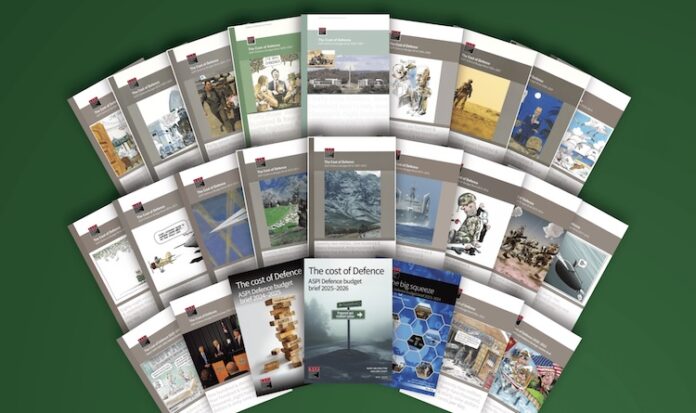
Australia’s 2026–27 budget commits the federal government to daily spending around A$181.9 million on defence. That headline sits on the cover of our 2026 The cost of Defencereport, released today. The number is sobering. The composition is more so.
In his budget night speech, Treasurer Jim Chalmers put defence in his ‘resilience and reform’ pitch, alongside fuel resilience, critical minerals and the Future Made in Australia agenda. The framing was correct: economic security, economic resilience and national security are now one and the same. On the policy architecture for that broader security pillar, the government should be acknowledged and praised. On the appropriation behind it, the work has barely begun.
The 2026 National Defence Strategy (NDS) and the updated spending plan that accompanied it, the Integrated Investment Program (IIP), describe a force built for the strategy of denial, anchored to the nuclear submarines of AUKUS Pillar One and funded across the coming 10 financial years at A$887 billion. But of every dollar in A$53 billion of additional decade investment the government announced, only about four cents is appropriated in this budget. The remaining 96 cents is in forward estimates promises, decade out-year profiles, Contingency Reserve allocations and alternative financing intentions that the budget papers don’t specify. The 2009 Defence White Paper, in which roughly A$48 billion of committed funding was later abandoned, shows that promises of this kind can be, and often are, reduced by subsequent budgets.
The shape of the 2026–27 Budget signals the choice the government has made. Spending on the Defence workforce is up by A$815 million, capability acquisition is down by A$724 million, and sustainment is down by A$283 million. Whole-of-government defence spending falls in nominal terms by A$799 million before backloaded growth begins in 2027–28. The government is paying for the people in advance of the equipment they will operate. The 2026 NDS is asking the present force to carry the deterrence load through the optimal pathway window to the 2030s, and asking it to carry it with less.
The 12 capability investment priorities that the IIP is organised around share a concern that our report assesses: the gap between the announced plans and committed delivery. Typically, 75 to 80 percent of the next decade’s IIP spending remains unapproved, backloaded into the period the NDS itself identifies as most dangerous. The most acute case is integrated air and missile defence, for which A$850 million is approved against A$21 billion to A$30 billion planned. The E-7A Wedgetail replacement carries A$5 million of approved funding against A$10 billion to A$15 billion planned. We have for several years identified integrated air and missile defence as the ADF’s most critical capability gap. The budget reads as if the government is yet to do so.
As for the defence fraction of GDP, the trajectory reaches around 2.5 percent by 2033–34 on the traditional appropriation measure and, we are told, around 3.0 percent on Defence’s calculation using NATO’s methodology. For want of detail in the calculation, we cannot verify this.
The government has chosen the NATO calculation to align with allies that also use it. On that basis, Australia is still behind the minimum 3.5 percent of GDP that NATO has set for core defence spending. The budget reads as if the government hasn’t recognised, and does not intend to close, that gap any time soon. But Australia’s broader security, beyond core defence, is closer to NATO’s 1.5 percent target than is generally appreciated.
Regardless of Defence’s share of GDP, Australia continues to fall in absolute terms behind Indo-Pacific powers. China’s officially reported spending, at US$314 billion (A$438 billion) in 2025, is now more than three times Japan’s and about 13 times Australia’s (and generally regarded as an understatement). Our rank in the regional defence spending league, inside the top five at the start of the decade, now sits outside it. And we won’t regain that position by 2035, with our defence spending growth rate below the regional median and below every major Indo-Pacific power.
If the promises of the 2026 NDS and IIP are delivered, the principal gap will no longer be money; it will be growing the Defence workforce, strengthening the industrial base, integrating capabilities and achieving the institutional follow-through – in reform and commitment to delivery – that the decade ahead requires. Availability of submariners, pilots, cyber operators, engineers, acquisition staff and other specialists is now the limiting constraint across almost every major capability stream. Without them, major equipment cannot be operated, the programs cannot be delivered and the strategic concept cannot be sustained. Money alone will not relax these constraints.
Three conclusions follow. First, we believe that funding present-day preparedness is important. The sustainment and operating reductions are buying a future force at a cost to the current one. The cost should be acknowledged and redressed. Second, we would argue for pushing forward the defence delivery reforms scheduled for 2027–28 with full institutional weight. Lifting the rate at which unapproved projects become contracted is the central reform task, and the Defence Delivery Agency and National Armaments Director cannot start that task soon enough. Third, the government should publish the formula for calculating the NATO-like funding methodology. The story that Australia is telling allies is weaker than the story Australia can actually tell.
The strategy is set. The budget is structured. Delivery has started. The decade ahead is a test of whether Australia has the institutional follow-through to see the strategy of denial through to the force it requires. The 2026–27 Budget is a promise to the future, partly paid for by the present. Whether the promise is kept will be settled, year by year, in budgets that future governments have yet to write.