By Tom Sharpe*
Gen Sir Gwyn Jenkins, the First Sea Lord used the inaugural Fisher Lecture on Wednesday to spell out his vision for a “hybrid Navy”. Gen Jenkins’s vision combined unmanned seacraft with more traditional crewed ships and submarines across the fleet, and was as transformative as the sweeping changes Adml John Fisher delivered during his tenure as First Sea Lord at the start of the 20th century.
Gen Jenkins was clear about the concept, saying “this paradigm shift is not about replacing existing capabilities. It is about increasing the mass, survivability and lethality of our force”.
Wargames conducted at Southwick Park in March 2026 tested this assumption and the results were positive: missile capacity increased threefold, with markedly improved success rates across carrier strike, continuous at-sea deterrence protection, amphibious operations and integrated air and missile defence (IAMD). Three “Atlantic” programmes – Atlantic Bastion for layered anti-submarine warfare, Atlantic Shield for air and missile defence, and Atlantic Strike for carrier and commando integration – will see uncrewed platforms embedded into every major role. The vision is simple: more hulls, more sensors, more weapons, without a proportional increase in sailors.
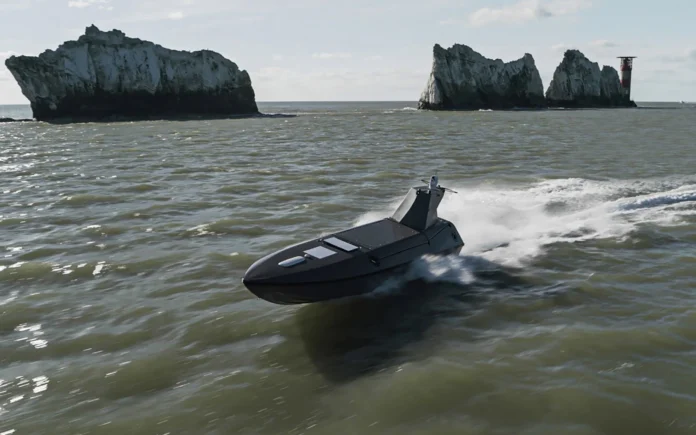
Parts of it are already taking shape as Project Beehive is showing. In a matter of months, the Ministry of Defence (MoD) awarded Kraken Technology Group in Fareham, Hampshire, a £12.3m contract for 20 K3 Scout medium unmanned surface vessels (USVs) – fast, modular 8.4m craft capable of 55 knots. Delivered to 47 Commando Royal Marines for training and experimentation, they are already contributing to Atlantic Bastion’s sensor network against Russian submarines. These are small and simple boats, but even so, in a procurement system that finds making good use of small businesses nearly impossible, it’s a good start and suggests the cultural shift required for this whole idea to work is under way.
The next step, to large uncrewed surface vessels (LUSVs), is the real test. Jenkins confirmed the first LUSV will operate alongside Royal Navy warships within two years. For this to stand a chance of happening, orders will need to be placed almost immediately. Shape, size, weapons and so on will need to be decided before the end of this year and the steel pointy bit isn’t always the hardest to get right. Companies like Ocean Infinity have already spent years refining how to operate large autonomous craft at sea but these are comparatively simple vessels. Start integrating weapons systems with secure communications and survivability – and then adopt a new way of operating at every level, from strategic down to mechanical, – and there are a lot of moving parts that will need to drop into place if this deadline is to be met.
The outline idea appears to be to have Type 91 Missile Barges and Type 92 Sloops – the “Type 9X” collaborative escorts. In principle, this makes sense. If the Type 92 can deploy in numbers accompanying a Type 26 frigate, which in turn will be able to operate other undersea autonomous vessels, then your anti-submarine web has become much bigger.
AI to cut the workload
The Type 91 could also be an intriguing proposition. Multiple small barges could integrate into a task group or provide a defensive barrier protecting land areas. Having one of these off Cyprus recently would have saved a whole load of red faces. But before we get carried away, there are hurdles here, too. To be an air defender you need a radar of some sort, and so far it has needed to be a fairly big one, using a lot of power. It also works better the higher above the waves it is.
If the radar is on the barge and at all high up, the size of the hull rapidly goes up: putting a heavy object high up in a small vessel makes it turn over. Putting the radar in the air in another drone is excellent in that you can now see low-flying or surface contacts from much further away – good for defence against cruise missiles and drones across wide areas – but if you are to provide cover around the clock you will need several aircraft and that gets expensive. Tech companies argue that modern AI-powered analytics can get so much more out of a smaller, less powerful radar that this problem goes away. I guess they now have a couple of years to show whether this is true. Air surveillance is a big gap in British capability now – as recently highlighted by Lockheed Martin amongst others. Anything that helps plug this should be considered.
Then there is the matter of weapons. Both the forthcoming Type 26 and Type 31 frigates will have US-made Mk 41 launch tubes. These can take a vast array of weapons but so far, we appear to be only looking at integrating Sea Ceptor. This is a short-range missile (15 miles) and therefore not an area defence weapon. It’s not suitable for defence against ballistic missiles either. Alternatively, various kinds of American-made Standard Missile (SM) can be fired from Mk 41 tubes to give strong area coverage plus ballistic and probably even hypersonic defences, but these aren’t cheap and you are then dependent on US supplies and support. There’s a more powerful, longer-ranged version of Sea Ceptor being developed in co-operation with Poland that can go in the Mk 41 too: it’s not clear whether we’ll be getting that.
Decision-makers hundreds of miles away
Then there’s the matter of communications. This network of ships will need to be able to transmit large quantities of data between themselves. If this is line-of-sight, then it will limit ranges. Having drones airborne to act as a relay could fix this, but again you would need multiple drones for 24-hour capability (although this task could be doubled up with radar surveillance). If the relay is via satellite, then who owns the satellite? Probably the US, whereupon the dependence problem re-emerges. In a normal ship, the sensors, operators and decision makers are all yards apart by design. Make this distance hundreds of miles and it had better work flawlessly in a contested and possibly kinetic environment or the whole thing fails.
If the barges and sloops are small, then they will get battered in anything above sea state six. Taking people off doesn’t negate the requirement for a stable platform if you want your sensors and weapons to work well. Ship too much salt water and those sensors will stop working at all. You then need to fly a team out to land on this small and unstable platform to fix it. Or you operate them with a tiny ship’s company, but this is not something we are good at. When I went to sea in the civilian ice breaker MV Polar Bjørn she had a crew of 17. By the time the Royal Navy bought her and converted her into HMS Protector, she had more than 80. This is what I mean by needing a significant mindset shift.
I cannot overemphasise the issue of things breaking. Every ship I ever served in broke, and I don’t mean now and then, I mean all the time. The frigate I had the honour to command carried 80 engineers and technicians for a reason. The only ship I ever served in that never broke was a converted offshore fishing boat which was so simple mechanically that the throttle lever on the bridge was connected to the lever in the Machinery Control Room by a very long bicycle chain. All the purpose-built warships I was in, from mine hunters to aircraft carrier and everything in between, broke often. The sea is such an unforgiving environment that if these sloops and barges are to be made to a standard where this never happens, then how much would that cost? And besides, I’m not sure it’s possible. This might be my biggest worry.
Not far behind is where the money for this is coming from. We won’t know what cash has been allocated for all this until the long-awaited Defence Investment Plan (DIP) has been published. It has been nearly a year now since the un-costed Strategic Defence Review, on which the DIP is supposedly to be based, and still there is no sign of any actual numbers. The MoD and Treasury are working flat out on it apparently. I would love to know what dawdling looked like, though I suspect what we are really seeing is a substantial struggle to produce a package of cuts and delays that somehow doesn’t look like a package of cuts and delays. Either way, building an entirely new capability in just two years for a department that can’t produce a spending plan in one year doesn’t seem especially plausible.
Certainly in this cash-strapped environment, there is always the risk that someone will decide that the uncrewed option can be paid for by cutting back on the crewed ones. Only the other day, a defence minister injected a degree of uncertainty over the number of Type 26 frigates we will now get. This sits contrary to the First Sea Lord’s intent, but is also hard for him to control and it has happened before. Our missing minehunters are a live case study in what happens if you refuse to build replacement ships and instead put all your eggs into an unmanned solution that was never going to be ready before the existing ships paid off. The crew of RFA Lyme Bay who are currently trying to put what unmanned mine clearance kit we do have into their hull for potential use in the Strait of Hormuz will attest to this.
There are other conceptual operating issues that will need to be worked through. If there are no people on a ship, what’s to stop it being stolen, or “accidentally” rammed? Would we go to war over something like that? I doubt it. You also can’t do rescue work, disaster relief, non-combatant evacuations and all the other soft power activities that navies spend far more time doing than actually fighting. One of a traditional warship’s greatest strengths is its flexibility. Unmanned ones will have less.
Overall, we must restore lethal mass to the navy and this is indeed a good way to do it. It is also the only way we can afford to, which is not the purest of reasons, but that is the reality.
The vision is compelling. Networked uncrewed surface vessels providing a web of anti-submarine, surface and air capabilities across a range of surveillance, deterrence, defensive and, if necessary, offensive missions. I spent too long at sea in manned warships that were not very well armed, and that problem has only worsened: most of our few remaining frigates and destroyers today do not carry any missile capable of being used to sink another ship, for instance.
We must rise to the challenge or we will never climb out of the deep, dark hole that 30 years of underinvestment has left us in. This initiative should therefore be applauded and supported by those who matter, especially those who are traditionally resistant to change. The old guard, like me, chuntering about how they’re not proper warships, can be ignored.
*Tom Sharpe OBE served for 27 years as a Royal Navy officer, commanding four different warships
This article is republished with he author’s permission.