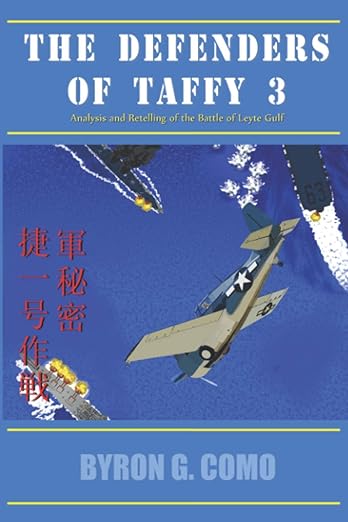
The Defenders of Taffy 3; Analysis and Retelling of the Battle of Leyte Gulf. By Byron G Como – b44como@gmail.com. 3rd Print On Demand Edition, Version 1.0, 2019r. ISBN 9781076442369
Reviewed by Tim Coyle
In his preface to The Defenders of Taffy 3, Byron Como sets out his motivation for writing ‘another book’ on the Battle of Leyte Gulf, concentrating on the courageous actions of Taffy 3 – Task Unit 77.4.3 under Rear Admiral Clifton Sprague.
The story of the overwhelmingly one-sided Battle is well known. Rear Admiral Thomas Sprague (Clifton and Thomas Sprague were not related) commanded Task Group 77.4 comprising three Task Units – 77.4.1, -.2, and .-3 with radio call signs Taffy 1, 2 and 3 respectively. Each TU comprised up to six escort carriers (CVE) with screening forces of three destroyers and four destroyer escorts.
On 15 October 1944 the Japanese Imperial Navy’s First Mobile Fleet launched Operation Shō, a last-ditch attempt to engage Allied naval forces off Leyte in the central Philippines. Following the 24 October Battle of the Sibuyan Sea, the Japanese Center Force appeared to be retiring westward. However, it resumed its eastward passage, broke out of the San Bernardino Strait north of Samar early the following day, and headed southward toward Leyte Gulf. The presence of the high value Japanese aircraft carriers in the Northern Force led Admiral Halsey to take his Third Fleet north to intercept them while Admiral Kinkaid’s Seventh Fleet was engaged to the south of Leyte Gulf. This left only three Seventh Fleet escort carrier (CVE) task units on the northern flank of the Leyte operational area, where they had been providing close air support and an ASW screen for the amphibious landings. Just after sunrise on 25 October, Taffy 3—positioned to the north-west and consisting of six CVEs, three destroyers, and four destroyer escorts – were faced with four Japanese battleships (including Yamato – the biggest battleship in the world), six heavy cruisers, two light cruisers, and 11 destroyers. The ensuing battle is ranked in the highest order of daring and courage at sea.
Taffy 3’s battle against the overwhelming power of the Japanese Navy’s Central Force attracted Byron Como’s interest after reading James Horfischer’s ‘The Last Stand of the Tin Can Sailors’. With a deep interest in military history, he began comparing that history with other works on the Battle. Como found that details in other works did not necessarily agree and he noted numerous discrepancies.
There his research fell into abeyance until sometime later when he found several ships’ (American and Japanese) official combat reports on-line. Now, completely absorbed with the Taffy 3 action, he decided to write an ‘analysis and retelling of the Battle of Leyte Gulf’.
Despite his discoveries of errors and omissions in the many books on the Battle, Como almost self-consciously moves to defend his decision to write a new book. He asks the rhetorical question ‘so what?’ which sceptics might advance as to his choice of topic, seeing it had been examined and analysed over many years. In answering this, Como also indirectly addresses why historians of subsequent generations revisit great moments in history.
From the initial ‘I Was There’ reminiscences of veterans and unit and official histories which appeared after the war, generational change brings third person and academic interpretations and techniques which, while furthering the study of the histories and campaigns, can lead to divergencies and pet theories (as an example, around 500 books were written on the Battle of Jutland from the early 1920s almost to the present).
Como’s relentless research is aided in the book by his graphics and language skills. In addition to archival images, he provides an astonishing quantity of self-generated maps of the Battle of Leyte Gulf on 25 October 1944 depicting almost a minute-by-minute pictorial narrative of the battle from 0655 to 0930.
To provide a measure of intimacy to the action, Como lists the ‘cast of characters’ who participated at the head of the chapters for each phase of the action, naming American and Japanese of all ranks and ratings and their duty stations on board.
Full colour renditions of the Taffy 3 combatants are accompanied by ships’ details- again drawn by the author.
Finally, Como mentions, almost in passing, his translations of Japanese combat reports as the source for his descriptions of the enemy’s participation in the battle. This linguistic capability adds gravitas to the work. This is one of the arguments Como uses in his ‘raison d’etre’ in writing this ‘retelling’ of the Battle. Most authors rely on several translational iterations which, over time, lend themselves to creeping inaccuracies.
The author’s narrative, buttressed by the features outlined above, are a fitting tribute to the magnificent courage exhibited by all ranks and ratings in Taffy 3. Byron Como’s forensic research, supported by his unique graphic and language skills, ensure The Defenders of Taffy 3 will stand as the definitive work on this epic Battle.