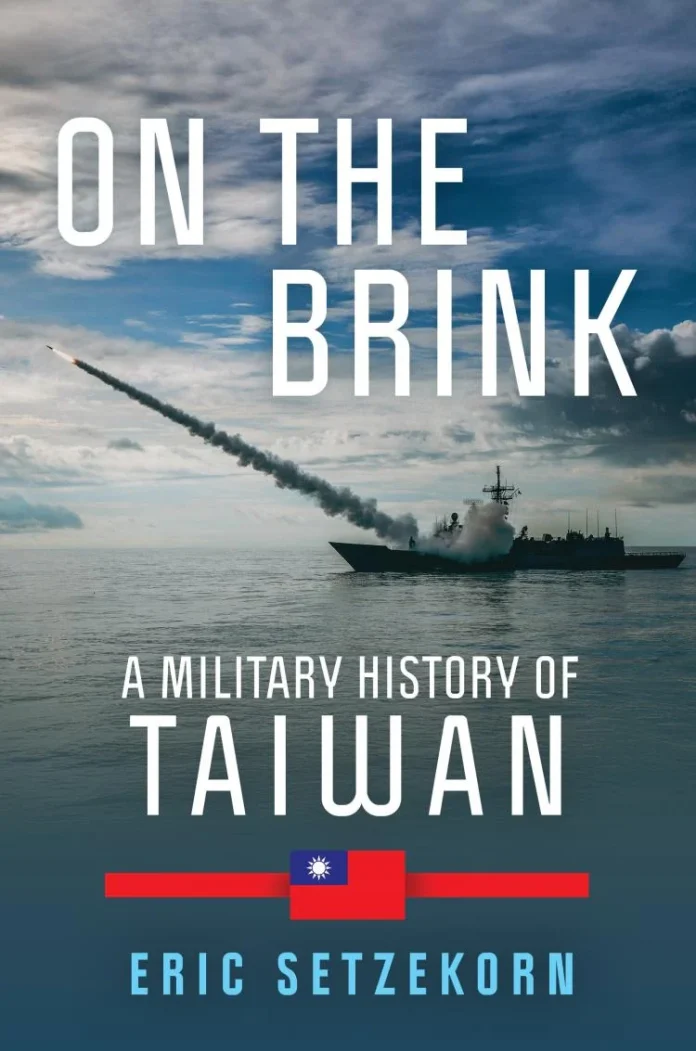
On the Brink; a Military History of Taiwan. By Eric Setzekorn. Naval Institute Press, Annapolis, Maryland, 2026.
Reviewed by Tim Coyle
Over the eighty years since the defeat of Chiang Kai-Chek’s Kuomintang (KMT) party and army by the Mao Zedong – led Chinese Communist Party, Taiwan has figured prominently in regional politics and military manoeuvring.
Held out as a bulwark of freedom against a totalitarian giant bent on regaining what it claimed as an integral part of the People’s Republic of China, Taiwan has resolutely battled the periodic waxing and waning of PRC pressures to subjugate this recalcitrant outpost.
The author, Eric Setzekorn, former US Army intelligence officer and East Asian military historian, delivers exactly what the book’s subtitle states: an honest wart-and-all narrative of Taiwanese military history vis-à-vis the PRC and the United States. Consisting of nine chapters, the saga begins with the defeated KMT’s flight to Taiwan in 1949, through the various Taiwan Strait crises of the mid-1950s and the associated domestic challenges of establishing KMT political control over the island. US support to Taiwan, through the Military Assistance Advisory Group (MAAG), had re-equipped and strengthened the KMT army to the extent that the MAAG r feared that Chiang Kai-shek would use the renovated force to mount a reinvasion of the mainland and so draw the US into another Asian war. The US authority managed to convince Chiang that trying to invade the PRC was unrealistic and US support would henceforth concentrate on equipping the army whose strategic direction would more closely relate to US regional interests.
Addition to this was the social issues of the assimilation of up to two million KMT troops and large numbers of civilians to an island which previously numbered approximately six million. The KMT was essentially a ‘party army’ (a status shared with the Chinese People’s Liberation Army). The KMT army assumed the government of Taiwan, continuing to style itself as the Republic of China (ROC – now displaced by the PRC on the mainland), and the indigenous population was reduced to second-class status. Indeed, the KMT under Chiang and his son Chiang Ching-kuo, exercised a level of totalitarian control not dissimilar to the mainland Chinese Communist Party.
The period 1959 to 1979 was a period of stalemate where, with MAAG support, the Taiwan military was modernised and configured for the defence of Taiwan. Relations with the PRC improved to the extent that a tenuous relationship was established and US support was less susceptible to Taiwanese extremist policies.
While ROC force development became more settled and stabilised, the societal tensions increased due to KMT insensitivity to the indigenous Taiwanese and corruption. Serving and retired military members enjoyed inflated salaries and pensions as the KMT retained total control.
The 1980s to the mid-1990s saw a gradual diminishment in the power of the KMT as the former hard-line leaders left the scene. Increasing democratisation and rationalisation of equipment acquisition and management effectively engineered a total transformation of civil-military relations. The Taiwanese military were now focussed on defence as, from 1996, the PRC began a force expansion aimed to exert a much stronger presence in the Taiwan Strait and contiguous waters.
The assumption of the PRC presidency by Xi Jinping in 2012 supercharged the ascendency of the People’s Liberation Army and brought Taiwan and the region to a full awareness of PRC intentions towards absorbing Taiwan. At the organisational level, the ROC military posture stood at the crossroads between acquiring replacement traditional combatant platforms such as warships, fighters and armour to favouring coastal missile batteries and inshore maritime assets. Taiwan transitioned to a heightened level of national defence by integrating the military totally into society through extensions to military service to conscription and liberalising conditions of service.
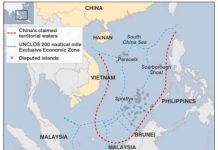
The PLA threats to Taiwan from 2016-2018, included blockade – by subsurface and carrier-based air interdiction – and seizure of the offshore islands of Kinmen, Matsu and Taiping in the South China Sea. From 2015, ROC planners recognised the potential for a PLA cross-Strait invasion and Taiwanese strategists moved to consider force structures capable of blunting these initiatives.
Countering a blockade would require a large conventionally equipped maritime force for Sea Lines of Communication security, whereas outer island defence and countering an assault on Taiwan itself would call for small, agile weapons systems and platforms, such as fast attack craft-mounted short-range anti-ship missiles and land-based missile batteries.
The 2016 an Overall Defence Concept (ODC) was formulated to devise a force structure emphasising an asymmetric profile with reduced reliance on expensive and vulnerable high value platforms. The ODC failed to be fully implemented due to internal argument within the military. It did, however, do much to enhance transparency in the defence debate.
Setzekorn concludes his study of the Taiwan military in the chapter ‘2025-2035 Looking Forward’ by offering ‘Reasons for Optimism: Three Positive Military Trajectories’ contrasting this with ‘Reasons for Pessimism: Three Negative Military Trajectories’. In ‘Planning for a Worst-Case Scenario’, he reviews the ‘Outlying Islands Takeover’ and the ‘Large-Scale Chinese Amphibious Assault on Taiwan.’
In his Overall Outlook for 2025-2035 Setzekorn explains: ‘this chapter was not designed to predict the future but to increase understanding of critical factors, probable issues, and lingering sources of tension in order to focus analysis of Taiwan’s probable military policies in the 2025 through 2035 period. It would be easy to be pessimistic about Taiwan’s military capabilities compared to the growing military strength of China, however, despite the growing disparity in numerical assessment of ships and aircraft, Taiwan still retains major sources of strength’. The overarching dilemma is how these ‘major sources of strength’ might be utilised to deter the PRC and defend Taiwan – with or without US direct support.
How long Taiwan remains On the Brink is cause for intensive strategic analysis – not confined to just the US and Taiwan – but all Indo-Pacific nations and beyond. A war between the US and the PRC over Taiwan would have incalculable outcomes for the region and, indeed, the world.
On the Brink is an important study. Its readership should include government decision makers and military planners at all levels . To formulate individual countries’, stance on how to react to a cross-Strait contingency, officials and their advisers should be aware of how Taiwan came to be where it is today.
As such, On the Brink; A Military History of Taiwan is an important addition to the understanding of Taiwan and its position in the world.